

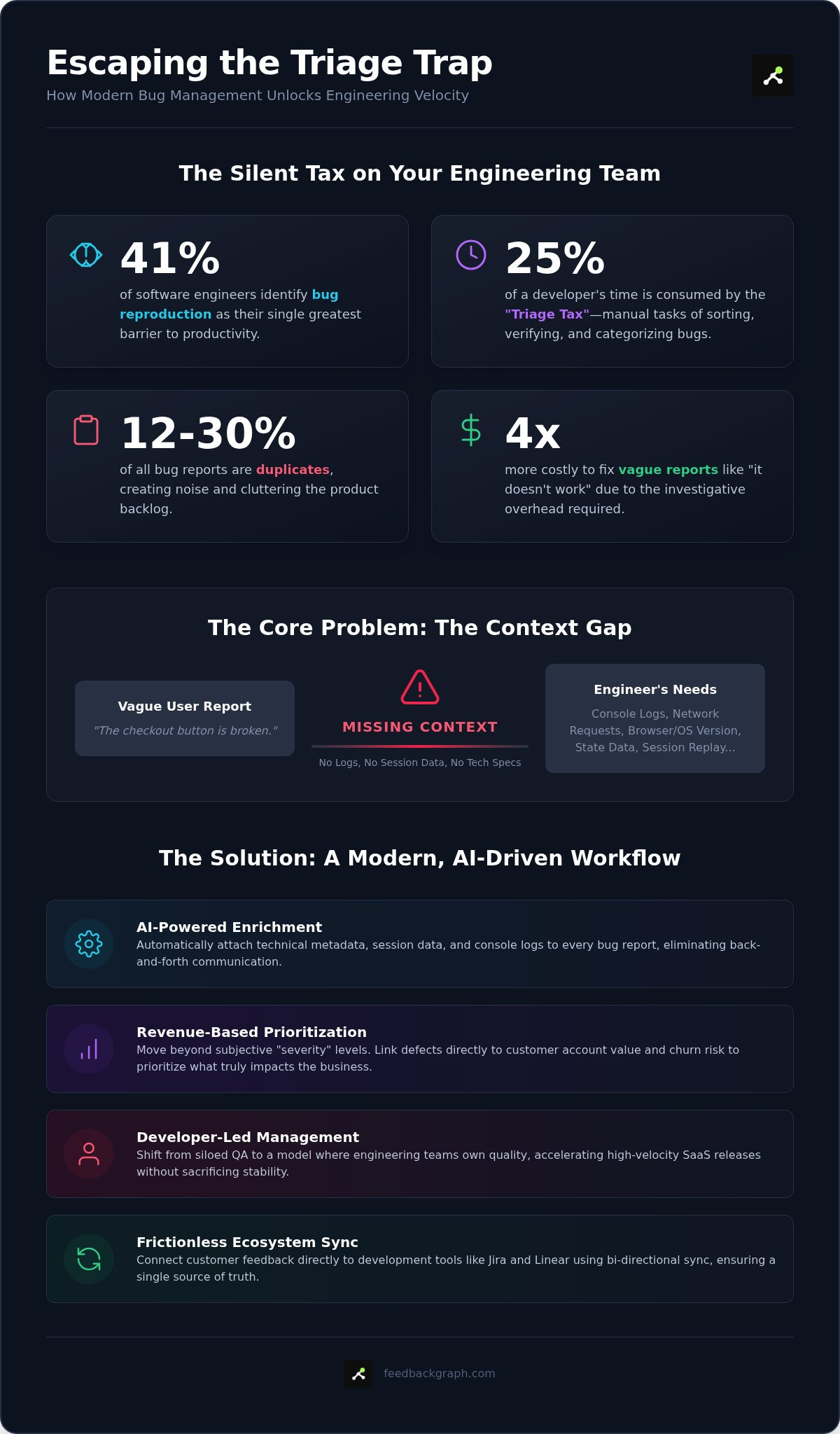
41% of software engineers identify bug reproduction as the single greatest barrier to their productivity. This isn't just a minor technical hurdle; it's a systemic drain on your team's output. You're likely already familiar with the primary challenges in bug tracking, from the endless stream of duplicate reports to the vague "it doesn't work" tickets that arrive without technical context. These manual triage tasks act as a silent tax, consuming up to 25% of your developers' time and significantly slowing down your ship cycle.
It's time to stop treating bug management as a reactive chore. You can master the complexities of the 2026 development environment by identifying hidden triage costs and implementing AI-driven workflows that link defects directly to revenue impact. We'll show you how to move beyond basic severity levels to a system where every ticket is enriched with technical context automatically. This guide provides a clear roadmap to reduce engineering noise, eliminate the triage trap, and ensure your backlog is prioritized by actual business value. You'll learn how to turn a chaotic list of issues into a streamlined engine for product growth and technical stability.
Key Takeaways
- Identify why traditional QA models fail and how developer-led management accelerates high-velocity SaaS releases in 2026.
- Quantify the "Triage Tax" to eliminate the manual work and repetitive challenges in bug tracking that stall engineering velocity.
- Bridge the context gap by implementing AI-powered enrichment that automatically attaches technical metadata and session data to every report.
- Replace outdated severity models with revenue-based prioritization that links specific defects to customer account value and churn risk.
- Build a frictionless ecosystem using bi-directional sync to connect customer feedback directly to development tools like Jira and Linear.
The Evolution of Challenges in Bug Tracking for 2026
The era of the siloed QA department has ended. In 2026, the responsibility for quality has shifted directly to engineering teams. This move toward developer-led management accelerates releases, but it also exposes the limitations of the traditional bug tracking system. Legacy platforms weren't built for the velocity of modern CI/CD pipelines. They act as passive repositories rather than active filters. This creates a friction point where the speed of deployment outpaces the speed of resolution.
The primary bottleneck is now the "Context Gap." This is the distance between a user's raw experience and the technical data an engineer needs to fix the issue. When a user reports that a feature is "broken," they rarely provide the network logs or state data required for a quick fix. Bridging this gap is the defining hurdle among modern challenges in bug tracking. Without automated enrichment, your most expensive resources waste hours on basic discovery rather than actual coding. Engineering velocity stalls when the data provided is insufficient for a reproduction attempt.
The Complexity of Modern Software Ecosystems
Isolation is no longer straightforward. Modern applications rely on a web of microservices and third-party integrations. A failure in one service often manifests as a bug in another, making defect isolation a grueling process. Industry data shows that over 57% of teams struggle with maintaining test environment parity. This leads to the persistent "ghost bug" phenomenon. If the staging environment doesn't mirror production exactly, "it works on my machine" remains a valid, yet frustrating, engineering reality. Fragmented dev environments only deepen the difficulty of tracking bugs across distributed systems.
The Information Overload in Product Backlogs
Backlogs are ballooning. In large-scale software projects, duplicate reports can account for 12% to 30% of all submissions. This surge of repetitive data creates a psychological burden on development teams. A "forever growing" list of issues leads to burnout and a sense of futility. It's not just about the volume; it's about the noise. Managing hundreds of reports from diverse user segments requires more than just a spreadsheet. You need a strategy for streamlining bug reporting workflows to ensure that only unique, actionable issues reach the sprint board. High-velocity teams must automate the filtering process to keep their focus on building rather than manual sorting.
The Manual Triage Trap: Why Engineering Velocity Stalls
Engineering velocity isn't just killed by complex code or technical debt. It's killed by the hours spent deciphering what a bug even is. Data shows that 35% of developers spend up to 25% of their time fixing bugs, but a significant portion of that time is lost before a single line of code is changed. This is the "Triage Tax." It's the manual labor of reading, categorizing, and verifying reports before they are even assigned. These systemic challenges in bug tracking directly impact broader challenges in software quality by shifting your team's focus from building new features to performing administrative cleanup.
Severity classification remains a major point of friction. Without automated data, severity is subjective. A "critical" tag from a frustrated user might only be a minor UI glitch, while a "low" priority report could hide a silent data leak. This inconsistency forces constant back-and-forth communication. Engineers spend their day chasing reporters for missing technical context instead of solving problems. If your team is stuck in this loop, you should explore how AI-driven triage eliminates manual overhead.
The Hidden Costs of Vague Bug Reports
A report that simply states "it doesn't work" is a resource sink. Investigative overhead makes these vague tickets cost up to four times more to fix than well-documented ones. 36% of developers report a reluctance to fix bugs specifically because gathering the necessary details takes too long. When browser versions, OS data, and console logs are missing, engineers must stop development to play detective. Triage friction is the gap between report submission and developer understanding.
Deduplication: The Silent Backlog Killer
Duplicate reports are a primary driver of challenges in bug tracking, often making up 12% to 30% of a large project's backlog. Manual deduplication is a losing battle in high-volume environments. When two engineers unknowingly work on the same issue under different tickets, you effectively double your cost per fix. AI-powered deduplication identifies similar issues across different phrasing and user segments instantly. It groups near-duplicates into a single actionable thread, preventing redundant work and keeping your backlog lean. By automating this identification, you ensure that engineering effort is never wasted on a problem that's already being solved.
Solving the Context Gap with AI-Powered Enrichment
AI Bug Enrichment is the automated process of injecting deep technical metadata into raw user reports. It transforms a vague complaint into a debuggable ticket instantly. Traditional challenges in bug tracking stem from the fact that users aren't engineers. They shouldn't have to be. By deploying AI bug reporting tools, you ensure that every submission arrives with the context required to initiate a fix. This shift stabilizes engineering focus. It removes the guesswork from the initial investigation phase and allows developers to stay in the flow rather than hunting for logs.
The enrichment process also includes the generation of concise bug titles and summaries. Instead of a developer reading a three-paragraph story about a button not clicking, the AI summarizes the core technical failure into a single line. This saves significant triage time across the entire organization. When every ticket in your backlog is clear and descriptive, the speed of decision-making increases. You stop debating what a bug means and start discussing how to resolve it. This clarity is essential for maintaining a high-velocity development cycle in 2026.
Automating Technical Data Capture
Manual screenshots are a legacy solution. They capture a static moment but miss the underlying state of the application. Modern workflows use automated session capture to record console logs, network requests, and environment variables without any user effort. This is the core of visual bug reporting. A two-click reporting widget reduces user friction while significantly improving data quality for the dev team. Engineers no longer need to ask which browser or OS was used. The data is attached to the ticket before they even open it. This eliminates the investigative overhead that often doubles the time required to close a ticket.
AI-Driven Severity and Categorization
Large Language Models (LLMs) now analyze bug descriptions and captured metadata to assign objective severity scores based on technical impact. This removes the subjectivity that often causes friction between departments. The AI understands functional areas. It auto-tags issues under Billing, UI, or Performance based on the captured data and user text. This process reduces the cognitive load on product managers during backlog grooming. PMs receive a structured and prioritized list. They can focus on strategic decisions rather than manual sorting. Automating these challenges in bug tracking ensures that your most critical issues are always at the top of the pile, backed by evidence rather than opinion.
Revenue-Based Prioritization: Beyond Technical Severity
Traditional severity scales fail because they ignore the balance sheet. A "Major" bug in a deprecated reporting module shouldn't take precedence over a "Minor" CSS alignment issue on your primary ₹10,00,000 enterprise checkout page. Relying solely on technical severity is one of the most common challenges in bug tracking that leads to misaligned engineering efforts. You need to move beyond technical labels and start looking at the financial weight of every defect. This transformation turns your bug tracker from a list of failures into a profit-led roadmap tool.
Linking bug reports to customer account value and churn risk provides a clear hierarchy for your sprint. When you can see the specific revenue tied to a ticket, prioritization becomes an objective business decision rather than a subjective technical debate. This approach ensures that your most expensive bugs, those impacting your most profitable users, are always addressed first. It shifts the conversation from technical debt to revenue protection.
Quantifying the Financial Impact of Defects
Integrating CRM data directly into your bug tracking workflow allows you to visualize "Revenue at Risk" in real time. You can instantly distinguish between an issue affecting a free-tier user and one blocking a high-value enterprise client. This visibility is critical for maintaining retention in a competitive SaaS market. Just as you benefit from ranking feature requests by revenue, applying the same logic to your bug backlog ensures every developer hour contributes to the bottom line. Prioritizing fixes for enterprise clients isn't just about service; it's about protecting the core of your business.
Balancing Technical Debt with Business Goals
Not every high-priority fix is technically complex. A "Low Severity" UI glitch that affects 90% of your user base might be causing more brand damage than a rare edge-case crash. Using AI to analyze the backlog can surface these high-impact, low-effort fixes that would otherwise be buried under "Major" technical tickets. This data-backed prioritization builds executive trust. It demonstrates that the engineering team is not just fixing code but actively protecting company revenue. By aligning technical debt resolution with business goals, you create a more resilient and profitable product. You stop guessing and start fixing what matters.
Building a Frictionless Ecosystem with Bi-Directional Sync
A common failure in legacy workflows is the one-way street. Information flows from the user to the developer, but it rarely returns. This disconnect remains one of the most frustrating challenges in bug tracking for modern engineering teams. Even after you solve the context gap and prioritize by revenue, the final hurdle is visibility. You must bridge this gap by connecting customer feedback to dev tools like Linear and Jira. A frictionless ecosystem doesn't just store bugs. It synchronizes the entire lifecycle of a defect across your technical stack in real time.
Bi-directional sync ensures that your product, support, and engineering teams are never out of alignment. When a developer moves a ticket to "In Progress" or "Resolved," that status should reflect everywhere. This transparency is the only way to scale feedback management without adding headcount. It transforms the bug report from a static document into a living thread that keeps every stakeholder informed without manual effort.
Seamless Integration with Jira, Linear, and GitHub
Bi-directional sync creates a single source of truth. When an engineer moves a ticket in Linear, the status updates automatically for the product manager and the end user. This transparency reduces "support noise" by eliminating redundant status inquiries. You can route bugs to the correct engineering team automatically based on AI triage results. If the AI identifies a billing logic error, the ticket lands in the fintech squad's backlog without manual intervention. For advanced connectivity, leveraging an MCP server allows your development tools to interact with your feedback data with unprecedented precision. This level of integration ensures that your engineering velocity isn't hampered by administrative sync tasks.
Closing the Loop: The Final Step in Bug Tracking
The bug isn't "done" when the code is merged. It's done when the user knows it's fixed. Closing the feedback loop is critical for customer retention and long-term trust. Automating the "We fixed it!" email the moment a fix is deployed turns a negative experience into a loyalty-building moment. You build a transparent relationship with your power users by showing them that their feedback directly impacts the product. This proactive communication prevents the feeling that reports are disappearing into a black hole. It transforms challenges in bug tracking into opportunities for customer success. By automating these updates, your support and product teams can focus on high-level strategy rather than constant status reporting.
Ready to eliminate triage friction? Book a FeedbackGraph demo today.
Scale Your Quality Without Adding Friction
The landscape of software development in 2026 demands more than just a repository for tickets. You've seen how manual triage stalls velocity and how the context gap drains your most expensive engineering resources. Overcoming the modern challenges in bug tracking requires a shift from passive data collection to an intelligent, automated triage layer. By implementing AI-powered enrichment and revenue-based ranking, you align every developer hour with your company's bottom line.
Syncing these insights bi-directionally with Jira, Linear, and GitHub ensures your team maintains a single source of truth without manual administrative overhead. You can now close the feedback loop automatically. This turns every resolved bug into a loyalty-building moment for your customers while providing your product managers with a clear, profit-led roadmap. It's time to eliminate the friction that holds your engineering team back and start fixing what truly impacts growth. You can build a faster, more transparent, and revenue-focused development cycle starting today.
Frequently Asked Questions
What are the most common challenges in bug tracking for SaaS teams?
The most frequent challenges in bug tracking include massive volumes of duplicate reports and tickets that lack technical context. SaaS teams often struggle with a disconnect between technical severity and business impact. This leads to backlogs filled with ghost bugs or low-priority fixes that don't protect revenue. Engineers waste hours playing detective instead of shipping code, which directly stalls product momentum and increases the cost per fix.
How does AI help in reducing the time spent on bug triage?
AI reduces triage time by automatically enriching every report with technical metadata, summaries, and severity levels. Instead of a human reading every ticket, the system categorizes issues and detects near-duplicates instantly. This automation removes the administrative burden from product managers and senior engineers. It ensures that only unique, actionable, and properly documented tickets enter the development sprint. This process cuts down the time spent on manual discovery by providing immediate technical clarity.
Why is manual bug deduplication so difficult for engineering teams?
Manual deduplication is difficult because different users describe the same issue using vastly different language. One user might report a login failure while another mentions a spinning wheel on the auth page. Identifying these as the same root cause requires deep technical investigation in a manual system. As report volume grows, the cognitive load of cross-referencing hundreds of tickets becomes impossible. AI groups these challenges in bug tracking by analyzing underlying data to identify similar issues automatically.
Can I integrate AI bug reporting with my existing Jira or Linear workflow?
Yes, you can integrate AI-first reporting tools directly into your existing Jira or Linear stack. High-performance platforms offer bi-directional sync, meaning updates in your dev tool reflect back in the feedback system. This creates a single source of truth across your organization. You don't have to change your core engineering workflow. Instead, you add an intelligent triage layer that cleans and enriches data before it reaches your primary project management boards.
What is revenue-based prioritization in the context of bug tracking?
Revenue-based prioritization involves linking every bug report to the financial value of the affected customer account. Traditional models focus only on technical severity, but this ignores business reality. A minor bug on a checkout page used by a ₹20,00,000 enterprise client is more critical than a major bug in a feature used by free-tier users. This approach helps product managers justify the roadmap to executives by showing exactly how much revenue is at risk.
How do vague bug reports impact engineering velocity?
Vague reports like "it's broken" destroy engineering velocity by forcing developers into investigative roles. Without browser data, console logs, or reproduction steps, a fix can cost four times more than it should. Developers often feel a strong reluctance to work on issues that lack detail, leading to long-lived bugs in the backlog. Providing automated technical context at the point of report ensures that engineers can start fixing the problem immediately without a back-and-forth email chain.
Is it possible to automate technical data capture for bug reports?
You can absolutely automate technical data capture using modern reporting widgets. These tools record console logs, network requests, and environment metadata the moment a user submits a report. This eliminates the need for users to manually attach screenshots or write out their OS version. By capturing this data automatically, you bridge the context gap and provide engineers with a complete picture of the application state during the failure. It makes every report actionable from the start.
How can I close the feedback loop with customers after a bug is fixed?
You close the feedback loop by automating status notifications that trigger when a fix moves to production. When a developer closes a ticket in Jira or Linear, the system should instantly notify the original reporter. This proactive communication builds immense trust and increases customer retention. It shows your power users that their feedback is valued and acted upon. This transparent process reduces support inquiries and turns a negative bug experience into a positive brand interaction.


