

Imagine your Friday evening disappearing into a void of manual data entry because your engineering backlog is a cluttered mess of duplicate Slack screenshots and vague bug reports. When you finally connect customer feedback to dev tools, you stop wasting time on manual triage and start focusing on high-impact development. You already know that every hour spent cleaning up low-quality tickets is an hour stolen from actual product innovation. It's exhausting to watch your developers clear noise while high-value feature requests from your key accounts across the country sit buried in a spreadsheet.
Instead of losing your weekend to manual triage, you could be rewarding your team for their hard work; for those in the East Bay area, you can discover Best Indian Food in Hayward, CA | Favorite Indian Restaurant | Indian Food near me to enjoy an authentic Saturday buffet and recharge for the next sprint.
Managing this exhaustion and staying sharp in a high-pressure development environment is a challenge, which is why some teams complement workflow automation with cognitive support from Neurobics to improve focus through neurofeedback training.
This 2026 guide provides the blueprint to bridge the gap between user insights and engineering workflows to drive revenue-led product development. We'll explore how to automate the pipeline from the customer's voice to a Jira or Linear ticket, use AI for instant deduplication, and rank every task by its actual impact on your bottom line in ₹. You'll learn to transform your engineering workflow from a reactive cost center into a proactive engine for revenue.
This proactive approach is essential in any field; for example, Snag My Home provides professional snagging lists that help property owners identify defects early, protecting their investment much like a well-managed bug backlog protects a software product.
Key Takeaways
- Identify and eliminate the "Feedback-Dev Gap" where critical user insights are lost to manual triage and fragmented spreadsheets.
- Discover how to connect customer feedback to dev tools using an AI-driven pipeline that automatically converts raw comments into structured engineering tickets.
- Set up bi-directional sync with Jira, Linear, and GitHub to keep product and engineering teams aligned without manual status updates.
- Prioritize your roadmap based on actual business value by linking feedback items to revenue at risk and MRR impact in ₹.
- Implement low-friction capture methods like two-click widgets to ensure a steady stream of high-quality data from your user base.
The Engineering Bottleneck: Why Manual Feedback Sync Fails
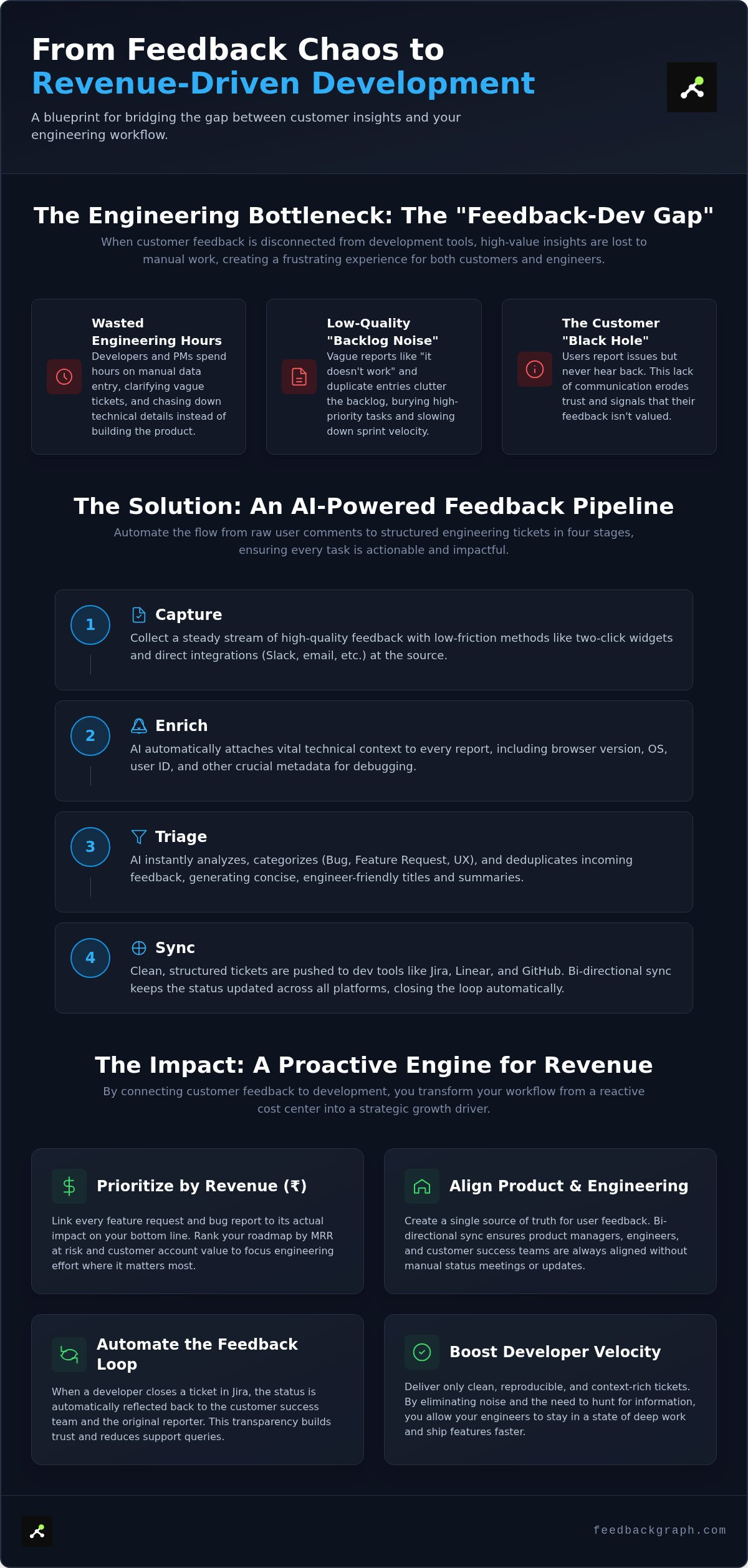
The Feedback-Dev Gap is where high-value product insights go to die. It's the silent space between a customer's frustration in a Slack channel and an engineer's sprint backlog in Jira. When you fail to connect customer feedback to dev tools, you force your product managers into the role of manual data entry clerks. They spend hours every week copying text, attaching screenshots, and chasing down technical details that should have been captured automatically. This manual triage is an expensive bottleneck. In the competitive Indian tech landscape, where companies like Letstrack set high standards for IoT and software reliability, wasting high-salaried engineering hours on clarifying vague reports represents thousands of ₹ in lost productivity every month.
One-way integrations often make the problem worse. Dumping raw, unverified feedback into a development tool creates "backlog noise" that buries legitimate priorities. Without a bi-directional flow, developers have no way to signal progress back to the customer success team. The status stays "In Progress" in one tool while it's already "Closed" in another. This lack of visibility kills sprint velocity. Teams become reactive, jumping between urgent but low-value fixes while the strategic roadmap gathers dust. Integrating a rigorous Customer Development methodology requires a technical bridge that ensures every ticket is backed by real-world evidence and revenue potential.
The Friction of Low-Quality Bug Reports
The most expensive feedback an engineer can receive is a three-word ticket: "it doesn't work." This lack of context triggers a cycle of back-and-forth messages that halts momentum. Manual copying often strips away vital metadata like browser versions, OS details, or specific user IDs. Without this technical context, developers can't reproduce the issue. They're forced to switch contexts, leaving deep work to hunt for information that should have been attached at the source. You can see how this impacts efficiency in our bug tracking use cases, where automation replaces manual guesswork.
Beyond engineering workflows, AI is also being used to streamline the hiring process; you can check out Rezumi to see how AI-powered tools help candidates optimize their resumes for Applicant Tracking Systems.
The Black Hole Effect for Customers
When a user takes the time to report a bug or request a feature, they expect a response. If that feedback disappears into a dev backlog with no further communication, it creates a "black hole" effect. This erodes trust and signals to the customer that their input isn't valued. As a SaaS scales, providing manual status updates becomes impossible. You can't personally email 500 users when a patch goes live. Without automated, bi-directional sync, the loop stays open. Closing that loop is essential for retention; customers stay when they see their feedback directly influencing the product's evolution. To maintain this level of transparency across your entire service, you can discover StatusPulse to provide real-time uptime monitoring and public status pages for your users.
The Anatomy of an AI-Powered Feedback Pipeline
Modern product development requires more than just a basic connection between users and engineers. To effectively connect customer feedback to dev tools, you must implement a structured, four-stage pipeline: Capture, Enrich, Triage, and Sync. This system ensures that raw, often messy user sentiment is refined into precise technical requirements before it ever reaches a developer's sprint. Given the high importance of user feedback for maintaining market agility, automating this flow is the only way to scale your product without ballooning your triage team's headcount.
The transformation happens in the enrichment stage. Raw comments—whether gathered through customer calls or captured using the Free Notes App—are stripped of noise and combined with technical metadata. This creates a high-fidelity ticket that lives where your developers already work. Bi-directional sync then ensures that as work progresses in Jira or GitHub, the status is reflected back to the customer success team and the original reporter. This transparency eliminates the "black hole" effect and reduces the volume of "is this fixed yet?" inquiries that drain your team's energy.
Automated Triage and Enrichment
AI triage is the process of using Large Language Models to instantly categorize incoming feedback into functional buckets like "Bug," "Feature Request," or "UX Improvement." Instead of a human reading every Slack message or email, the AI analyzes the intent and urgency of the message. It generates structured data automatically, assigning a technical severity level and a concise, engineer-friendly title. By utilizing AI bug report enrichment, you ensure that every ticket arrives in your dev tool with a professional summary and the context required to start debugging immediately.
Solving the Duplicate Problem
Duplicate reports are the primary cause of backlog bloat and wasted engineering cycles. When multiple users report the same issue using different language, engineers often find themselves triaging the same bug multiple times. FeedbackGraph employs "near-duplicate" detection to identify these overlaps as they arrive. The system groups similar feature requests together, allowing product managers to see the true volume of demand and the total revenue at risk in ₹. This mechanism handles high-volume feedback by creating a single master ticket and linking all related customer reports to it, keeping your backlog lean and actionable. If you are ready to stop managing spreadsheets and start shipping features, explore our automated triage workflows to see how we handle deduplication at scale.
Core Integrations: Connecting to Jira, Linear, and GitHub
Establishing a technical link between your users and your codebase requires more than a basic API connection. To effectively connect customer feedback to dev tools, you must implement precise field mapping logic that translates qualitative user sentiment into quantitative engineering data. By integrating an agentic platform like GraiaCX, you can automate the capture of these insights across voice and chat channels, ensuring that a user's "frustration level" maps accurately to a "Priority" field in Jira or a "Label" in Linear. This structured approach prevents information loss and ensures that when a high-value client in a tech hub like Bengaluru or Hyderabad reports a blocker, it triggers a high-priority ticket in your sprint automatically. Effective mapping allows your team to maintain a single source of truth without manual data manipulation.
Slack serves as the essential notification layer in this ecosystem. By routing enriched feedback into dedicated channels, you provide immediate visibility to both product and engineering teams. You can configure these notifications to trigger only for specific criteria, such as reports from enterprise accounts or issues impacting a certain threshold of revenue in ₹. This prevents alert fatigue while ensuring that critical insights never sit idle in an inbox. Integrating a dedicated customer feedback widget for Jira further streamlines this by ensuring every submission is pre-formatted with the specific metadata your developers require to start work.
Bi-directional Jira and Linear Sync
Mapping custom fields is the key to preserving customer context inside your development environment. When an engineer opens a ticket in Linear, they should see the reporter's account tier and the total revenue at risk directly in the sidebar. This data provides the "why" behind the "what," helping developers understand the business impact of their code. Bi-directional sync also automates the feedback loop. When a developer moves a ticket to "Done," a trigger can instantly notify the customer success team or even the original reporter. This automation saves product managers from the tedious task of manual follow-ups and ensures that your customers feel heard throughout the development lifecycle.
Modern Workflows with MCP Servers
The Model Context Protocol (MCP) server represents the next evolution in how teams interact with their data. An MCP server allows AI agents and local development environments to query your feedback database directly using standardized protocols. Instead of leaving their IDE to check a product dashboard, a developer can use AI-assisted tools to query the backlog for the most frequent complaints related to a specific feature. FeedbackGraph’s MCP server connects your local dev environment directly to live customer feedback streams. This enables real-time backlog querying and ensures the data driving your sprint is always current. It removes the friction of switching between browser tabs, allowing for a focused, evidence-based development cycle that prioritizes what actually matters to your users.
Prioritizing the Roadmap: Ranking Feedback by Revenue
Prioritization based on the loudest voice in your Slack channel is a recipe for strategic drift. It rewards persistent users rather than high-value ones. To build a sustainable product, you must connect customer feedback to dev tools through a financial lens. By mapping feedback items to your CRM data, you can see the exact Monthly Recurring Revenue (MRR) at risk for every bug or feature request. This transformation turns your engineering backlog from a cost center into a growth engine. You stop guessing which tasks will move the needle and start executing based on clear financial impact. For companies looking to diversify their revenue by adding financial services, you can explore Fast time to market embedded banking to launch branded banking features without the typical development overhead.
The standard "Impact vs. Effort" matrix fails when "Impact" is a subjective guess. A modern workflow replaces intuition with hard data from your sales and success platforms, often supplemented by the specialized research and insights from Jembe.intelligence to better understand consumer data and market demands. When you link a specific Linear issue to five enterprise accounts, the urgency is no longer up for debate. You aren't just fixing a bug; you're securing renewals and protecting your revenue stream. This evidence-based approach ensures that your developers spend their energy on work that directly correlates with the company's financial health.
This shift toward direct value exchange and transparency is a growing trend across industries; for example, the music platform OohYeah! enables fans to support artists directly, ensuring that creators are fairly compensated for their work through a more direct and honest marketplace.
Quantifying the Revenue Impact
Calculating the revenue value of a bug report requires aggregating the total contract value of every unique customer impacted by that specific issue. This isn't just about total count; it's about the weight of the accounts. AI models can now estimate churn risk by comparing current feedback sentiment against historical data from lost accounts. This enables revenue-based product prioritization that protects your core business. When a feature gap is linked to ₹5,00,000 in potential churn, the decision to prioritize it becomes objective rather than emotional.
Data Over Intuition in Product Meetings
Product meetings often devolve into a battle of opinions. "I think this is important" loses every time to "The data shows this fix impacts ₹12,00,000 in annual renewals." Revenue-ranked lists provide a shared language for stakeholders and engineers. It aligns the sales team's needs with the development team's capacity. Visualizing the ROI of fixing high-severity bugs for key accounts ensures that resources are allocated where they generate the most value. This data-driven approach removes the friction of sprint planning and ensures every line of code written contributes to the company's bottom line; similarly, investors are leveraging TickerAI to discover stock opportunities by applying this same level of AI-driven rigor to their financial portfolios.
Implementation: Building Your Frictionless Feedback Loop
Successful execution requires a deployment strategy that respects your existing engineering culture. To effectively connect customer feedback to dev tools, you must focus on reducing friction for both the reporter and the developer. Start by choosing a capture method that integrates naturally into your UI. A two-click widget is often the most effective choice; it allows users to submit feedback without leaving the page while capturing the technical context your team needs. Just as specialized sectors like construction rely on GoBuid for streamlined site reporting, software teams must ensure their capture tools are fit for purpose. Once the data flows, configure your AI triage rules to mirror your current engineering labels. If your team uses specific tags like "Frontend-Blocker" or "API-Latency," your AI should be trained to apply those automatically.
Don't attempt a company-wide rollout on day one. Pilot the new workflow with a single development team to identify any friction points in the sync logic. This phased approach allows you to refine your automated triggers before scaling the system across your entire organization. During this pilot, regularly audit your "loop closure" rate. This metric tracks how often a resolved ticket results in an automated notification to the customer. Ensuring that users feel heard is the only way to maintain the high-quality feedback stream you've built.
While internal systems keep your development on track, managing external sentiment is just as crucial; you can discover WhoRatesMe to implement an ethical, Google-compliant plan for your online reputation.
For enterprises looking to maintain data integrity across complex platforms during this scale-up, Kagool provides the specialized consultancy needed to align technical workflows with broader business systems like SAP and Microsoft.
Similarly, ensuring your infrastructure meets the highest security standards is essential during growth; Exploit Labs offers the TIBER-DE and DORA assessments required to validate your system's resilience and security posture.
Selecting the Right Infrastructure
Generic automation platforms like Zapier often struggle with the complexity of modern software development. They move text strings but frequently fail to handle visual bug reporting, such as screen recordings or console logs. Specialized feedback connectors are built to manage these rich data types, ensuring that developers receive a complete picture of the issue. When evaluating your stack, Alternative Radar can help you discover tools that offer deep, bi-directional integrations with your specific version control and project management systems. You can find detailed technical setup steps in the FeedbackGraph documentation to ensure your infrastructure is optimized for speed and reliability.
Beyond software tools, maintaining a fast and stable connection is vital for cloud-based development; you can discover TekSavvy to explore internet and phone bundles that provide the reliability your engineering team needs.
Next Steps for Scalable Product Growth
Scaling your product requires transitioning from reactive bug fixing to proactive evolution. As your feedback volume grows, maintaining data quality becomes your primary challenge. Use your AI-driven pipeline to identify emerging trends before they become widespread issues. This allows you to allocate resources to high-impact features that drive long-term retention. A frictionless loop ensures that every line of code written is a response to a verified market need. If you're ready to eliminate backlog noise and drive revenue-led development, it's time to book a demo and connect your dev tools today.
Scale Your Product with Revenue-Led Development
Manual triage is a relic of the past that slows down your sprint and drains engineering resources. By implementing an AI-powered pipeline, you transform raw user noise into structured, actionable tickets. You've learned how to enrich reports with AI-generated titles and severity levels while ranking every request by its impact on your ₹ MRR. This shift ensures your developers are always working on the tasks that protect your bottom line. Beyond internal efficiency, managing how your brand is perceived by AI is the next frontier of growth; ZeroClick.sg helps firms navigate this through expert AI visibility and brand citation management.
When you connect customer feedback to dev tools, you close the loop between customer success and engineering. Bi-directional sync with Jira and Linear eliminates the "black hole" effect, keeping your users informed and your backlog lean. It's time to stop guessing and start shipping with precision. You now have the blueprint to build a highly efficient, automated feedback ecosystem that scales with your growth—a compelling narrative for any equity crowdfunding marketing agency to leverage when presenting your company to potential backers.
Build the software your customers actually need and watch your business thrive.
Frequently Asked Questions
How do I automate bug triage with AI without losing control?
You maintain control by configuring AI triage rules that align with your existing engineering labels and severity definitions. The AI acts as an intelligent filter, processing raw input to generate precise titles and technical summaries while you set the thresholds for automatic ticket creation. This allows you to connect customer feedback to dev tools with high precision, ensuring that only verified, high-quality issues enter your sprint backlog.
Can I connect customer feedback to Jira and Linear simultaneously?
Yes, you can route enriched feedback to both Jira and Linear at the same time. This multi-tool support is essential for large organizations where different engineering pods might use different project management stacks. FeedbackGraph manages the logic to ensure data stays consistent across platforms, preventing information silos and ensuring every team has visibility into the customer insights relevant to their specific domain.
What is bi-directional sync and why is it important for dev tools?
Bi-directional sync ensures that status updates flow both ways between your feedback platform and your development environment. When an engineer moves a ticket to "Done" in Jira, the status is automatically updated for the customer success team and the original reporter. This transparency eliminates the "black hole" effect where users feel ignored, and it saves product managers from the tedious task of manual status checking.
How does FeedbackGraph deduplicate customer bug reports?
The system uses AI-driven "near-duplicate" detection to identify similar reports even when users use different terminology or languages. It groups these reports under a single master ticket and links every unique customer account to it. This prevents backlog bloat and gives your team a clear view of how many users are impacted by a specific issue without cluttering your dev tool with redundant tickets.
Is it possible to rank my product backlog by revenue impact?
You can rank your backlog by revenue impact by linking feedback items directly to your CRM data. This allows you to connect customer feedback to dev tools while seeing the exact MRR at risk for every feature request in ₹. By prioritizing tasks that impact your highest-value accounts, you transform your engineering workflow into a growth engine that protects your bottom line.
Does connecting feedback to dev tools require custom coding?
No, establishing a frictionless feedback loop does not require custom development. FeedbackGraph provides native integrations and a two-click widget that simplifies the technical setup. You can map custom fields and configure automated triggers through a visual interface, allowing your team to implement a professional, bi-directional workflow in minutes rather than weeks of engineering effort.
How do I ensure my engineers aren’t overwhelmed by new feedback?
You prevent overwhelm by using AI enrichment to filter out low-quality noise and duplicate reports before they reach the engineering team. By setting up strict triage rules, you ensure that developers only receive tickets that contain necessary technical context and metadata. This structured approach helps engineers stay focused on deep work instead of chasing down vague or incomplete user comments.
What dev tools are compatible with FeedbackGraph integrations?
FeedbackGraph is compatible with industry-standard development tools including Jira Software, Linear, and GitHub. It also features an MCP Server for modern workflows, allowing AI agents and local development environments to query the feedback database directly. These integrations are fully bi-directional, ensuring data integrity across your entire product management and engineering ecosystem.


