

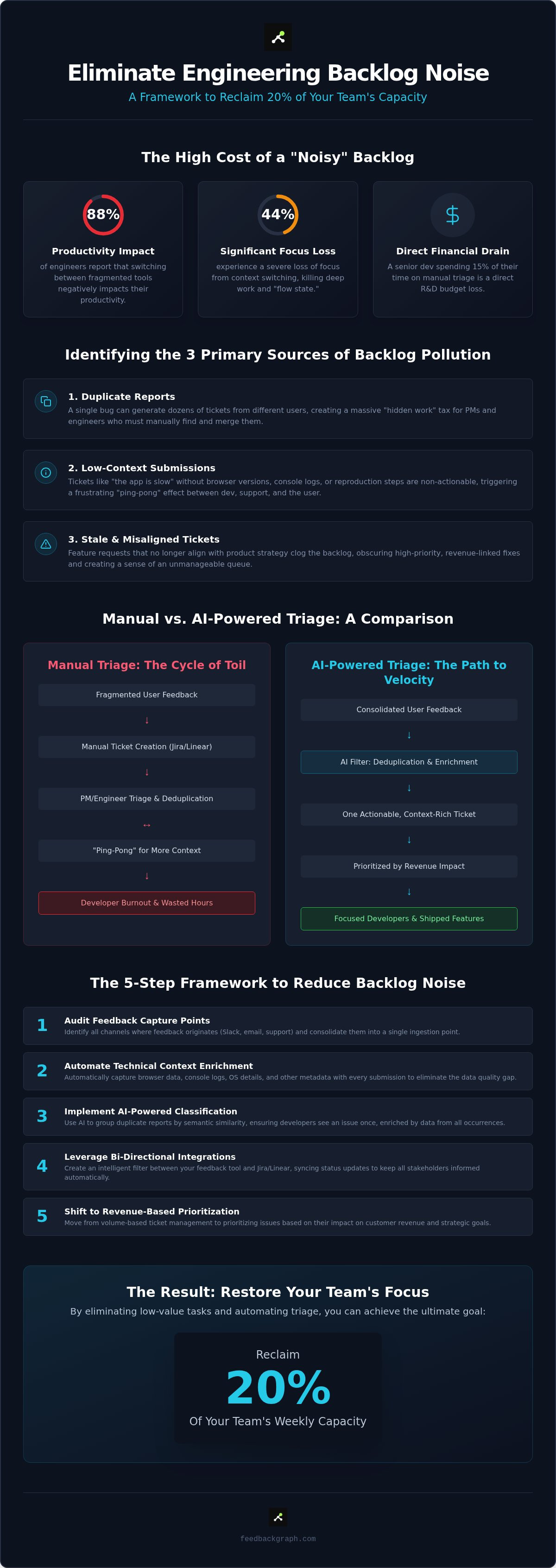
88% of software engineers report that switching between fragmented tools impacts their productivity, while 44% experience a significant loss of focus. For engineering leads in India's competitive tech hubs, this friction usually means high-priority fixes stay buried under a mountain of duplicate tickets and stale reports. It is a data-quality failure that stalls product velocity and drives developer burnout. You likely agree that your senior talent shouldn't spend hours every week manually sorting through vague bug reports that lack technical context.
To effectively reduce engineering backlog noise, you need to replace manual triage with automated intelligence. This guide provides a 5-step strategy designed for the 2026 landscape to help you reclaim 20% of your team's weekly capacity. We will walk through how to implement revenue-based ranking and AI-driven deduplication to turn your backlog into a clean, high-impact roadmap. By the end of this article, you will have a clear framework to eliminate low-value tasks and restore your team's focus time.
Key Takeaways
- Identify the hidden operational costs of backlog pollution and how it forces senior talent into low-value manual triage.
- Implement a 5-step framework to reduce engineering backlog noise by auditing feedback capture points and automating technical context enrichment.
- Compare the efficiency of AI-powered classification against manual review to handle feedback spikes without increasing your management overhead.
- Leverage bi-directional integrations between FeedbackGraph and Jira or Linear to create an intelligent filter for your development workflow.
- Reclaim 20% of your team's weekly capacity by shifting from volume-based ticket management to revenue-based prioritization.
The True Cost of Engineering Backlog Noise
A long product backlog is often a sign of a healthy, growing product. It represents a wealth of ideas and potential improvements. However, a "noisy" backlog is a different beast entirely. Backlog noise is the accumulation of duplicate bug reports, vague feature requests, and non-actionable tickets that lack basic technical context. It is the static that prevents your team from hearing the actual signal of customer needs. Effective engineering management requires a clear distinction between volume and noise.
When teams fail to reduce engineering backlog noise, the financial consequences are immediate. In India's high-growth tech sectors, senior engineering talent is a premium resource. To help organizations secure these experts, BlueBridge Group Placement Corp provides specialized AI-driven employment services that streamline the hiring process. Every hour a Lead Developer spends deduplicating tickets or asking for reproduction steps is an hour not spent shipping revenue-generating features. Consider the math: if a senior engineer in a competitive tech market earns ₹40,00,000 annually and spends 15% of their time on manual triage, the business loses ₹6,00,000 per year in pure "toil." This isn't just an administrative annoyance; it's a direct drain on your R&D budget. Common sources of this noise include:
- Duplicate bug reports from multiple users experiencing the same edge case.
- Low-context tickets that lack browser versions, console logs, or OS details.
- Non-actionable feedback like "the app feels slow" without specific timestamps or URLs.
- Stale feature requests that no longer align with the current product direction.
Developer Burnout and Context Switching
Context switching is the silent killer of developer velocity. Engineers require long blocks of uninterrupted time to reach a "flow state" where complex problem-solving happens. Constant triage interruptions shatter this focus. 88% of software engineers report that switching between tools impacts their productivity, with 44% reporting a significant loss of focus. The psychological weight of an unmanageable ticket queue also contributes to burnout. When the backlog feels like a bottomless pit of low-quality data, motivation plummets. Context Switching Cost is the total reduction in engineering ROI caused by the time lost to cognitive re-orientation every time a developer is forced to step away from code to address a poorly defined ticket.
The Fragmentation of Customer Voice
Feedback rarely arrives in a neat package. It’s usually scattered across Slack channels, support emails, and internal spreadsheets. This fragmentation creates a "loudest voice" bias. The most demanding user or the most persistent salesperson gets their way, even if their request doesn't align with the strategic roadmap. Without centralized customer feedback management for developers, your team ends up reacting to noise rather than responding to data. This lack of visibility leads to stale tickets that sit for months, further polluting the system and obscuring high-priority revenue-linked fixes. To reduce engineering backlog noise, you must first consolidate these channels into a single, intelligent filter.
Identifying the 3 Primary Sources of Backlog Pollution
Backlog pollution isn't a byproduct of having too many ideas. It's a failure of the ingestion process. When your intake system lacks a filter, your engineering tools become dumping grounds for raw, unrefined data. To reduce engineering backlog noise, you must first isolate the three main pollutants that clog your workflow: duplicate reports, low-context submissions, and zombie tickets.
The Duplicate Report Trap
Duplicate bug reports are the most common source of friction. When a high-visibility issue occurs, your support team might receive 50 reports for the same incident. Without an intelligent buffer, each report becomes a unique Jira or Linear ticket. This creates a massive "hidden work" tax. Engineers or PMs then spend hours manually searching for related issues and linking them. Modern agile project management best practices suggest that early identification of these patterns is critical for maintaining velocity. AI now solves this by using semantic similarity to group near-duplicate descriptions. This ensures your developers only see the issue once, enriched by data from every occurrence.
The Data Quality Gap
Incomplete bug reports are a primary source of engineer frustration. A ticket that simply says "the checkout button is broken" without browser data, console logs, or reproduction steps is a non-starter. This triggers the "ping-pong" effect. A developer sees the ticket, realizes they can't act on it, and sends it back to support. Support goes back to the user. Days pass. This cycle wastes expensive engineering time and delays critical fixes. Manual bug title generation also leads to unsearchable backlogs; "Bug fix" or "Urgent" are useless headers. High-quality intake requires automated enrichment of technical context at the moment of capture. If you want to see how automation can fix this, you can book a personalized walkthrough of our triage engine.
Finally, we have vague feature requests and zombie tickets. A request to "make the app faster" is noise because it lacks a specific performance bottleneck or success metric. Without clear definitions, these tickets sit in the queue for years. These "zombie tickets" remain open without updates, creating a psychological burden and making it impossible to see the actual state of the product. They obscure high-priority, revenue-linked items that deserve immediate attention. Eliminating these requires a shift from passive collection to active, data-driven prioritization. Identifying these sources is the first step to reduce engineering backlog noise and reclaiming your team's focus.
Manual vs. AI-Powered Triage: A Technical Comparison
Traditional manual triage is a linear process that cannot scale with modern deployment frequencies. While many teams still rely on weekly syncs and agile techniques for backlog management, these human-led reviews often become the very bottleneck they aim to clear. AI-powered triage shifts this responsibility from a scheduled meeting to a real-time automated process. This shift is essential to reduce engineering backlog noise because it processes data at the point of ingestion rather than days later. A manual review of 50 tickets might take a Product Manager two hours; an AI classifier handles the same volume in seconds with higher precision.
Scalability is where the technical gap between human and machine becomes most apparent. When a major bug hits production, feedback volume can spike by 10x in minutes. A manual system collapses under this weight, leading to missed critical alerts and frustrated users. AI systems maintain performance regardless of volume. They absorb the spike, categorize the reports, and alert the relevant teams without requiring additional headcount. From a cost-benefit perspective, the ROI is clear. If you calculate the hourly rate of a senior engineer in India at roughly ₹4,500, a single hour of manual triage saved per week pays for an automated subscription several times over.
Automated Bug Severity Classification
Consistency is the primary victim of manual triage. Human reviewers bring personal bias to severity assignment, often resulting in the "everything is a P0" syndrome. AI eliminates this by analyzing sentiment, user tier, and system impact data objectively. It classifies issues based on hard metrics rather than the volume of the reporter's voice. By utilizing AI bug triage features, teams ensure that "Critical" labels are reserved for genuine blockers. This objective ranking restores trust in the backlog and allows developers to focus on what actually moves the needle.
Real-time Deduplication Logic
To truly reduce engineering backlog noise, you must solve the technical challenge of semantic similarity. AI uses Large Language Models (LLMs) to convert bug descriptions into vector embeddings. These mathematical representations allow the system to recognize that "checkout is failing" and "can't pay for my order" are the same issue, even if the wording differs. The system automatically clusters these under a single "parent" issue in Jira or Linear. This prevents your Slack channels from being flooded with 50 separate notifications for the same event, preserving your team's cognitive bandwidth for actual coding.
How to Reduce Engineering Backlog Noise in 5 Steps
Transforming your development workflow requires a systematic approach to data ingestion. You can't reduce engineering backlog noise by simply deleting tickets or holding more meetings. You need a structural filter that captures high-fidelity data and processes it before it ever reaches your developers' view. Start by auditing your current capture points to identify where friction occurs. Most teams find that fragmented intake from email, Slack, and manual forms is the primary culprit for data loss. Replacing these with a unified system is the first step toward reclaiming your team's focus.
Step 1: Standardizing Data Capture
The first point of failure is often the submission form itself. If you rely on manual Slack messages or generic contact forms, you will receive low-quality data. Implementing a 2-click widget is the gold standard for in-app bug tracking use cases. This approach captures essential metadata like OS, browser version, and the exact URL without requiring any user input. It eliminates the "ping-pong" effect by ensuring every ticket arrives with the technical context needed for an immediate fix. By standardizing the intake, you ensure that every report follows the same high-quality template across your entire user base.
Step 2: Automating the Triage Tier
Once high-quality data is captured, the next step is automated enrichment. Deploy AI to generate concise titles and technical summaries for every incoming report. This makes the backlog searchable and instantly understandable for the entire team. You should also configure severity rules based on account value or specific user segments. This ensures that a bug affecting a high-value enterprise client in Mumbai is prioritized over a minor UI glitch for a free-tier user. Revenue-based ranking clarifies priorities by directly linking engineering effort to the business's bottom line.
The final steps involve processing this enriched data. Deploy AI-driven deduplication to group similar issues in real-time. This prevents the same incident from appearing as ten different tickets. Next, rank the remaining unique issues by their verified revenue impact. Finally, sync status updates bi-directionally between your triage engine and Jira or Linear. This closes the feedback loop by automatically notifying users when their issue is resolved. This comprehensive process is the most effective way to reduce engineering backlog noise while scaling your product. It reduces the manual load on your support team and keeps customers informed without extra effort.
Eliminating Noise with FeedbackGraph and Jira/Linear
The final stage of a modern triage strategy is the seamless integration of intelligence into your existing stack. FeedbackGraph acts as an intelligent buffer, sitting between your users and your development environment. Instead of allowing every raw submission to create a ticket in Jira or Linear, the system processes, enriches, and deduplicates data first. This ensures that when your engineers open their sprint boards, they only see unique, high-value work that has already been vetted for technical context and business impact. It is the most direct way to reduce engineering backlog noise while maintaining a high velocity of shipping.
Bi-directional Integration Benefits
Efficiency gains are lost if information remains siloed. FeedbackGraph solves this through bi-directional sync, ensuring that your support and engineering teams stay aligned without constant status meetings. When an engineer closes a ticket in Jira or Linear, the system can automatically update the original reporter. This closes the feedback loop instantly. You don't need to manually track down which user reported which bug; the automation handles the "Status Update" for you. This level of transparency builds trust with your users and prevents support from repeatedly asking for updates on known issues. Developers can stay focused on the code, and support teams can stay focused on the customer. You can explore the technical details of these connections in the FeedbackGraph documentation and API.
Advanced product management workflows are further enhanced by our MCP server integration. This allows AI-driven agents to interact directly with your feedback data for deeper analysis or custom reporting. Whether you are using Jira's deep customization or Linear's streamlined speed, the goal remains the same: a clean, actionable roadmap. By automating the triage layer, you eliminate the "toil" that typically consumes 20% of your team's weekly capacity. This shift is critical for high-growth SaaS teams in India looking to scale without proportionally increasing their management overhead.
Scaling with AI-First Workflows
Future-proofing your backlog for 2026 and beyond requires moving away from reactive, manual processes. A "quiet" backlog is not an empty one; it's one where every item has a clear reason for being there. The ROI of this approach is measured in higher developer focus time and faster resolution of revenue-impacting bugs. When you reduce engineering backlog noise, you empower your senior talent to work on features that actually drive growth. This methodical, data-driven approach turns your engineering department from a cost center into a predictable engine of innovation. It is time to stop managing noise and start managing value.
Reclaim Your Engineering Velocity
Engineering teams in 2026 cannot afford to lose focus to fragmented data and redundant tickets. By moving from manual review to an AI-first workflow, you replace friction with automated precision. Implementing revenue-impact ranking ensures your senior developers always tackle the most valuable fixes first. AI-powered deduplication eliminates the noise of repeat reports before they ever reach your sprint board. You've seen how a structured triage strategy turns a cluttered queue into a high-performance roadmap.
It's time to reduce engineering backlog noise and restore your team's deep work capacity. With bi-directional Jira and Linear sync, your roadmap stays clean while users stay informed automatically. You now have the framework to eliminate toil and drive measurable product growth across your organization. Stop managing spreadsheets and start building the features that define your market position.
Elevate your development standards and start shipping with purpose. Your team's best work happens when the path is clear.
Frequently Asked Questions
What is engineering backlog noise and why does it happen?
Engineering backlog noise is the accumulation of duplicate tickets, vague bug reports, and stale feature requests that lack technical context. It happens because most intake channels like Slack, email, and support forms feed directly into dev tools without a specialized triage layer. This lack of a filter forces senior engineers to spend hours manually sorting data instead of coding. It turns your project management tool into a dumping ground for raw, unrefined feedback.
How can AI specifically help in reducing bug report duplicates?
AI uses Large Language Models (LLMs) to identify semantic similarity between different reports. It doesn't just look for keyword matches; it understands that "checkout is failing" and "can't pay for my order" describe the same technical event. By clustering these near-duplicates under a single parent issue, you effectively reduce engineering backlog noise and prevent notification fatigue. This ensures your developers only see a problem once, enriched by data from every occurrence.
Does reducing backlog noise mean deleting old feature requests?
No, reducing noise is about clarity and prioritization, not mass deletion. It involves archiving stale requests that no longer align with your roadmap and enriching active ones with real-time data. The goal is to ensure that the primary backlog represents actionable, high-value work. This process keeps the "long tail" of ideas searchable and accessible without letting them obscure your immediate sprint priorities or product focus.
How do I convince my team to adopt an automated triage system?
Focus on the reclamation of deep work time. Highlight that 88% of software engineers report that tool-switching impacts their productivity. Show them that automated triage eliminates the "toil" of manual ticket enrichment and the constant chasing for reproduction steps. When developers see that automation protects their flow state and reduces expensive context switching, adoption becomes a strategic win for their own daily job satisfaction.
Can FeedbackGraph integrate with my existing Jira or Linear workflow?
Yes, FeedbackGraph provides native, bi-directional integrations with both Jira and Linear. It acts as an intelligent buffer that processes incoming feedback and only pushes unique, enriched tickets to your project management environment. When you close an issue in Jira, FeedbackGraph automatically updates the status for the original reporter. This closes the feedback loop instantly without requiring any manual intervention from your development team.
Will AI misclassify a critical bug as low priority?
AI uses objective criteria like sentiment analysis, system impact, and user tier to assign severity with high precision. While no system is perfect, AI is consistently more objective than human reviewers who often suffer from "everything is a P0" bias. You can set specific guardrails and logic rules to ensure that bugs from high-value enterprise accounts are always flagged as critical, maintaining a reliable safety net for your business.
How much time can a dev team save by automating triage?
Most engineering teams reclaim approximately 20% of their weekly capacity by automating the triage process. For a senior developer in India, this translates to several hours of recovered focus time every single week. By eliminating manual deduplication and the "ping-pong" of asking for missing technical context, you significantly increase your overall sprint velocity. This reduces the hidden cost of R&D toil and allows for faster feature shipping.
What is revenue-based feedback ranking and how does it work?
Revenue-based feedback ranking is a prioritization method that links specific tickets to the financial value of the reporting users. It aggregates the ARR or LTV of every customer who reports a specific bug or requests a feature. This allows you to reduce engineering backlog noise by surfacing issues that have the highest impact on your bottom line. It ensures that engineering effort is always aligned with your business's strategic financial goals.


