

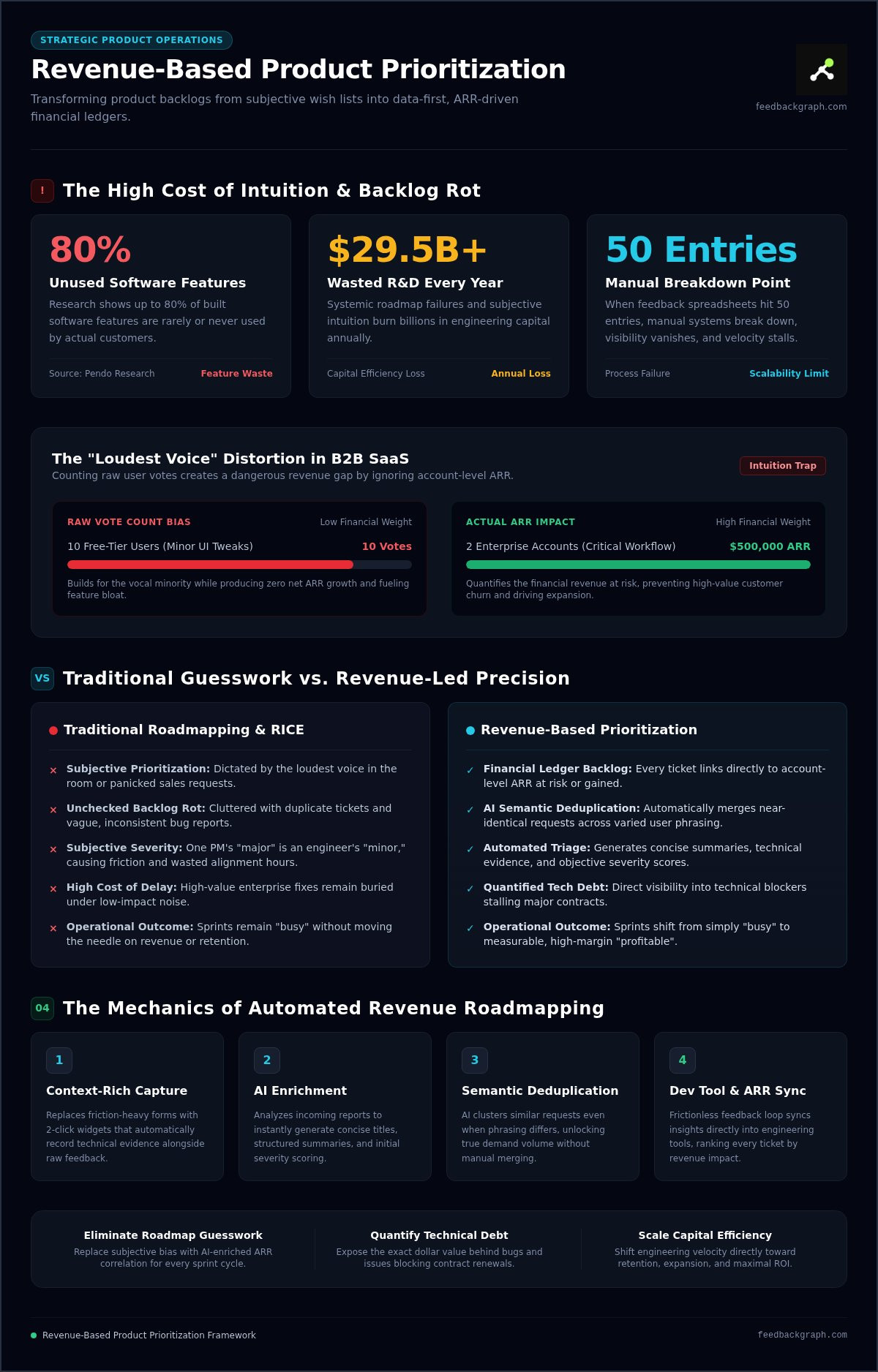
Research shows that 80% of software features go virtually unused, leading to over $29.5 billion in wasted R&D every year. It's a staggering figure that highlights a systemic failure in how teams decide what to build. You've likely felt this friction when the loudest voice in a meeting hijacks the roadmap. It's frustrating when your backlog becomes a graveyard of duplicate tickets with no clear dollar value attached. You shouldn't have to guess which features will actually move the needle on retention. You need a way to filter the noise with precision.
This guide introduces revenue based product prioritization, a methodical approach to ranking your backlog using AI-enriched financial data. We'll show you how to stop the guesswork and start building features that directly correlate with ARR. You'll learn to implement an automated sync between customer feedback and dev tools to create a clean, AI-triaged roadmap. We are moving past subjective opinions and into a world where every ticket has a documented financial impact. It's time to turn your technical tasks into tangible business growth.
Key Takeaways
- Replace subjective "loudest voice" bias with a data-first roadmap that prioritizes features based on actual ARR impact.
- Discover why traditional RICE frameworks fail in 2026 and how revenue based product prioritization provides the precision needed for modern SaaS growth.
- Use AI-enriched data to automatically triage your backlog, deduplicate requests, and generate context-rich tickets without manual effort.
- Implement a frictionless feedback loop that syncs customer insights directly with your engineering tools to eliminate roadmap friction.
- Quantify the financial cost of technical debt to ensure your team builds what actually drives retention and expansion revenue.
The Failure of Intuition: Why Manual Prioritization Stalls SaaS Growth
SaaS roadmaps are often built on a foundation of noise. When you rely on manual prioritization, you aren't just guessing; you're actively burning resources. Research from Pendo indicates that up to 80% of software features are rarely or never used. This happens because the decision-making process is frequently disconnected from financial reality. Traditional roadmapping relies on intuition, which scales poorly and invites bias. Intuition is a liability in a market that demands capital efficiency.
Revenue based product prioritization is the strategic shift from counting votes to calculating financial impact. It's a data-first approach that ranks features by their direct effect on Annual Recurring Revenue (ARR). Instead of asking how many people want a feature, you ask how much revenue is at risk if you don't build it. This methodology transforms the backlog from a wish list into a financial ledger.
The 'Loudest Voice' vs. The Most Profitable Signal
The loudest voice in the room often belongs to a single, vocal user or a panicked sales rep. In B2B SaaS, this creates a dangerous distortion. Ten free-tier users requesting a minor UI change can easily outvote two enterprise accounts representing $500k in ARR. Biased data leads to feature bloat, where you build for the vocal minority while ignoring the profitable majority. The Revenue Gap represents the hidden financial loss incurred when roadmap velocity is decoupled from account-level ARR. Without a clear link between a ticket and its dollar value, you're essentially flying blind.
Backlog Rot: The Silent Killer of Engineering Velocity
Backlogs don't just grow; they rot. Without automated triage, they become cluttered with duplicate requests and vague bug reports. This "backlog rot" forces engineers to spend hours deciphering tickets rather than writing code. Manual severity classification is inherently flawed because it's subjective. One PM's "major" is another engineer's "minor," leading to constant friction and misaligned goals. Manual triage is a drain on resources, and teams often lose days to noise that could be cleared with automated bug tracking systems.
This lack of clarity triggers a high Cost of Delay, as high-value fixes sit buried under low-impact noise. You can't manage what you can't quantify. When your feedback spreadsheet hits 50 entries, the manual system breaks. You lose visibility, and your engineering velocity stalls. Transitioning to a revenue-led model ensures that every sprint cycle targets the highest possible ROI, moving your team from "busy" to "profitable."
The Mechanics of Revenue-Based Product Prioritization
Most product teams are still prioritizing intuition over data, treating revenue as a manual field they might fill in later. This approach is fundamentally broken. To build a roadmap that scales, you must move beyond static forms and subjective spreadsheets. Effective revenue based product prioritization requires a system that captures high-fidelity signals and enriches them with financial context automatically. It starts with replacing friction-heavy feedback forms with context-rich, two-click widgets that record technical evidence alongside user requests.
AI Enrichment: Turning Raw Feedback into Structured Data
Raw feedback is messy and inconsistent. AI-driven systems solve this by instantly analyzing incoming reports to generate concise titles, summaries, and initial severity scores. This process turns a vague complaint into a structured data point that your team can actually use. By automating the classification of technical debt and feature requests, you enable instant filtering by potential financial impact. You can explore how these automated workflows function in detail by reviewing the FeedbackGraph Features. This level of structure ensures that your backlog is always organized, allowing you to see which issues are blocking the most significant contracts.
The Power of Automated Deduplication
Manual ticket merging is a massive bottleneck that drains product management resources. When multiple customers report the same issue using different language, manual systems fail to connect the dots. AI solves this through semantic deduplication, identifying near-identical requests even when the wording varies. This clustering reveals the true demand volume for a specific fix or feature. Reducing this noise is essential for maintaining a high-velocity development cycle. For more on optimizing these processes, see our guide on How to Streamline Bug Reporting Workflows. Automated merging ensures that your data reflects the collective weight of your customer base rather than a fragmented list of individual complaints.
The final, most critical step is Revenue Mapping. By linking enriched feedback directly to your CRM data, you can see the exact Annual Contract Value (ACV) and Lifetime Value (LTV) associated with every ticket. This objective ranking replaces "gut feel" with a clear financial calculation. You no longer build what is easiest or what sounds best in a meeting; you build what the data proves will drive growth. If you want to see how this looks in practice, you can book a personalized walkthrough to see your own data mapped to revenue.
Framework Comparison: Revenue Ranking vs. Traditional RICE
The RICE framework was once the gold standard for product managers. It provided a structured way to evaluate Reach, Impact, Confidence, and Effort. However, in 2026, this model is showing its age. The primary issue is that RICE relies on manual inputs that are inherently subjective. Reach is often measured by raw user count rather than the economic value of those users. Impact is usually a finger-in-the-wind estimate. Revenue based product prioritization upgrades this logic by replacing abstract guesses with hard financial data. It moves the conversation from "how many users" to "how much revenue."
The Flaw in Subjective Scoring
The Confidence score is perhaps the greatest subjectivity trap in modern product management. PMs often assign high confidence scores to features they personally favor, turning a metric into a tool for confirmation bias. Impact scores vary wildly between team members because they depend on individual perspectives rather than empirical evidence. This inconsistency creates friction during stakeholder meetings and leads to misaligned roadmaps. Revenue data provides a Single Source of Truth that stakeholders can't dispute. While manual RICE relies on subjective estimates that vary by person, automated revenue ranking uses live CRM data to anchor every decision in financial reality. This transparency builds trust across the organization and ensures that engineering resources target high-growth opportunities.
Quantifying the Cost of Bugs
Traditional prioritization often fails when it comes to technical debt. Teams frequently treat all "High Severity" bugs as equal priorities. This approach ignores the reality of SaaS economics. A critical bug affecting a churn-prone enterprise account is objectively more urgent than the same bug affecting a low-tier trial user. Ranking bugs by revenue prevents churn in high-value accounts by identifying which technical failures pose the greatest financial risk. It allows you to separate critical infrastructure issues from noisy requests that don't impact the bottom line. By integrating technical severity with real-world revenue, you identify the specific debt that blocks renewals or prevents expansion. You can see how this logic applies to real-world scenarios in our Bug Tracking Use Cases. This method ensures that your maintenance work is as strategic as your new feature development.
Implementation Guide: Building a Profit-First Roadmap
Moving from theory to execution requires a structured workflow that eliminates manual friction. You can't achieve revenue based product prioritization without high-fidelity data entering your system from the start. A profit-first roadmap depends on a four-step cycle: capture, triage, execute, and notify. This loop ensures that every engineering hour targets the most profitable opportunities while maintaining full transparency for stakeholders. By anchoring your roadmap in financial reality, you transform your product team from a cost center into a growth engine.
Frictionless Capture: High-Quality Data from Day One
Long feedback forms are where high-quality data goes to die. Users won't spend ten minutes filling out custom fields, which results in vague reports that require endless manual follow-up. Two-click widgets solve this by making reporting effortless. These tools capture essential metadata like browser versions, network logs, and screen recordings automatically. This technical context is vital for engineering teams to reproduce issues without back-and-forth communication. You can explore how these widgets improve data quality in our Customer Feedback Use Cases. High-quality input is the prerequisite for high-quality output, ensuring your AI triage has the data it needs to rank by revenue accurately.
Bi-directional Sync: Keeping Product and Engineering Aligned
Alignment fails when feedback lives in one tool and development happens in another. You need a system that routes prioritized issues directly to Jira, Linear, or GitHub without leaving your triage dashboard. Bi-directional sync ensures that when an engineer closes a ticket in Linear, the status update reflects immediately in your feedback portal. This automation eliminates the manual status check emails that clutter your inbox and stall progress. For a deep dive into these workflows, read our guide on how to Connect Customer Feedback to Dev Tools. Keeping your dev tools in sync with customer signals ensures that your sprint velocity directly translates to account retention.
The final step is closing the loop. Automated notifications alert users the moment their requested feature or fix goes live. This builds immense trust and directly impacts Net Dollar Retention (NDR). When a customer sees that their specific feedback led to a product improvement, they are far more likely to renew or expand their contract. You aren't just shipping code; you're proving value to your most important accounts. This systematic approach ensures that your roadmap isn't just a list of tasks, but a strategic document that drives measurable ROI.
Maximize SaaS ROI with FeedbackGraph
Manual roadmapping is no longer just inefficient; it's a strategic liability. FeedbackGraph provides the no-nonsense remedy for backlog rot by automating the entire lifecycle of customer signals. By implementing revenue based product prioritization, you replace subjective gut feelings with a methodical, evidence-based system. The platform doesn't just store data; it actively triages it to ensure your engineering resources are always allocated to the highest-value tasks. It's the difference between guessing and knowing exactly which fix will protect your bottom line.
FeedbackGraph uses vector embeddings for semantic deduplication, ensuring that near-duplicate tickets never clutter your view. It connects each feedback cluster to actual account data, providing a real-time view of the financial impact behind every request. This level of visibility allows you to justify your roadmap to stakeholders with absolute confidence. You're no longer debating opinions; you're presenting a financial calculation backed by the AI Bug Triage engine.
The FeedbackGraph Advantage: AI-First Triage
The platform's technical core is built for speed and precision. Through its MCP Server, FeedbackGraph allows AI developer agents like Cursor or Claude Code to ingest bug evidence directly. This means your engineers can query top revenue-backed opportunities without leaving their IDE. It turns vague customer complaints into actionable tickets enriched with console logs and network requests. This process eliminates the friction of manual reproduction and speeds up time-to-resolution.
Bi-directional integrations with Jira, Linear, and Slack ensure that status updates flow naturally across your stack. When a developer moves a ticket to "Done," the system automatically updates the customer, closing the loop without manual intervention. You can see the full breakdown of these technical workflows by exploring How it Works. This transparency ensures that your team stays focused on execution rather than status reporting.
Building for the Future of SaaS
In a market where capital efficiency is paramount, FeedbackGraph is an essential partner for teams that value rapid iteration. It shifts the focus from raw feature volume to durable growth levers. The tangible benefits of revenue based product prioritization are clear: higher Net Dollar Retention (NDR), increased ARR, and a significant reduction in churn from high-value accounts. You stop building features that 80% of users ignore and start building the capabilities that drive renewals.
Transitioning to a profit-led model starts with a single integration. Whether you're clearing technical debt or unlocking new revenue pipelines, the platform provides the structural integrity your roadmap needs. It's time to eliminate the friction between customer needs and engineering execution. Take control of your growth strategy today with a FeedbackGraph Subscription.
Build Your Roadmap on Financial Evidence
Stop letting subjective opinions or the loudest customer in the room dictate your engineering velocity. We've explored how revenue based product prioritization transforms a cluttered backlog into a high-impact growth lever. By utilizing AI-powered deduplication and bi-directional Jira/Linear sync, you eliminate the manual noise that stalls development. This transition ensures every feature you ship has a documented financial impact on your ARR. You're shifting from being a feature factory to becoming a methodical growth engine.
You don't have to settle for a roadmap built on guesses and gut feelings. Implementing revenue-led roadmap automation provides the structural integrity your team needs to scale effectively. It's time to build with technical precision and focus on the signals that actually drive retention and expansion. Your team is ready to move past the noise and deliver real-world financial results that stakeholders can't ignore.
Frequently Asked Questions
What is revenue-based product prioritization?
It is a data-driven framework that ranks backlog items based on their direct impact on Annual Recurring Revenue (ARR) and customer retention. Unlike traditional voting systems, it weights every request by the financial value of the account making it. This ensures teams build features that protect high-value contracts and unlock expansion revenue. It moves the roadmap from subjective gut feel to objective financial calculations that stakeholders can easily understand.
How does AI help in ranking feature requests?
AI automates the enrichment of raw feedback by generating concise titles, summaries, and initial severity scores. It uses vector embeddings to perform semantic deduplication, merging near-identical requests to show true demand volume. By clustering these signals, the AI provides a structured dataset that can be instantly mapped to CRM data. This process eliminates manual triage and ensures that the prioritization logic remains consistent across the entire organization.
Can I use revenue-based prioritization with Jira or Linear?
Yes, FeedbackGraph offers bi-directional integrations with Jira, Linear, and GitHub. Once a request is ranked by revenue, you can route it directly to your preferred issue tracker with a single click. Status updates sync automatically; when an engineer closes a ticket in Linear, the reporter is notified through the portal. This keeps product and engineering teams perfectly aligned without requiring manual status updates or duplicate data entry.
How do you calculate the revenue impact of a bug report?
Impact is calculated by mapping the bug report to the specific customer account and their associated ARR. If a critical bug affects an enterprise account worth $500k, its priority score is weighted significantly higher than a bug affecting a trial user. This calculation often includes factors like churn risk, pipeline blockers for pending deals, and the total contract value of all impacted users within a specific semantic cluster identified by the AI.
Is revenue the only factor I should use for my roadmap?
Revenue is a primary driver, but it works best when balanced with engineering effort and strategic alignment. While revenue based product prioritization provides the financial foundation, you should still consider technical feasibility and long-term vision. The goal is to maximize ROI by building high-value features that require manageable effort. Using revenue data ensures that even your maintenance work and technical debt fixes are prioritized by their actual business impact.
How does FeedbackGraph handle duplicate feedback entries?
The platform uses AI-powered deduplication to identify near-duplicate submissions automatically. Instead of having dozens of separate tickets for the same issue, FeedbackGraph clusters them into a single opportunity. This clustering aggregates the revenue of every account that reported the issue, giving you a true picture of the total ARR at risk. It effectively eliminates backlog noise and prevents engineers from wasting time on redundant tasks or manual ticket merging.
Do I need to manually enter revenue data for each customer?
No, the system is designed to automate data flow. FeedbackGraph enriches feedback by pulling account details and financial metrics directly from your billing or CRM tools. When a user submits feedback through the two-click widget, the system identifies their account and attaches the relevant ARR data automatically. This ensures that your ranking remains accurate and real-time without requiring product managers to perform tedious manual data entry for every new request.
What is the ROI of using an AI bug reporting tool?
The ROI comes from two main areas: engineering efficiency and revenue retention. Teams often see a massive reduction in noise by using AI for triage, allowing developers to focus on high-impact code rather than deciphering vague tickets. Additionally, by prioritizing fixes for high-value accounts, you directly reduce churn and improve Net Dollar Retention (NDR). Focusing on revenue-backed tickets ensures you don't waste R&D spend on features that fail to gain traction.


