
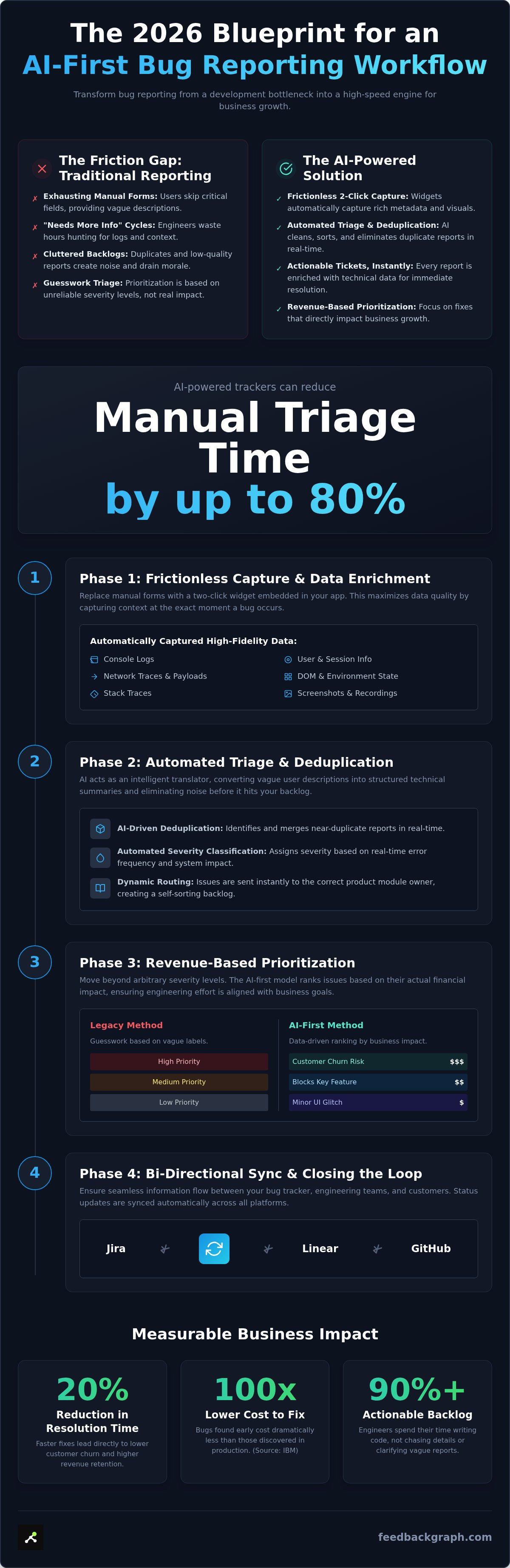
AI-powered bug trackers now reduce manual triage time by up to 80%. This technology makes it possible to streamline bug reporting workflow and finally end the "needs more info" cycles that stall development. You already know the frustration of a backlog cluttered with duplicates and vague reports. It’s a drain on your engineering talent and a direct risk to your product's stability.
This guide provides the 2026 blueprint for an AI-first pipeline that automates everything from capture to code. We will show you how to eliminate manual data entry and prioritize fixes based on their actual revenue impact. You’ll learn to build a self-sorting backlog that connects directly to Jira and Linear through bi-directional sync. By implementing these strategies, you can accelerate resolution times and transform your bug reporting from a bottleneck into a high-speed engine for business growth. We move quickly from technical capture to strategic resolution, ensuring your team stays focused on shipping value.
Key Takeaways
- Replace manual forms with two-click widgets to capture high-fidelity metadata and visual context automatically.
- Deploy AI-driven deduplication to identify near-duplicate reports in real-time and eliminate backlog noise.
- Discover how to streamline bug reporting workflow by ranking issues based on their actual revenue impact rather than arbitrary severity levels.
- Automate the entire triage process to reduce manual intervention by up to 80% and accelerate resolution times.
- Implement bi-directional sync with Jira, Linear, and GitHub to ensure status updates flow seamlessly between engineering and customers.
The Anatomy of a Modern Bug Reporting Workflow
A modern workflow is a high-speed pipeline. It moves from capture to triage, prioritization, and resolution without human friction. While a legacy bug tracking system acts as a static database, a modern architecture functions as an active intelligence layer. Teams that successfully streamline bug reporting workflow processes see immediate gains in engineering velocity. A 20% reduction in resolution time isn't just a vanity metric. In SaaS, this speed correlates directly with lower churn and higher revenue retention. Moving from reactive tracking to proactive management means fixing issues before they impact the broader user base. According to reports from IBM's Systems Sciences Institute, a bug found in production can cost 100 times more to fix than one identified during the design phase. Speed is literally profit.
Why Traditional Bug Reporting Fails in 2026
Manual reporting creates a "Friction Gap" that kills productivity. Users find long forms exhausting. They skip critical fields or provide vague descriptions like "it's broken." This forces engineers into "needs more info" cycles. Developers waste hours hunting for browser logs, OS versions, or specific network requests. This back-and-forth stalls progress and destroys morale. Context switching is expensive. Every time an engineer stops coding to ask for a screenshot, the project timeline slips. Traditional methods rely on human memory and manual effort. Both are unreliable under the pressure of a rapid release cycle. When data is missing, triage becomes guesswork rather than engineering.
The AI-First Workflow Architecture
The AI-first model eliminates manual data entry. It captures "invisible" metadata in the background, including console logs and session recordings. This data enrichment ensures every ticket is actionable the moment it appears in the backlog. AI doesn't just record data; it interprets it. It generates clean, technical issue titles and assigns severity levels based on the actual system impact. This precision is vital for effective bug tracking. By automating the triage layer, you remove the bottleneck of manual review. Dynamic routing then sends the issue to the correct product module owner instantly. The result is a self-sorting backlog where engineers spend their time writing code, not chasing details. It's a methodical approach that replaces chaos with structural integrity.
Phase 1: Frictionless Capture and Data Enrichment
Efficiency starts at the point of discovery. If reporting a bug takes more than a few seconds, your users will simply ignore the glitch and move on. This creates a visibility gap that hides systemic issues until they cause major churn. To truly streamline bug reporting workflow performance, you must eliminate the traditional report form entirely. Proximity to the bug is the most critical factor in data quality. When a report is filed from within the app, the system captures the exact state of the environment. This includes the technical payload that developers actually need: console logs, network traces, and stack traces. Capturing these details manually is impossible for most users, but an AI-first widget handles it in the background, ensuring no critical data is lost in transition.
The Two-Click Capture Strategy
The core of a frictionless capture strategy is reducing user effort while maximizing data output. By using in-app bug reporting for SaaS, you allow users to flag issues with just two clicks. This approach replaces long-form text boxes with automatic visual context. High-resolution screenshots and session recordings are attached instantly, showing engineers exactly what the user saw. This removes the ambiguity of written descriptions. The system also identifies the user automatically through their active session. This eliminates the "who reported this?" emails and allows developers to reference the specific account data without leaving their IDE. If you are ready to remove this friction, you should book a live demonstration of the widget in action.
AI-Powered Report Enrichment
Most user reports are technically incomplete. A user might say "the button is broken," but they don't see the 500 error in the network tab. AI bridges this gap by acting as an intelligent translator. It takes vague natural language and converts it into a structured technical summary. The AI analyzes the system state to determine if the issue is a UI glitch or a critical backend failure. It then applies automated severity classification based on real-time error frequency and system impact. Bug report enrichment with AI eliminates manual data entry by populating every field in your ticket automatically. This ensures that your backlog is filled with actionable engineering tasks rather than mystery novels written by frustrated users.
Phase 2: Automating Triage and Deduplication
Triage is often where development momentum goes to die. In a traditional setup, a product manager or lead engineer spends hours every week manually reviewing tickets. This process is slow, expensive, and prone to human error. To truly streamline bug reporting workflow efficiency, you must automate the decision-making process between capture and code. The primary culprit of backlog bloat is "Backlog Noise," which is the endless stream of duplicate reports that clutter your system. When ten different users report the same checkout error, your team doesn't need ten different tickets. They need one clear signal. AI-powered bug trackers now reduce manual triage time by up to 80%, allowing your team to focus on resolution rather than administration.
Eliminating the Duplicate Ticket Nightmare
Duplicate reports drain engineering resources by forcing developers to investigate issues that are already being solved. AI agents can now identify likely duplicates with 70% to 85% accuracy using embeddings. Instead of waiting for a human to spot a pattern, the system compares every new report against the existing backlog in real-time. It looks beyond simple keywords to understand the underlying technical context. If a new report matches an open issue, the AI automatically clusters them together. This provides a clear view of how many users are affected by a specific bug without creating extra work. For a deep dive into the technical logic behind this process, read our guide on how to deduplicate customer bug reports. This clustering identifies widespread outages instantly, transforming isolated complaints into actionable data points.
AI Triage for Engineering Efficiency
Once duplicates are handled, the system must determine what matters most. AI models achieve 82% to 91% accuracy in predicting bug severity by analyzing project-specific data. This allows the system to distinguish a minor UI glitch from a "System Down" event automatically. The AI then routes the ticket to the correct engineering squad. AI-powered routing achieves up to 85% accuracy on the first try, compared to just 60% for manual processes. This automation also handles the "First Response" to the user, setting immediate expectations based on the calculated priority. By linking customer reports to internal feedback, you gain full visibility into how an issue impacts both your users and your team. This structural integrity ensures that the right developer gets the right data at the right time, every single time.
Phase 3: Revenue-Based Prioritization and Ranking
Legacy systems rely on subjective labels. A "High" priority bug for a free-tier user is fundamentally different from a "High" priority bug blocking a six-figure enterprise account. To truly streamline bug reporting workflow outcomes, you must connect your backlog to your bottom line. This means moving beyond arbitrary severity tags. By quantifying the financial cost of every defect, you transform engineering from a cost center into a value protector. You no longer guess which issues to fix first. You execute based on financial logic that protects your most valuable contracts.
The Revenue Impact Framework
This framework maps every report to the reporter's Lifetime Value (LTV). It calculates "Revenue at Risk" by identifying which bugs affect high-paying accounts or block core conversion paths. If a login error prevents a VIP customer from renewing, the system ranks it above a visual glitch on a low-traffic landing page. Identifying these "VIP Bugs" allows your Customer Success team to provide proactive updates to high-value clients before they even report the issue themselves. You can now prioritize product backlog by revenue automatically. This data-driven approach allows you to justify engineering sprints to stakeholders with clear financial evidence. You aren't just fixing bugs; you're protecting revenue retention and ensuring your highest-paying accounts remain stable.
From Intuition to Data-Driven Roadmaps
In high-scale SaaS environments, PM intuition is a bottleneck. Relying on "gut feel" often leads to over-prioritizing vocal minorities while ignoring silent, high-value churn risks. A modern workflow ranks feature requests alongside bugs by their potential profit. This ensures your roadmap reflects the actual needs of your most valuable customers rather than the loudest ones. Using specialized software for ranking feature requests by revenue allows you to see exactly where your engineering hours yield the highest return. It creates a transparent, evidence-based culture where technical debt is balanced against immediate financial impact. Logic replaces loud opinions. This structural integrity ensures that every developer hour spent on a fix is an investment in the company's financial health.
Phase 4: Bi-directional Sync and Closing the Loop
Efficiency doesn't end when a ticket is created. It ends when the fix is shipped and the user is notified. Many teams focus exclusively on intake, but a one-way push into a developer tool creates a dangerous data silo. To effectively streamline bug reporting workflow operations, your system must maintain bi-directional sync with your engineering stack. This connectivity ensures that when a developer updates a ticket status, that information flows back to the origin point instantly. It creates a single source of truth that spans both product management and engineering. Without this loop, your support team remains in the dark, leading to misaligned expectations and wasted hours on manual status checks.
Integrating with Your Existing Stack
Developers shouldn't have to leave their preferred environment to update a reporter. A modern workflow uses deep integrations to keep data in sync across the entire stack. This structural integrity allows your team to maintain momentum without constant context switching. You can now automate Jira issue creation from feedback to remove manual entry entirely. Key integration benefits include:
- Linear and GitHub Sync: Keep developers in their preferred tools while maintaining visibility for product teams.
- Bi-directional Status Updates: Automatically move issues from "In Progress" to "Resolved" across all platforms.
- Slack Notifications: Trigger real-time alerts for critical bugs to ensure immediate response times.
This level of integration replaces manual coordination with automated logic. It ensures that every stakeholder has access to the same data at the same time.
Automated Customer Communication
Closing the feedback loop is the most effective way to reduce support ticket volume. When a bug moves to "Resolved" in a dev tool, the system should trigger an automatic notification to the affected users. This transparency builds trust and eliminates the repetitive inquiries that often clutter support queues. By providing transparent resolution timelines, you demonstrate a commitment to quality that encourages continued user engagement. Automated communication ensures that the end of the technical workflow is also a positive touchpoint for the customer. It transforms a negative experience, like encountering a software defect, into a demonstration of your team's responsiveness and engineering excellence. This proactive approach is the final step in a truly AI-first bug management strategy.
Accelerate Your Engineering Velocity
The transition to an AI-first workflow is no longer optional for high-growth SaaS teams. You've seen how frictionless capture and automated enrichment eliminate the "needs more info" cycle. By implementing AI-powered deduplication, you remove the noise that clutters your backlog and drains engineering resources. This shift allows your team to focus on high-impact resolution rather than tedious administration. Automated triage ensures that every ticket is actionable from the moment it is captured.
When you streamline bug reporting workflow processes, you gain the ability to prioritize fixes by revenue impact. This ensures your most valuable accounts remain stable while your engineers stay focused in their preferred tools through bi-directional Jira and Linear sync. You aren't just fixing bugs; you're building a structural foundation for rapid, data-driven iteration. Every automated step brings you closer to a zero-manual-entry pipeline that scales with your growth.
High-performing teams don't wait for the backlog to sort itself. They build systems that act as an intelligent partner in the development lifecycle. It's time to replace manual triage with structural integrity and intelligent automation.
Frequently Asked Questions
What is a bug reporting workflow?
A bug reporting workflow is the structured sequence of steps that takes a software defect from discovery to resolution. It typically encompasses capture, triage, prioritization, and the final fix. By using an AI-first approach to streamline bug reporting workflow efficiency, teams replace manual hand-offs with automated data flow. This ensures that every report is enriched with technical context before it reaches an engineer, reducing the friction that usually stalls development and prevents project delays.
How does AI streamline bug triage?
AI streamlines triage by automating the analysis of incoming tickets to determine severity and technical scope. Instead of a human manually reviewing every report, AI models achieve up to 91% accuracy in predicting bug severity based on project-specific data. It interprets natural language descriptions and converts them into structured technical summaries. This automation reduces manual triage time by up to 80%, allowing engineering leads to focus on complex architectural fixes.
Why is deduplication important in bug management?
Deduplication is vital because it prevents the engineering backlog from becoming cluttered with redundant information. When multiple users report the same issue, AI agents use embeddings to identify near-duplicates with up to 85% accuracy. Clustering these reports together provides a clear signal of an issue's widespread impact without forcing developers to investigate ten separate tickets. This structural integrity saves hundreds of hours that would otherwise be wasted on repetitive investigative tasks.
Can I sync customer feedback directly with Jira or Linear?
Yes, you can sync customer feedback directly with Jira, Linear, and GitHub through bi-directional integrations. This ensures that any status change in the developer tool reflects back to the reporter instantly. It's essential for maintaining a single source of truth across product and engineering teams. Bi-directional sync eliminates the need for manual status updates and ensures that your internal feedback loop remains closed, reducing the volume of inquiries sent to support.
How do you calculate the revenue impact of a bug?
Revenue impact is calculated by mapping bug reports to the Lifetime Value (LTV) of the affected users. The system identifies which defects are blocking core conversion paths or impacting high-paying enterprise accounts. This "Revenue at Risk" metric allows teams to prioritize fixes based on financial logic rather than subjective severity labels. It transforms the backlog into a value-protection engine, ensuring that your highest-paying customers receive the most stable product experience possible.
What technical data should be included in a high-quality bug report?
A high-quality report must include console logs, network traces, stack traces, and environment metadata like OS and browser versions. Visual context, such as automatic screenshots or session recordings, is also essential for rapid reproduction. AI-first tools capture this "invisible" data in the background during the initial report. This technical payload eliminates the need for back-and-forth communication, providing engineers with everything they need to resolve the issue on the first try.
How do I reduce engineering backlog noise?
Reducing backlog noise requires automated deduplication and revenue-based ranking to filter out low-value or redundant tasks. By deploying AI agents to cluster related issues, you prevent the same bug from appearing as multiple separate work items. This approach ensures that your engineers only see unique, actionable, and prioritized tickets. It's a proven way to streamline bug reporting workflow performance, allowing the team to focus exclusively on items that deliver the highest technical return.
Is a two-click widget better than a traditional bug report form?
A two-click widget is significantly better because it removes the friction that causes users to ignore bugs. Traditional forms are time-intensive and often result in vague, incomplete data. A widget captures high-fidelity metadata and visual context automatically while the user stays within the app. This proximity to the bug ensures data accuracy and increases report volume. It turns every user into a precise technical reporter without requiring them to write a single line of text.


