

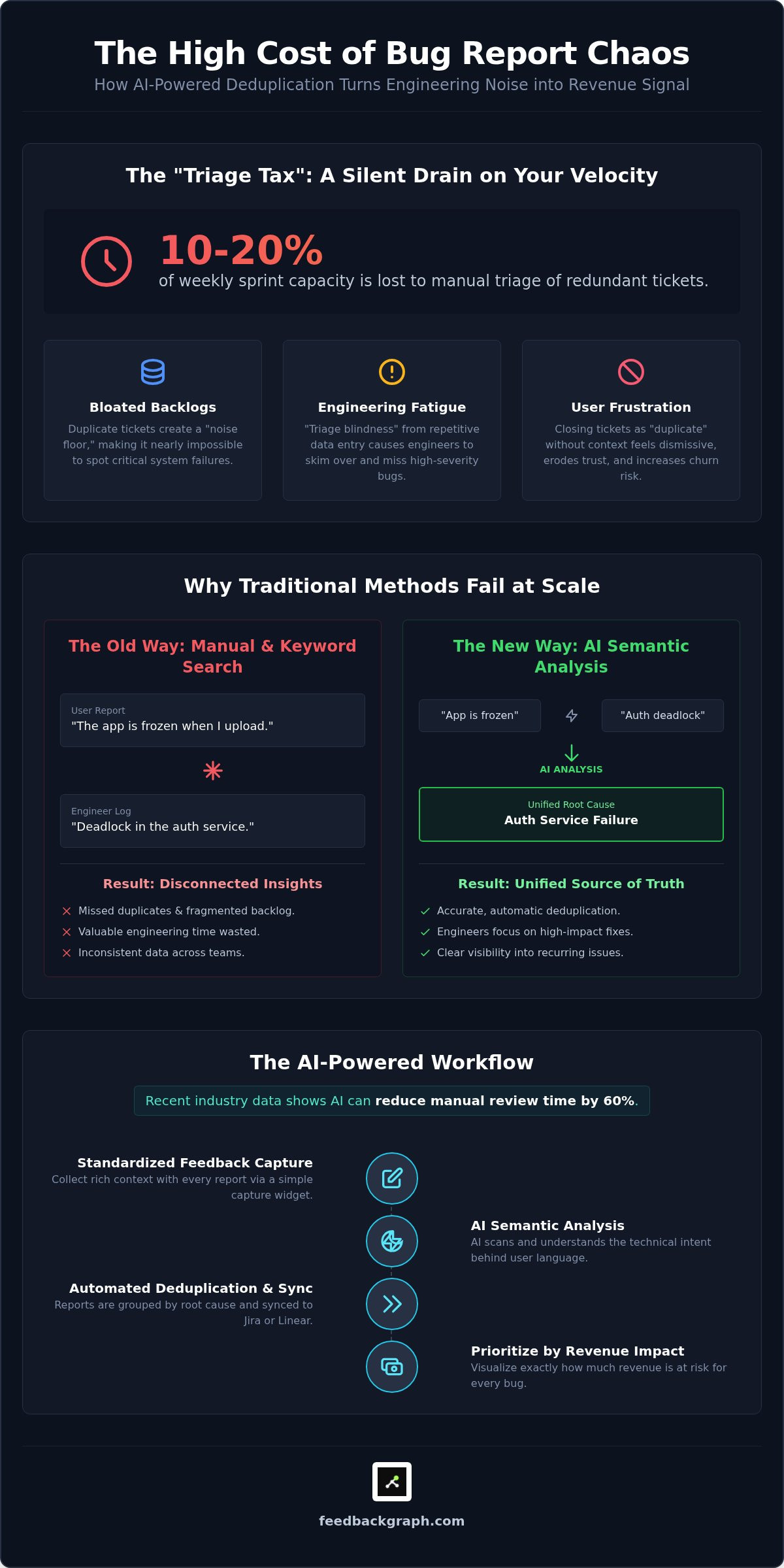
Recent industry data shows that AI-powered triage systems can reduce manual review time by 60%. If your engineering team spends more hours closing redundant tickets than shipping features, you're paying a heavy tax on your velocity. Most backlogs are currently bloated with "me too" reports and fragmented logs that obscure critical system failures. You need a precise, automated way to deduplicate customer bug reports without forcing a senior developer to manually audit every incoming ticket.
It's exhausting to watch your roadmap stall because of triage burnout. You likely already know that a cluttered backlog leads to missed regressions and frustrated customers who feel ignored when their issues disappear into a black hole. This guide promises to solve that friction by leveraging AI-driven semantic analysis to clean your workspace. We'll explore how to automate ticket routing to Jira or Linear and use revenue-impact data to prioritize fixes. You'll move from reactive firefighting to a streamlined, evidence-based workflow that protects your team's time and your company's bottom line.
Key Takeaways
- Quantify the triage tax on your team by identifying how redundant tickets obscure high-severity issues in a bloated backlog.
- Transition from flawed keyword matching to AI-driven semantic analysis to accurately deduplicate customer bug reports based on technical intent.
- Standardize your feedback loop with a two-click capture widget to provide the rich context AI needs for instant backlog scanning.
- Automate your engineering workflow by syncing deduplicated insights directly into Jira or Linear to eliminate manual spreadsheets.
- Use deduplication to aggregate user feedback and visualize exactly how much revenue is at risk for every reported bug.
The Hidden Cost of Duplicate Customer Bug Reports
Every duplicate ticket is a micro-leak in your engineering budget. When multiple users report the same UI glitch using different language, your triage team spends valuable cycles reading, verifying, and manually linking them. This "triage tax" isn't just an administrative annoyance; it's a direct hit to your velocity. A modern bug tracking system is designed to organize tasks, yet without a way to effectively deduplicate customer bug reports, these systems quickly turn into data graveyards.
The problem scales faster than your team can hire. As your user base grows, the volume of redundant feedback increases exponentially. Redundant tickets mask high-severity issues. They create a "noise floor" that makes it nearly impossible to hear the signal of a critical system failure. Beyond the technical debt, there's a significant customer experience failure. Closing a ticket as a "duplicate" without providing context or a timeline feels dismissive. It tells your users that their specific friction is just another number in a bloated queue. This lack of transparency erodes trust and turns power users into churn risks.
Engineering Fatigue and Triage Bottlenecks
Manual triage often steals 10% to 20% of weekly sprint capacity. This isn't just lost time; it's a source of deep friction between support and engineering teams. When engineers spend their mornings cleaning up repetitive data, they experience "triage blindness." They stop analyzing reports with a critical eye and start skimming. This fatigue is exactly where real bugs are ignored. The inability to deduplicate customer bug reports automatically forces your most expensive talent into low-value data entry. A critical security flaw can easily be dismissed as another minor UI duplicate when the person triaging is overwhelmed by a thousand-line backlog. You don't just lose time; you lose the ability to distinguish a nuisance from a crisis.
The Fragmented Feedback Loop
Data silos are the natural result of unlinked bug reports. When your support team uses one tool and engineering uses another, the context gets lost in the gap. Many teams try to solve this with manual spreadsheets, but these are the ultimate enemy of SaaS scaling. They're static, prone to error, and impossible to keep in sync with real-time development. Breaking these silos requires a unified approach to bug tracking that links every report to a single source of truth. This lack of visibility prevents stakeholders from seeing recurring issues. Instead of identifying a single bug that threatens your revenue, leadership sees fifty unrelated tickets. You can't prioritize what you can't see, and you can't see clearly through the fog of a fragmented backlog.
Why Manual Deduplication Methods Fail in 2026
Manual search is a relic of low-volume development. It doesn't scale. Relying on human intuition to deduplicate customer bug reports is a recipe for a fragmented, unmanageable backlog. When your backlog grows past 100 active issues, your team's ability to recognize patterns through memory alone evaporates. Different engineers have different mental models; one might see a duplicate, while another thinks they've discovered a new edge case. This inconsistency leads to a split backlog where the same root cause is being investigated by two different people simultaneously, doubling your cost of discovery.
Keyword matching is the most common failure point in traditional workflows. A user might report that "the app is frozen," while an engineer logs a "deadlock in the auth service." These are the same issue, but a standard search bar won't bridge that linguistic gap. Academic research into how surveyed bug prioritization works confirms that manual classification is often the weakest link in the software lifecycle. You're essentially asking your team to be human search engines, which is an expensive and inefficient use of high-level technical talent.
The Limitations of Keyword-Based Search
Linguistic variance makes simple search tools ineffective. Technical and non-technical users describe friction differently. A developer might search for "CORS policy error," while a customer reports "I can't upload my profile picture." Simple keyword search requires the triager to guess every possible synonym, which is impossible at scale. This leads to missed duplicates and a bloated database. Tagging systems often exacerbate the problem. Without strict governance, your team will end up with ten different tags for the same UI glitch, creating more confusion than clarity.
Customer Frustration and Dead-End Tickets
Manual deduplication often results in silent ticket closures. When an engineer finds a duplicate, they often close it and move on to the master ticket. The original reporter is left in the dark, wondering if their feedback was ignored. This is a massive hit to customer retention. Support teams then waste hours re-explaining the same issues to frustrated users because they lack a linked history of the bug. If you're ready to stop the manual churn, you can see how AI handles this automatically to keep your customers informed without the manual overhead.
How AI and Semantic Analysis Automate Deduplication
AI doesn't just read words; it understands intent. By using Large Language Models (LLMs), modern triage systems can recognize that "authentication failure" and "I can't sign in" describe the same underlying technical failure. This transition from simple string matching to semantic similarity is the foundation of an efficient AI-driven triage process. To effectively deduplicate customer bug reports, AI analyzes the latent meaning within the text, technical logs, and user behavior patterns. Recent research on automated duplicate bug report detection highlights how vectorization allows for instant comparison across thousands of tickets. Semantic deduplication is the process of mapping disparate user inputs to a single technical root cause based on shared intent and behavior.
Clustering algorithms group these vectorized reports into logical buckets. Instead of a flat list of 500 tickets, your team sees 10 distinct clusters. Each cluster represents a unique problem, with all related user reports nested underneath. This structure allows for automated triage, where the system routes every duplicate to a single "master" issue. This consolidation ensures that all user context, screenshots, and logs are accessible in one place. Engineers can finally stop hunting for scattered information and start fixing the root cause.
From Keyword Matching to Semantic Similarity
Vectorization transforms text into numerical data that represents concepts rather than characters. This allows the AI to calculate a "distance" between reports. If two reports are conceptually close, the system flags them as duplicates instantly. This happens in milliseconds, regardless of whether the user is a senior developer or a first-time customer. You no longer need to rely on perfect tagging or specific terminology to keep your backlog clean.
AI Enrichment: Generating Clarity from Chaos
Raw customer feedback is often messy and inconsistent. AI acts as a professional translation layer. It generates standardized, technical summaries for diverse inputs and automatically classifies severity based on the described impact. Modern AI bug reporting tools clean this data at the source. This enrichment ensures that every ticket entering your system is structured and actionable. Automated severity classification prevents low-priority UI tweaks from drowning out critical service outages, keeping your team focused on what actually moves the needle.
Implementing an Automated Deduplication Workflow
Moving from manual triage to an automated system requires a structural shift in how your team processes incoming data. The goal is to create a straight line from the moment a user encounters friction to the moment an engineer starts a fix. A streamlined workflow ensures that your team doesn't just manage the chaos; they eliminate it. By following a structured, AI-driven sequence, you can deduplicate customer bug reports before they ever reach your primary development backlog.
The process begins with standardized data capture. When you rely on emails or loose Slack messages, you get fragmented information that is impossible for a machine to parse effectively. Standardizing the input at the source is the only way to scale your triage efforts without hiring more coordinators. This structured data then feeds into an intelligent scanning layer that acts as a gatekeeper for your engineering team.
Integrating Feedback Capture with Dev Tools
The first step is replacing long, ambiguous email chains with a two-click capture widget. This tool allows users to report issues directly within your application, ensuring that every submission is accompanied by essential technical metadata. When you connect customer feedback to dev tools, you automatically capture the reporter's OS, browser version, and console logs. This technical context is vital for the AI to accurately deduplicate customer bug reports. It looks beyond the user's description and compares the underlying system state to existing issues in your backlog. If a near-match is found, the system flags it instantly, preventing a new, redundant ticket from being created.
Bi-directional Sync: Closing the Feedback Loop
Efficiency doesn't stop at the point of capture. Once a report is identified as a duplicate, it must be linked to a master ticket in Jira or Linear. This creates a single source of truth for the engineering team while maintaining a record of every affected user. The real power lies in the "sync back" mechanism. When an engineer moves a ticket from "In Progress" to "Fixed" in Jira, the system automatically updates the status for every linked reporter across Slack, email, or your support portal. This Jira feedback sync ensures that no customer is left in the dark. Implementing this bi-directional flow can reduce support ticket volume by 40% by eliminating the need for manual status check-ins. You stop wasting time on repetitive updates and start focusing on shipping code.
FeedbackGraph: Turning Bug Report Noise into Revenue Signal
Deduplication is the first step toward strategic prioritization. While traditional tools focus on the "what," FeedbackGraph focuses on the "how much." By aggregating every duplicate report into a single technical issue, the platform reveals the total dollar value currently at risk. This visibility allows product leadership to stop guessing and start making evidence-based decisions. You move from counting tickets to measuring revenue impact. To effectively deduplicate customer bug reports is to unlock a clear, profit-led view of your product health.
The AI triage dashboard provides a high-level overview for product leadership. It doesn't just show a list of bugs; it shows a prioritized map of friction points. You can see which clusters are affecting your highest-value accounts and which regressions are driving the most support volume. This transformation of raw data into actionable intelligence ensures that your engineering resources are always allocated to the tasks that protect your bottom line. You stop firefighting and start building with confidence.
Two-Click Capture and Automated AI Triage
The process starts with a two-click capture widget that eliminates friction for your users. Unlike manual forms that lead to vague descriptions, FeedbackGraph features ensure that every report is enriched with technical context from the moment it's submitted. The system applies instant deduplication logic before your engineering team ever sees the ticket. This gatekeeping mechanism prevents backlog bloat and ensures that your developers only interact with unique, high-quality data. For high-growth SaaS teams, this automation is an essential partner that maintains velocity even as the user base scales.
Prioritizing Fixes Based on Real-World Revenue Impact
A clean backlog is only valuable if it leads to the right decisions. FeedbackGraph allows you to rank feature requests and bugs by revenue, turning your development queue into a profit-first roadmap. By linking your CRM data with your bug reports, the system automatically calculates the financial weight of every issue cluster. You can instantly see if a recurring UI glitch is affecting $50,000 in recurring revenue or just a handful of free-tier users. This clarity allows you to deduplicate customer bug reports and prioritize their resolution based on actual business value rather than the loudest voice in the room.
Ready to eliminate the noise and focus on what drives growth? Start your free trial of FeedbackGraph and transform your triage process into a revenue engine.
Reclaim Your Engineering Velocity
Manual triage is a hidden tax on your product roadmap. By the time your team identifies a duplicate report, you've already lost the momentum required to fix the root cause. Transitioning to an automated system allows you to deduplicate customer bug reports instantly. This process transforms a chaotic backlog into a structured, revenue-led priority list. You gain more than just a clean workspace; you gain the visibility needed to protect your highest-value accounts.
Success in modern software development requires a frictionless feedback loop. The two-click capture widget and bi-directional Jira and Linear sync allow your team to move from reactive firefighting to proactive quality assurance. AI-powered revenue impact ranking ensures that every sprint cycle delivers maximum business value. Stop letting redundant tickets obscure your critical path.
Your engineering team's time is too valuable for manual data entry. Start building a more efficient, data-driven development cycle today.
Frequently Asked Questions
How does AI deduplicate customer bug reports without losing important details?
AI uses semantic analysis to group reports by technical intent rather than just matching text strings. It preserves unique context, such as specific logs, browser versions, and screenshots, by nesting these details under a single master ticket. This structure ensures that engineers have access to every piece of evidence while the primary backlog remains clean and manageable.
Can I sync deduplicated reports directly into Jira or Linear?
Yes, FeedbackGraph provides bi-directional sync with Jira, Linear, and GitHub to keep your development workflow unified. When the AI identifies a duplicate, it automatically links the new feedback to the existing issue in your project management tool. This prevents redundant ticket creation while ensuring that all user context is visible to the developer assigned to the fix.
What is the difference between keyword matching and semantic deduplication?
Keyword matching relies on exact character strings, which often fails when a user says "app won't start" while an engineer logs a "bootloader exception." Semantic deduplication uses Large Language Models to understand the underlying concept of a report. It recognizes that different language can describe the same technical failure, allowing the system to accurately deduplicate customer bug reports that traditional search tools would miss.
How much time can my engineering team save with automated bug triage?
Most teams reduce their manual triage time by 60% after implementing an automated system. By eliminating the need for a senior engineer to manually audit and link every incoming ticket, you reclaim 10% to 20% of your weekly sprint capacity. This shift allows your most expensive talent to focus on shipping features rather than performing administrative data cleanup.
Does deduplicating bug reports help with product prioritization?
Deduplication is the foundation of evidence-based prioritization. By clustering related reports, you can see the true volume and severity of an issue rather than looking at scattered, individual tickets. This visibility ensures that your team tackles the bugs that are causing the most friction for your user base first.
What happens to the customer when their bug report is marked as a duplicate?
Customers stay informed through automated status updates driven by bi-directional sync. Instead of their report vanishing into a "closed" status, it is linked to the active master ticket. When an engineer resolves the issue in Jira or Linear, the system automatically notifies every linked reporter, closing the loop without manual intervention from your support team.
Is it possible to track the revenue impact of duplicate bug reports?
FeedbackGraph connects with your CRM to calculate the total financial weight of every bug cluster. By aggregating duplicates, the system shows you the exact dollar value of recurring revenue at risk for any specific technical failure. This allows you to deduplicate customer bug reports and prioritize fixes based on their actual impact on your bottom line.
How do I get started with automated bug deduplication?
You can get started by deploying the two-click capture widget and connecting your existing dev tools. The AI immediately begins scanning your backlog to identify near-matches and cluster related issues. There is no need for custom software development or complex on-premise installation to begin cleaning your backlog.


