

What if every Slack ping, support ticket, and spreadsheet row was actually a line item in your next revenue report? Most product managers lose hours every week drowning in a sea of vague bug reports and conflicting feature requests. You know the frustration of trying to figure out how to manage product feedback when the data is scattered across five different platforms. Engineering ignores the noise. You're left guessing which feature will actually move the needle for your biggest accounts.
It's time to stop paying the manual triage tax and start building with technical precision. This guide shows you how to transform that chaotic backlog into a high-velocity, revenue-focused roadmap using automated AI workflows. We'll explore how to deduplicate entries instantly, rank requests by actual customer value, and keep users updated without manual intervention. You'll learn how to deploy a clean, data-driven system that turns feedback into your most powerful growth engine.
Key Takeaways
- Transition from manual spreadsheets to an automated pipeline to handle feedback volume as your user base scales.
- Eliminate the manual "triage tax" by learning how to manage product feedback with AI-driven deduplication and severity scoring.
- Prioritize your roadmap based on financial signal rather than upvotes by linking feature requests to Customer Lifetime Value (CLV).
- Stop the "black hole" effect by automating status updates through bi-directional syncs with Jira and Linear.
- Ensure high-quality reporting by implementing the "Two-Click" rule for frictionless customer bug and feature capture.
The Evolution of Product Feedback Management in 2026
Product feedback management has undergone a radical transformation. It's no longer about collecting requests in a static, dusty bucket. Modern teams treat it as an automated pipeline. If you're still wondering how to manage product feedback using manual entry or disconnected forms, you're already behind. High-velocity teams now use AI to ensure every customer data point flows directly into a decision engine. This shift from passive storage to active intelligence is what separates market leaders from those struggling to keep up.
Manual spreadsheets are where good ideas go to die. Once your product reaches 50 monthly active users, these documents become unmanageable. They create "Feedback Debt," a hidden cost that drains engineering velocity. Developers waste hours chasing missing context or asking for screenshots. In 2026, the focus has shifted from qualitative "vibes" to quantitative, revenue-driven metrics. Unlike legacy Enterprise Feedback Management (EFM) systems designed for static reporting, modern pipelines prioritize immediate action and structural integrity.
Why Traditional Feedback Loops Are Breaking
Fragmentation kills progress. Currently, feedback lives everywhere: Slack, Zoom transcripts, email threads, and support tickets. Without a central hub, context disappears. Engineering teams often reject bug reports because they lack logs or clear reproduction steps. This creates a friction-filled cycle where the "Squeaky Wheel" bias takes over. You end up building for the loudest customer, not the one contributing the most to your annual recurring revenue. Learning how to manage product feedback in a high-growth environment means moving from intuition to automation.
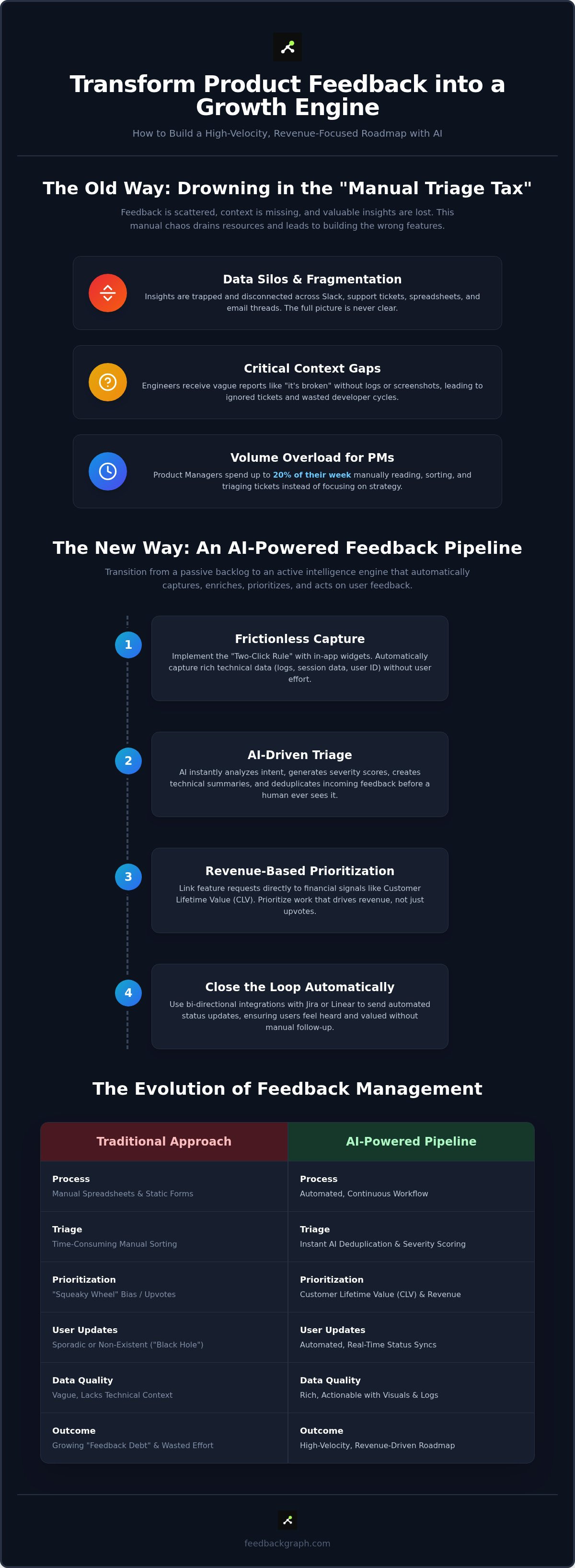
- Data Silos: Insights are trapped in tools that don't talk to each other.
- Context Gaps: Engineers receive vague descriptions instead of technical data.
- Volume Overload: PMs spend 20 percent of their week just reading tickets.
The AI-First Feedback Framework
Solving these issues requires a shift to an AI-first framework. It starts with frictionless capture. If a user has to leave your app to report a bug, they won't do it. A two-click capture widget ensures high-quality data entry without interrupting the user journey. Next, AI enriches every submission. It doesn't just store text; it analyzes intent. It generates severity scores, creates technical summaries, and identifies duplicates before a PM even sees the ticket.
Finally, the system routes these insights. It connects feedback directly to your engineering backlog in Jira or Linear. This creates a transparent loop where status updates are automated. You stop guessing what to build next. You start building what pays. By using bi-directional integrations, you ensure that every customer who provides feedback feels heard without requiring a manual reply from your team. It's a faster, more professional way to scale.
Step 1: Implementing Frictionless Feedback Capture
Friction is the primary killer of actionable data. If you want to master how to manage product feedback, you must respect the "Two-Click" rule. If a user spends more than ten seconds finding a report button or navigating to an external portal, they'll abandon the effort. You lose a critical data point. Your engineering team loses a chance to fix a silent churn driver. High-growth teams don't wait for users to find them; they make the reporting process an invisible part of the user journey.
In-App Widgets vs. Email Support
Legacy feedback systems often rely on external portals or generic email support. This creates a massive context switch. Users don't want to leave your product to tell you it isn't working. In-app widgets solve this by capturing feedback directly within the UI. They don't just collect text; they automatically scrape browser metadata, OS versions, and user IDs. This technical depth is essential for modern PMs who need to evaluate, design and implement machine learning applications to process incoming signals. Implementing a customer feedback widget for Jira ensures that these rich technical details flow directly to the people who can fix the problem.
Capturing High-Quality Bug Reports
Engineering teams routinely ignore tickets that simply say "it is broken." These vague reports are a waste of resources. High-quality capture requires visual context. Screenshots and session data are non-negotiable in 2026. If a report lacks a visual reference, it shouldn't reach the backlog. AI-first widgets now prompt users in real-time for missing information. If a user submits a feature request without explaining the business impact, the AI asks for clarification on the spot. This ensures your backlog remains clean and actionable from the start. Understanding how to manage product feedback effectively means ensuring every ticket is "dev-ready" before it's even triaged.
Your internal teams are equally vital sources of intelligence. Sales and Success teams in India's competitive SaaS market hear feature requests during every demo and check-in. They shouldn't have to fill out complex forms. By integrating internal feedback loops into their existing workflows, you capture high-intent requests without slowing them down. This creates a unified stream of data that balances customer pain with commercial opportunities. To see how this looks in practice, you can explore a live capture workflow today and see the difference in data quality.
Step 2: Automating Triage and Deduplication with AI
Manual backlog grooming is a hidden productivity killer. Most product managers in India's high-growth tech hubs spend up to 20 percent of their week simply reading through tickets. This is the "Triage Tax." It's the time lost to repetitive administrative tasks that should be automated. If you're still trying to figure out how to manage product feedback by reading every single support ticket or Slack message, you're creating a bottleneck for your entire engineering team. In 2026, triage is no longer a human job; it's an AI automation problem.
Effective AI bug triage removes the friction between identifying a problem and fixing it. By the time a PM opens their dashboard, the AI has already enriched the data, removed the noise, and prepared the ticket for a developer. This level of systematic feedback integration ensures that engineering velocity remains high while feedback debt stays low.
Eliminating the Duplicate Nightmare
Duplicate reports are the primary cause of backlog bloat. When multiple users report the same issue using different phrasing, manual systems fail. One user might report a "login lag," while another mentions "slow authentication." AI uses vector embeddings to analyze the semantic meaning behind these words. It recognizes that these are the same issue, regardless of the language or specific terminology used. AI deduplication is the process of merging semantic matches into a single source of truth. By grouping these related issues into "Master Themes," you can see the true scale of a problem without wading through hundreds of identical tickets. This allows for cleaner roadmap planning and more accurate prioritization.
Generating Actionable Engineering Data
Engineering teams need data, not rants. A typical customer feedback entry might be a three-paragraph explanation of a user's frustration. Developers don't have time to parse that. AI-powered summary generation transforms these messy inputs into clean, one-sentence bug titles. It extracts the core technical issue and discards the fluff. Beyond just summarizing, the system performs automated severity classification. By analyzing user sentiment and the reported system impact, the AI assigns a priority level instantly. This ensures that a critical payment failure is flagged higher than a minor UI alignment issue in a secondary menu. For a deeper look at these technical workflows, refer to our SaaS product feedback system guide. This automation ensures that how to manage product feedback becomes a solved problem, allowing your team to focus on building features that drive revenue.
Step 3: Prioritizing Feature Requests by Revenue Impact
Upvoting is a vanity metric that often leads to poor product decisions. It treats every user as equal, ignoring the financial weight of their feedback. If you're building based on raw vote counts, you're likely ignoring your most valuable customers. To master how to manage product feedback, you must connect every ticket to your CRM data. A feature request from a trial user doesn't carry the same weight as a bug report from an enterprise account contributing ₹8,00,000 in Annual Recurring Revenue (ARR). Popularity is not a strategy; profitability is.
Prioritization requires identifying at-risk revenue with technical precision. When high-value accounts report recurring bugs, your system should flag these as high-priority retention items immediately. This model balances "Innovation" features that attract new leads with "Retention" fixes that keep existing revenue secure. You stop guessing and start calculating. Without this link, your roadmap is just a list of guesses. By quantifying the financial impact of every request, you transform the product team from a cost center into a direct driver of growth.
The ROI of Every Backlog Item
Every item in your backlog should have a price tag. By mapping feedback directly to customer spend, you gain instant visibility into the total ARR behind every request. This allows you to prioritize features that unlock specific market segments or prevent high-value churn. For specific calculation formulas on weighting these requests, see our Revenue-Based Feature Ranking guide. It's the only way to ensure your engineering resources are spent on high-yield tasks that directly impact the bottom line.
Data Over Intuition
Intuition is expensive and often wrong. Objective revenue data gives you the leverage to say "no" to low-value requests from the "squeaky wheels" without causing internal friction. You can use specific bug tracking use cases to justify technical debt removal to your board or stakeholders. When you can prove that fixing a specific set of bugs protects ₹20,00,000 in revenue, the conversation shifts from "nice-to-have" to "business-critical." Revenue-based ranking aligns product goals with business outcomes by ensuring every sprint delivers measurable financial value. It's the ultimate framework for anyone learning how to manage product feedback at scale.
Step 4: Closing the Loop with Bi-directional Integrations
The "Black Hole" effect is the silent killer of customer engagement. When users submit detailed bug reports or feature requests and hear nothing back, they stop contributing. You lose your most valuable source of field intelligence. Mastering how to manage product feedback effectively requires a closed loop where communication is the default, not an afterthought. In 2026, manual status emails are obsolete. You need a system that communicates directly with your engineering environment to keep stakeholders informed without manual intervention.
Technical teams now use an MCP server for product management to bridge the gap between AI agents and developer tools. This infrastructure ensures that the insights gathered during triage don't just sit in a dashboard. They become active triggers for development. By creating a direct link between the customer's voice and the developer's workspace, you eliminate the friction that usually slows down high-growth SaaS companies in India's competitive market.
Connecting Feedback Directly to Dev Workflows
Enriched feedback must trigger Jira or Linear issue creation automatically. There's no room for manual copy-pasting in a high-velocity environment. When a report is verified and ranked, it should appear in the engineering backlog with all its technical metadata intact. If you're building developer-centric products, mapping the customer voice directly to GitHub issues is a requirement for maintaining transparency. This creates a single source of truth for both product managers and engineers. For a deeper technical dive into these setups, learn more about connecting feedback to dev tools. This integration ensures that every ticket includes the revenue context established in previous steps, so developers know exactly why a task is prioritized.
The Automated Status Update
Trust is built through transparency. When an engineer moves a task from "In Progress" to "Done" in Linear, the original reporter should know instantly. Bi-directional sync automates the "Shipped" notification, closing the loop without a single manual email from your Success team. This transparency shows users their direct impact on the roadmap and encourages future participation. It turns a one-sided reporting process into a collaborative partnership. By automating these status changes, you eliminate the administrative burden that usually falls on PMs every Friday. You focus on shipping code while the system handles the communication. It's the final, essential step in understanding how to manage product feedback for long-term growth.
Build the Future of Your Product with Data-Driven Certainty
Static feedback buckets are a liability in a high-velocity market. You've seen how to eliminate the triage tax by automating deduplication and enriching messy user data with technical precision. Mastering how to manage product feedback in 2026 means moving beyond intuition and letting revenue data guide every sprint. By linking your backlog directly to ARR impact, you ensure your engineering resources are always focused on high-yield growth rather than the loudest voices.
Transparency is your competitive advantage. Bi-directional syncs with Jira and Linear remove the administrative burden of manual updates while building deep trust with your users. You can eliminate 90 percent of manual triage time and rank your backlog by actual financial signal. It's time to turn your feedback loop into an automated revenue engine that scales with your ambition.
Your team deserves a roadmap backed by evidence. Start building with technical precision and structural integrity today.
Frequently Asked Questions
How do you manage a large volume of product feedback without a huge team?
You automate the administrative layer using AI triage. By deploying an intelligent pipeline, you can deduplicate thousands of entries and enrich them with technical context before a human ever sees them. This removes the manual triage tax that typically consumes 20 percent of a PM's week. It allows small teams to maintain a clean, high-velocity backlog regardless of incoming data volume.
What is the best way to prioritize feature requests from customers?
The most effective method is revenue-based ranking. Instead of relying on misleading upvotes, you link every request to actual account value or Annual Recurring Revenue (ARR). This provides an objective financial signal for your roadmap. It ensures you build features that protect high-value accounts and drive growth rather than just satisfying the loudest users.
How do you handle duplicate bug reports automatically?
AI uses vector embeddings to identify semantic matches between different reports. It recognizes that "login is slow" and "authentication lag" refer to the same underlying issue. The system merges these into a single master theme automatically. This prevents backlog bloat and gives you an accurate count of how many users are affected by a specific problem.
Should I use a public feedback portal or an in-app widget?
In-app widgets are superior for high-growth SaaS products because they reduce friction. Users are more likely to provide high-quality data if they don't have to leave your UI. Widgets also capture critical browser metadata and user IDs automatically. This provides engineers with the technical context they need to reproduce bugs without back-and-forth emails.
How do I connect customer feedback to Jira or Linear?
You implement bi-directional integrations to sync data between your feedback tool and your engineering environment. This ensures that how to manage product feedback stays aligned with your actual development sprint. When a developer moves a ticket to "Done," the status update should flow back to your feedback dashboard and the original reporter instantly.
How do you measure the revenue impact of a specific bug report?
You map the reporter's user ID to their account spend in your CRM. If a customer contributing ₹1,00,000 in ARR reports a critical failure, that ticket is prioritized over lower-value requests. This data-driven approach allows you to justify technical debt removal by proving exactly how much revenue is at risk if a bug remains unfixed.
How do you close the feedback loop with customers effectively?
Automate your "Shipped" notifications through status syncing. When an issue is resolved in your dev tool, the system should trigger a notification to every user who reported or upvoted that item. This transparency proves that you value their input. It encourages future engagement without requiring manual outreach from your Success or Product teams.
What is AI bug triage and how does it work?
AI bug triage is an automated process that enriches messy user submissions into dev-ready tickets. It analyzes the sentiment and technical content of a report to assign severity levels and generate concise summaries. It acts as a smart layer between the user and your backlog. This ensures that engineers only receive actionable, high-priority tasks that are ready for immediate development.


