

Research indicates that up to 80% of software features are rarely or never used. This represents a massive drain on engineering resources that could have generated millions of ₹ in additional revenue for your business. You likely feel the constant pressure of a bloated backlog and the influence of the "loudest voice" in the room, yet you lack the hard data to push back. It is exhausting to watch your team burn out on low-impact tasks while high-value opportunities slip away because you cannot quantify their worth.
You deserve a system that links every development ticket to your bottom line. This guide will show you how to transform your chaotic list into a profit-led roadmap by mapping feedback directly to revenue data using AI-driven triage. By building a truly customer-driven product backlog, you will finally align your product and sales teams with surgical precision. We will walk through the exact steps to rank features by their specific value in ₹ (INR), ensuring every engineering hour delivers a measurable ROI and clear strategic impact.
Key Takeaways
- Learn how to link every backlog item to MRR and retention metrics to ensure your roadmap drives measurable growth.
- Master the Revenue Impact Formula to quantify the financial value of features in ₹ and justify engineering spend.
- Build a high-signal customer-driven product backlog by using AI-driven triage to deduplicate feedback and eliminate noise.
- Replace subjective RICE scoring with objective revenue data to move from speculative "Impact" guesses to financial facts.
- Discover how to automate your profit-led roadmap with bi-directional integrations that keep sales and customers in sync.
The Crisis of the "Everything is a Priority" Backlog
The standard product backlog has become a liability for most SaaS companies. By 2026, the sheer volume of feedback across Slack, email, and support tools has outpaced manual triage capabilities. Most product managers are buried under a mountain of unranked tickets. This noise masks the signals that actually drive growth. When every request is marked "high priority," nothing truly is. You are left with a stagnant list that reflects the loudest voices rather than the most profitable ones.
A revenue-led backlog is the only technical remedy. It is a dynamic list where every item is ranked by its impact on Monthly Recurring Revenue (MRR) and retention. Without this financial clarity, teams fall victim to the HiPPO (Highest Paid Person's Opinion). Senior stakeholders often push pet projects based on intuition rather than evidence. This derails product growth and forces engineers to build features that no one actually pays for. It creates a "customer-driven product backlog" in name only, serving the ego of a few instead of the needs of the market.
The hidden cost of this noise is devastating for engineering velocity. Low-impact bugs and "nice-to-have" requests drain your most expensive resources. When developers spend their sprint on tasks that don't generate value, morale plummets. They want to build things that move the needle. Linking every task to ₹ (INR) values gives the team a clear mission and a reason to ignore the distractions.
Symptoms of a Misaligned Backlog
You can identify a failing backlog by the presence of "zombie features." These are tools built because of a single stakeholder request that now require constant maintenance but drive zero growth. You might also notice a widening gap between sales promises and engineering output. If your sales team is losing deals because the roadmap is filled with low-value tasks, your priorities are misaligned. This eventually leads to feedback fatigue. When the backlog feels like a black hole, your internal teams stop providing the insights you need to stay competitive.
The Shift to Profit-First Product Management
Sustainable growth in 2026 demands a move from generic customer-centricity to aggressive revenue-centricity. You must know the exact account value behind every feature request before it reaches a developer. This requires injecting real-time revenue data directly into your development workflow. AI acts as the essential bridge here. It automates the triage of raw feedback, deduplicates requests, and assigns a financial weight to every ticket. This process ensures your team focuses on the ₹10,00,000 opportunities instead of the ₹1,000 distractions, turning your backlog into a profit engine.
How to Quantify Revenue Impact for Every Backlog Item
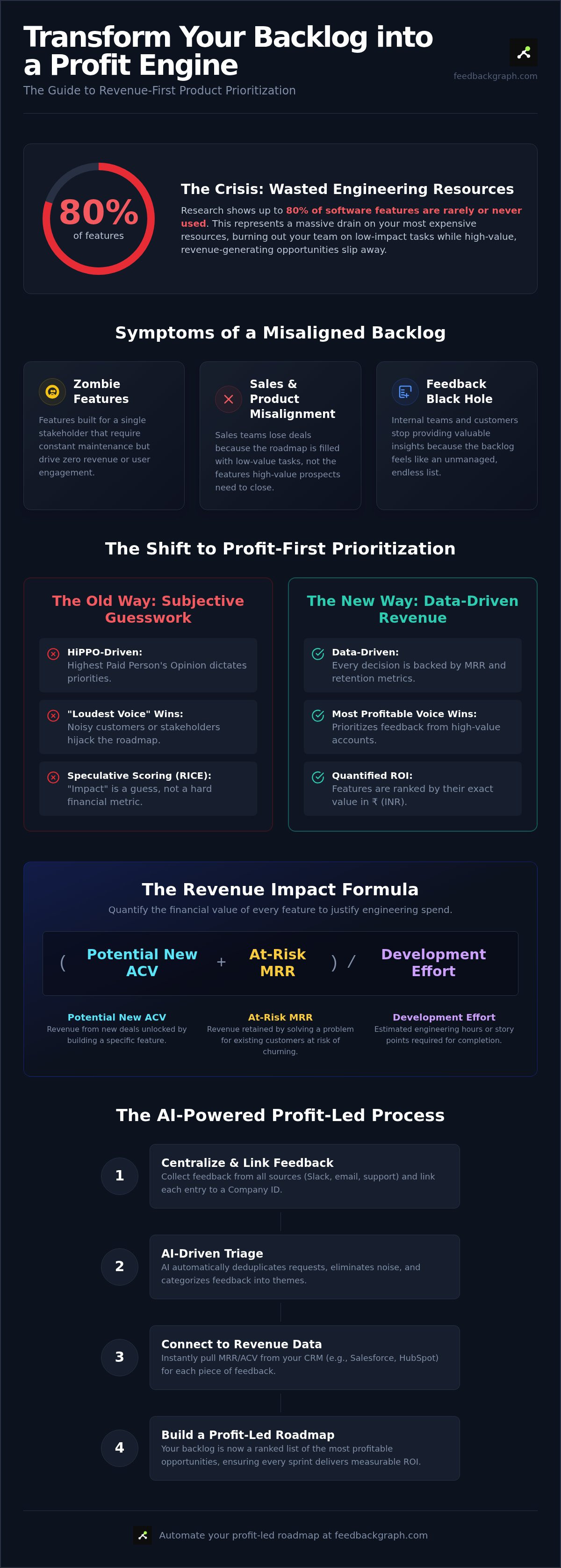
Quantifying impact transforms a chaotic list into a surgical roadmap. You cannot rely on gut feelings or the volume of requests alone. You need a mathematical foundation. The Revenue Impact Formula provides this clarity: (Potential New ACV + At-Risk MRR) divided by Development Effort. This formula yields a specific value in ₹ (INR) for every engineering hour spent. It forces your team to evaluate every task through the lens of business growth rather than technical curiosity.
Mapping feedback to Account Value is the first technical hurdle. You must link user IDs directly to CRM data from platforms like HubSpot or Salesforce. When a user submits a feature request, your system should instantly pull their company's total contract value. This data allows you to categorize revenue types with precision. You can separate expansion revenue from churn prevention or new logo acquisition. This level of detail ensures you build a truly customer-driven product backlog that prioritizes the most profitable opportunities.
Automatic weighting by customer tier is essential for efficiency. An Enterprise account worth ₹50,00,000 carries significantly more weight than a thousand users on a free tier. Your triage system must recognize this disparity immediately. This prevents your roadmap from being hijacked by the "noisy majority" who don't contribute to your bottom line. You can see how this data engineering approach clarifies your roadmap when you schedule a revenue-ranking walkthrough.
Linking Feedback to MRR Data
Success starts with metadata. Every feedback event should carry a unique company ID. This allows your SaaS product feedback system to automate Customer Lifetime Value (CLV) lookups in real time. By assigning a Revenue Score to every ticket, you move from "I think this is important" to "This ticket is worth ₹12,00,000." This creates a transparent environment where every prioritization decision is backed by hard financial data.
Quantifying the Cost of a Bug
Bugs are more than just technical debt; they are financial risks. Calculate the total MRR of every customer reporting a specific defect. If a critical error affects accounts totaling ₹2,00,00,000 in annual revenue, it is a priority zero. AI-driven triage can deduplicate these reports to show the true scale of the risk across your entire user base. Revenue-Based Feedback Ranking is the correlation of user sentiment with financial health. While many prioritization frameworks focus on subjective effort, this model focuses on objective profit.
Step-by-Step: Implementing a Revenue-First Prioritization Framework
Implementing a revenue-first framework requires moving beyond static spreadsheets. You need a live pipeline that connects user pain directly to your financial ledger. While traditional product prioritization frameworks often rely on subjective "confidence" scores, a revenue-led approach uses hard evidence to rank every ticket. This process transforms a standard list of requests into a high-signal customer-driven product backlog that your sales and engineering teams can both trust.
Follow these five steps to operationalize your revenue-centric roadmap:
- Step 1: Deploy a frictionless capture widget. Stop relying on manual support tickets. Use an in-app tool to gather high-quality user data at the moment of friction.
- Step 2: Automate triage and deduplication. Use AI to group similar requests. This allows you to see the true volume of a problem rather than looking at fifty fragmented reports.
- Step 3: Enrich with revenue metrics. Connect your billing system to your feedback loop. Automatically attach the MRR and account tier of every reporter to their specific request.
- Step 4: Sync to development tools. Push prioritized items to Jira or Linear. Ensure the revenue impact in ₹ (INR) is visible directly within the developer's workspace.
- Step 5: Close the feedback loop. Automatically notify every reporter when their request is shipped. This demonstrates value and encourages future high-quality contributions.
Capturing High-Quality Data
Manual bug reporting is the enemy of accurate revenue tracking. It is slow, prone to human error, and often lacks the technical context engineers need. You must capture customer feedback in app to ensure you get the full picture. Frictionless widgets capture user IDs and session metadata automatically. This data is the foundation for linking a bug to a ₹1,00,000 enterprise account versus a free-tier user. Without this automated capture, your revenue data will always be incomplete.
Automating the Triage Pipeline
AI-driven triage removes the manual labor from backlog management. The system generates concise titles and summaries that highlight specific business pain points. This allows you to route critical issues to dedicated Slack channels based on the reporter's revenue tier. If an account worth ₹50,00,000 reports a blocker, your team knows instantly. This automation helps you filter out high-effort, low-revenue noise. It protects your engineering velocity and ensures your most expensive hours are spent on tasks with the highest financial ROI.
Comparing Revenue Ranking with Traditional Agile Models (RICE vs. ROI)
Traditional agile models like RICE (Reach, Impact, Confidence, Effort) have supported product teams for years, but they possess a critical flaw in SaaS environments. In the RICE model, "Impact" is almost always a subjective guess. You might assign an impact score of 3 to a feature, yet that number lacks real-world context. Revenue ranking replaces these arbitrary scores with hard currency. A customer-driven product backlog shouldn't rely on a 1-to-10 scale when you can use ₹ (INR) instead. If Feature A serves users representing ₹50,00,000 in ARR and Feature B serves ₹5,00,000, the decision is immediate. This removes the ambiguity that often paralyzes development teams.
MoSCoW prioritization suffers from similar subjectivity. A "Must Have" label is an opinion that fluctuates depending on who you ask. Your sales team might claim a new integration is a "Must Have," while engineering insists on a database migration. Revenue ranking settles these disputes by showing exactly how much MRR is at risk. When you can prove that a specific bug affects ₹45,00,000 in renewals, it becomes an objective priority that no one can argue against. You move from defending your roadmap to presenting a financial case for every sprint.
When Revenue Ranking Beats RICE
Revenue-based data effectively ends the "whoever shouts loudest" culture in sprint planning meetings. Sales and product teams often have conflicting priorities, leading to friction and stalled progress. By using a customer-driven product backlog, you provide a neutral ground for decision-making. Transitioning from RICE to revenue-based product prioritization represents a fundamental shift from human intuition to verifiable financial evidence. It aligns every department around the single goal of sustainable growth, ensuring that high-value accounts receive the attention they pay for.
Balancing Revenue with Product Health
You cannot follow the money blindly. A healthy roadmap must allocate a specific percentage of resources to non-revenue items like security, infrastructure, and technical debt. The ROI framework helps here by calculating the cost of inaction. If ignoring technical debt will eventually cost ₹20,00,000 in lost engineering velocity, it earns its place on the roadmap. Using an AI bug reporting tool helps identify high-risk bugs that might not have a direct price tag but threaten long-term stability. This balanced approach maintains your product vision while ensuring you hit your revenue targets.
Automating Profit-Led Roadmaps with FeedbackGraph
Manual spreadsheets are a bottleneck for fast-moving teams. Most competitors assume you'll calculate revenue impact by hand in a static document. FeedbackGraph replaces this manual labor with an automated technical pipeline. It enriches your customer-driven product backlog by pulling live financial data directly into your triage workflow. You don't need to guess which features will drive growth. The platform does the math for you. It identifies exactly which tickets are tied to your highest-paying accounts, allowing you to prioritize with total confidence.
The AI Triage dashboard provides a visual Revenue Map of your entire backlog. It groups duplicate reports and calculates the aggregate MRR at risk for every bug. This allows a startup to scale into an enterprise-grade operation without hiring a massive team for manual ticket management. You see the ₹ (INR) value of every ticket at a glance. This visibility ensures that your engineering hours are never wasted on low-impact tasks that don't contribute to the bottom line. It turns your feedback loop into a predictable engine for expansion revenue.
Connecting Feedback to Dev Tools
Technical efficiency requires a closed loop between customer feedback and the development environment. Setting up the bi-directional Jira feedback sync ensures that when a developer moves a ticket to "Done," the customer who requested it receives an automated notification. You can route feature requests to Linear or GitHub while preserving the full revenue context of the reporter. For teams leveraging AI agents, our MCP server allows your internal LLMs to access FeedbackGraph data securely. This integration keeps your engineering team focused on high-ROI tasks without forcing them to leave their preferred development tools.
The ROI of FeedbackGraph
AI automation delivers immediate and measurable operational benefits. You can reduce time spent on manual triage by up to 80% with AI-powered deduplication and intelligent summaries. This recovered time allows your product managers to focus on high-level strategy instead of administrative cleanup. By building the features that customers are actually willing to pay for, you significantly increase feature adoption rates and decrease churn. It ensures your customer-driven product backlog remains a high-signal roadmap to profitability. You stop building based on noise and start building based on verified financial demand.
Ready to rank by revenue? Book a FeedbackGraph Demo.
Operationalize Your Profit-Led Roadmap
Transitioning from subjective prioritization to a revenue-first model is the only way to protect your engineering velocity in 2026. By linking user feedback directly to account value in ₹ (INR), you remove the guesswork that leads to feature bloat and stakeholder friction. A high-signal customer-driven product backlog ensures your team builds exactly what the market is willing to pay for, maximizing every development hour.
FeedbackGraph automates this entire lifecycle. Our AI-powered triage removes 90% of backlog noise, while bi-directional sync with Jira, Linear, and GitHub keeps your development workflow seamless. It is why growth-stage SaaS teams nationally trust us to turn chaotic feedback into clear, profit-led roadmaps. You don't have to manage the noise manually anymore.
Frequently Asked Questions
How do I calculate the revenue value of a single bug report?
Calculate the revenue value by aggregating the total Monthly Recurring Revenue (MRR) of every customer who has reported the specific issue. If an enterprise account worth ₹5,00,000 and two mid-market accounts worth ₹1,50,000 each report the same blocker, that bug has a direct revenue impact of ₹8,00,000. This calculation provides a factual financial weight that overrides subjective severity levels.
Is revenue the only factor I should use for backlog prioritization?
Revenue is a critical driver but it must be balanced with product vision and core infrastructure needs. You should use a weighted model where revenue data informs the "Impact" score, while engineering effort and strategic alignment act as secondary filters. Relying exclusively on revenue can lead to a fragmented product that serves high-paying outliers rather than your broader market.
How does AI help in prioritizing the product backlog?
AI automates the manual labor of deduplication and sentiment analysis to maintain a high-signal customer-driven product backlog. It scans thousands of fragmented reports to identify clusters of similar pain points and assigns a financial priority based on the account data attached to those reports. This process eliminates the noise that typically paralyzes triage meetings.
Can I prioritize by revenue if I have a mix of B2B and B2C customers?
Yes, you can normalize these segments by using Customer Lifetime Value (CLV) for B2C users and Annual Recurring Revenue (ARR) for B2B accounts. A revenue-based system handles both by aggregating the total financial weight across all segments. This ensures that a high-volume B2C issue with significant churn risk is ranked appropriately against a high-value B2B feature request.
What is the difference between RICE and revenue-based prioritization?
The primary difference is the shift from subjective estimates to objective financial data. RICE relies on a speculative 1-to-10 scale for "Impact," whereas revenue-based prioritization uses actual ₹ values from your billing system. This moves your roadmap from human intuition to verifiable evidence, ensuring that every development hour is tied to a specific business outcome.
How do I handle high-revenue requests that do not align with my product vision?
Filter every request through your product vision first before considering its financial potential. If a request worth ₹15,00,000 forces the product into a niche that contradicts your long-term strategy, you must reject it. Having the revenue data allows you to have a transparent conversation with stakeholders about exactly what strategic trade-offs are being made.
Does prioritizing by revenue lead to ignoring technical debt?
It does not, provided you quantify the financial risk of inaction. Use the "Cost of Delay" metric to show how unaddressed debt will eventually lead to churn or lost engineering velocity worth millions of ₹. When technical debt is framed as a financial liability, it can compete fairly with new feature requests for a spot in the sprint.
What tools do I need to start revenue-based backlog ranking?
You need an integrated stack that connects user feedback directly to your financial ledger. This requires a feedback capture widget, a CRM like Salesforce, and an AI-powered triage platform like FeedbackGraph. These tools ensure your customer-driven product backlog is enriched with account-level data, allowing for automated ranking without manual spreadsheet work.


