

What if your Jira backlog stopped being a graveyard for unvetted feature requests and started acting as your most reliable revenue forecaster? Most product teams lose hours every week to manual triage, drowning in duplicate bug reports that lack basic technical context. It's a friction-heavy process that stalls engineering velocity and kills team focus. You already know that a cluttered board is the fastest way to lose sight of what actually matters to your users and your bottom line.
This guide shows you how to deploy a customer feedback widget for Jira that does the heavy lifting for you. We'll explore how the latest AI-powered tools automate bug triage, deduplicate entries instantly, and provide clear visibility into the financial value of every request. You'll learn how to bridge the gap between customer voice and Jira issues without the manual overhead. We're breaking down the top 2026 solutions to help you transform your backlog from a chaotic firehose into a streamlined, revenue-driving engine.
Key Takeaways
- Stop losing engineering velocity to manual triage and learn why basic collectors often create more backlog noise than they solve.
- Identify the essential features of a high-performance customer feedback widget for Jira, including AI-driven enrichment and automated deduplication.
- Master the transition from subjective feature requests to revenue-based prioritization by linking user reports to actual financial impact.
- Evaluate the technical differences between native Jira tools and next-gen AI platforms to ensure seamless bi-directional synchronization.
- Streamline your feedback loop with a two-click capture system that provides developers with full technical context without interrupting the user.
The Jira Firehose Problem: Why Basic Feedback Widgets Fail
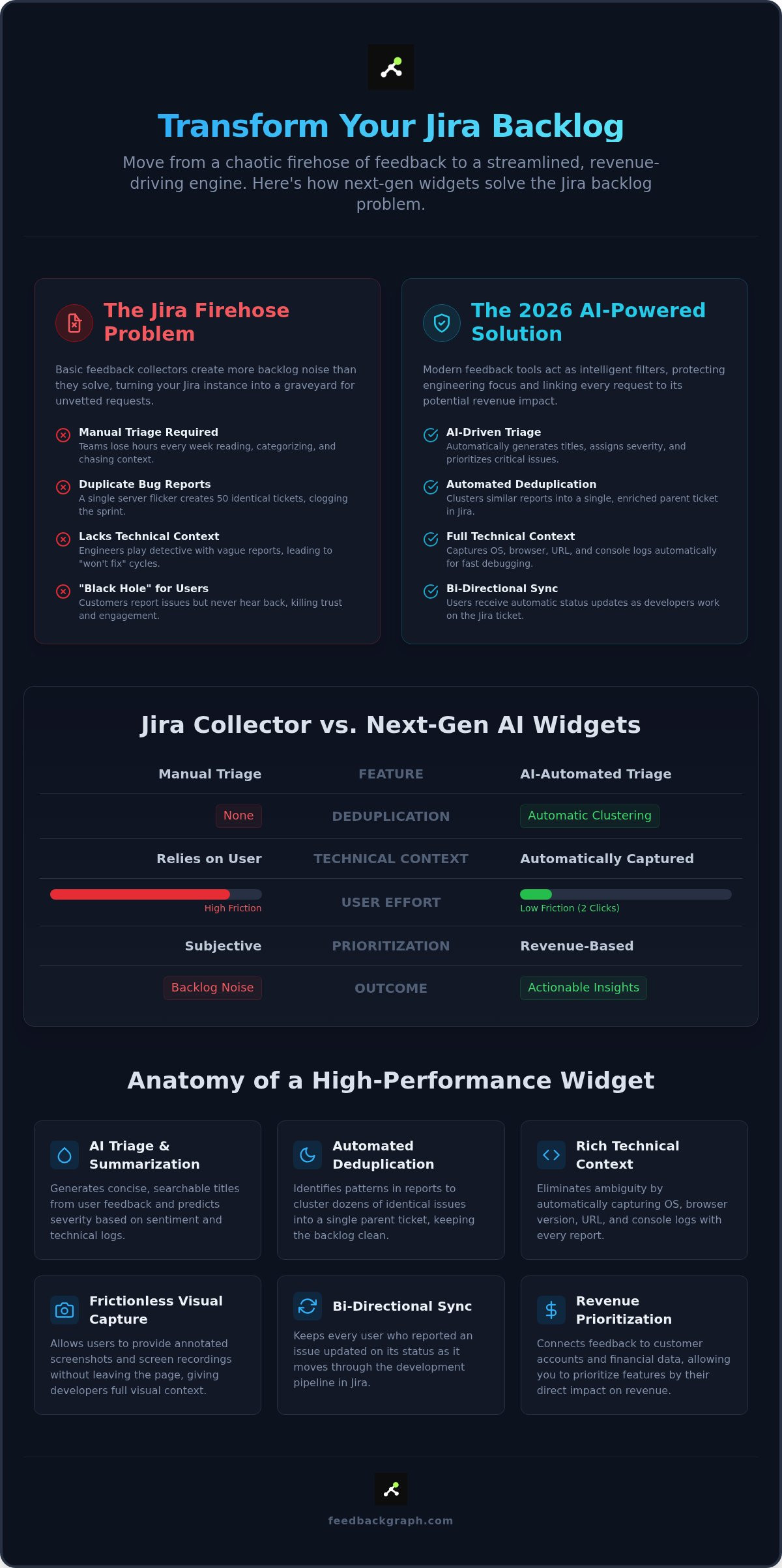
The "free" native Jira Issue Collector is a trap for scaling product teams. While it captures data, it lacks the intelligence to process it. This creates a firehose effect where every minor gripe and major system failure lands in the same unorganized heap. By 2026, the industry has shifted away from the 2024 "capture everything" philosophy. Modern teams now prioritize curation. They know that raw customer feedback without technical context is just noise that stalls engineering velocity.
When you rely on a basic customer feedback widget for Jira, you're essentially outsourcing your data entry to frustrated users. They rarely provide the browser version, the specific URL, or the console logs your engineers need. This leads to endless "won't fix" cycles. Developers can't reproduce the error, so the ticket dies. This cycle doesn't just waste time; it destroys morale. Engineers want to build features, not play detective with vague bug reports. A cluttered backlog is a symptom of a tool that captures data but fails to provide insight.
The Reality of Manual Triage in Scaling Teams
Scaling teams often lose hours every week simply reading and categorizing tickets. Without automated intelligence, a single server flicker can result in 50 identical reports clogging your sprint board. This creates a "ping-pong" communication cycle. Support asks for details, users get frustrated, and developers wait. High-value feature requests, the ones that actually drive revenue, get buried under a mountain of minor UI bugs and duplicate reports. You can't scale a product when your most expensive resources are spent manually triaging low-quality data.
Why 'Dumb' Widgets Damage the Customer Experience
Basic widgets often create a "black hole" effect. A user takes time to report an issue but never receives an update or confirmation that the team is acting on it. This lack of transparency kills trust and discourages future engagement. Friction-heavy forms are another culprit. If a user has to fill out ten mandatory fields just to report a broken button, they'll simply leave. The feedback loop is the vital link between user and developer. If that link is broken, your product strategy is flying blind. Implementing a smart customer feedback widget for Jira ensures that every report is actionable, enriched with context, and linked to a transparent resolution path.
The Anatomy of a High-Performance Jira Feedback Widget
A high-performance customer feedback widget for Jira isn't just a data entry form. It's an intelligent filter designed to protect engineering focus. In 2026, the standard for feedback capture has evolved from simple text boxes to rich, automated data packets. To maintain velocity, your team needs tools that act as an active assistant rather than a passive relay. This starts with moving beyond manual titles and severity levels toward a system that understands the technical weight of every report.
Effective product development relies on listening to customer prospects, but that listening must be backed by hard technical evidence. A modern widget automatically captures the OS, browser version, and exact URL where an issue occurred. It eliminates the "it doesn't work" ambiguity that leads to wasted investigation time. When these technical logs are attached to the ticket from the start, developers can reproduce bugs in minutes instead of days.
Automated deduplication is the next pillar of high-performance feedback management. Smart widgets use pattern recognition to identify when multiple users are reporting the same server outage or UI glitch. Instead of 50 separate tickets cluttering your sprint board, the system clusters these reports into a single parent issue. This keeps your backlog clean and ensures that Jira status updates reflect back to every affected customer in real-time through bi-directional sync.
AI Triage: The End of Manual Categorisation
Manual triage is an expensive bottleneck. By leveraging AI Bug Triage, teams can automate the most tedious parts of the feedback loop. AI generates concise, searchable titles from rambling user descriptions and assigns predictive severity levels based on sentiment analysis and technical error logs. This process ensures that critical failures jump to the top of the queue while minor requests are categorized for later review. You get a prioritized list of work without spending hours in triage meetings.
Capturing Visual Context Without the Friction
Visual context is non-negotiable for modern bug reporting. High-performance widgets allow users to submit annotated screenshots or session replays with a single click. The goal is a "two-click" submission standard that balances detail with speed. Users shouldn't feel like they're filing a police report. By capturing visual evidence and technical logs behind the scenes, you maintain privacy compliance while giving developers everything they need to ship a fix. If you want to see how AI can clean your backlog and accelerate your workflow, book a personalized walkthrough of these features.
Native Jira Collector vs. Next-Gen AI Widgets: A Comparison
Choosing between a native Atlassian tool and a specialized customer feedback widget for Jira often comes down to a choice between price and performance. Native collectors are accessible. They come bundled with your existing Jira subscription. However, they're passive instruments. They don't think; they simply relay raw data. As noted in the discussion on how GenAI Can Help Companies Do More with Customer Feedback, modern AI tools act as an active layer that interprets, summarizes, and prioritizes data before it ever hits your backlog.
Native tools live entirely within the Jira ecosystem, which sounds convenient but often creates a disconnect. They lack the intelligence to filter out noise at the point of capture. This means your developers end up doing the heavy lifting of sorting through low-quality tickets. Specialized AI platforms bridge the gap between the user and the developer. They ensure that by the time a report reaches Jira, it's already enriched with technical metadata and assigned a clear priority level.
The subscription fee for a next-gen widget is a fraction of the cost of engineering hours lost to manual triage. If your team spends five hours a week cleaning up duplicate tickets, you're losing thousands in productive output every month. Scalability is where the gap widens significantly. A manual process might survive 100 reports, but it will collapse at 10,000. AI-powered widgets handle this volume by clustering similar issues and filtering out low-quality reports automatically.
The Limits of the Jira Service Management (JSM) Portal
JSM portals are designed for support tickets, not agile product development. They require users to leave your app, navigate a separate interface, and fill out complex fields. This friction kills engagement. There's a fundamental difference between 'Service Desk' intent (fixing a broken account) and 'Product Feedback' intent (suggesting a new feature). For a deeper dive into these distinctions, read our SaaS Product Feedback Systems: The 2026 Guide.
The Power of Bi-directional Sync
A one-way data dump is a dead end for customer relations. Bi-directional sync ensures that when an engineer moves a ticket to "Done" in Jira, the customer receives an automated notification in your app. This maintains a single source of truth across product, engineering, and customer success teams. Implementing a bi-directional Jira feedback sync is the gold standard for 2026 because it eliminates manual follow-ups and keeps users informed without extra effort from your team.
Selection Criteria: How to Rank Your Feedback by Revenue Impact
Prioritizing a product roadmap based on volume alone is a strategic mistake. The loudest user in your feedback forum isn't necessarily your most valuable customer. When you use a generic customer feedback widget for Jira, you're often buried under requests from free-tier users while high-value enterprise needs remain silent. This "volume trap" leads teams to build features that satisfy the many but ignore the few who actually pay the bills. By 2026, high-performing teams have moved beyond counting votes. They now rank every ticket by its actual financial weight.
True prioritization requires a direct link between your feedback tool and your CRM. By mapping user IDs to contract values, your customer feedback widget for Jira stops being a list of suggestions and becomes a financial dashboard. You can instantly see which feature requests are tied to $500,000 in recurring revenue versus those requested by churn-prone trial users. This evidence-based approach settles roadmap debates instantly. It removes the guesswork from product management and replaces subjective intuition with hard financial data. You no longer have to guess which feature will drive the most growth; the numbers tell the story for you.
Integrating Financial Data into the Feedback Loop
Mapping user IDs to subscription tiers and specific contract values allows for granular visibility. When a critical bug is reported, the system should automatically visualize the "Revenue at Risk" based on which accounts are experiencing the issue. This isn't just about fixing bugs; it's about protecting your biggest assets and preventing churn. For a deeper look at this strategy, see our Revenue-Based Feature Ranking: 2026 Profit-First Guide.
Deduplication as a Strategic Advantage
Deduplication does more than just clean up your board; it reveals the true demand for a feature. When AI groups similar requests together, it highlights the aggregate dollar value behind a specific need. This prevents the "feature creep" trap where teams build niche requests that don't move the needle. Utilizing software for ranking feature requests by revenue changes executive conversations from "I think we should build this" to "building this will unlock $2M in expansion revenue."
This transformation turns product management from a game of intuition into a disciplined, evidence-based science. It ensures that every engineering hour is spent on the tasks that maximize ROI. When you can prove the financial impact of your backlog, you gain the confidence of stakeholders and the clarity needed to scale rapidly. It's about moving from a reactive state of "fixing things" to a proactive strategy of "building value." Evidence-based ranking is the only way to ensure your product survives in a competitive 2026 market.
Implementing FeedbackGraph: The 2-Click Bridge to Jira
Deployment shouldn't be a development project in itself. FeedbackGraph is designed as a zero-configuration AI layer that sits between your users and your development environment. From the moment you install the customer feedback widget for Jira, our AI begins triaging tickets, deduplicating reports, and enriching data packets with technical metadata. It's an immediate injection of efficiency into your existing workflow. You don't need to spend weeks mapping fields or writing custom scripts; the system thinks like a product manager from day one.
Our "two-click" promise is about more than just speed. It's about maintaining the user journey. By capturing high-quality data without interrupting the experience, you increase the volume of actionable reports. You can fully customize the widget to match your SaaS brand's aesthetics and UX patterns, ensuring it feels like a native part of your product rather than a third-party intrusion. This frictionless capture is what allows you to scale your feedback loop without adding support overhead.
Bi-directional status mapping ensures that transparency is automated. When an engineer moves a ticket to "In Progress" or "Resolved" within Jira, that status reflects back to the customer instantly. This eliminates the need for manual update emails and keeps your users engaged with the product's evolution. It's a professional, tech-forward way to manage expectations while your team stays focused on shipping code.
Setting Up Your Revenue-Aware Workflow
Connecting your Jira projects to FeedbackGraph takes under 60 seconds. Once connected, you can define custom rules for AI severity classification and routing based on your team's specific needs. You can route critical bugs to one sprint board while sending feature requests to a separate discovery backlog. This granular control ensures that the right data always reaches the right person at the right time. You can explore the full range of these capabilities on our FeedbackGraph Features page.
Conclusion: Building a Roadmap That Actually Scales
The shift from manual bug tracking to AI-driven growth is no longer optional for scaling SaaS teams. By moving beyond the "firehose" of raw data, you protect your engineering velocity and ensure that every feature you build is backed by financial evidence. A modern customer feedback widget for Jira is your most powerful tool for eliminating backlog noise and focusing on high-ROI development. For a broader look at how the industry is evolving, read our analysis on Bug Reporting Software in 2026. It's time to stop guessing and start building a roadmap that scales as fast as your ambition.
Build a Revenue-First Product Strategy
The transition from manual data entry to AI-driven curation is the only way to protect engineering velocity in 2026. You've seen how raw feedback without context creates a cluttered firehose that stalls progress and drains team morale. By deploying a modern customer feedback widget for Jira, you replace manual triage with AI-powered deduplication and enriched technical logs. This ensures your team builds features that actually move the needle for your business.
Revenue-based prioritization turns your backlog into a strategic financial engine. You can now settle roadmap debates using hard evidence from your CRM instead of relying on subjective intuition or the loudest voice in the room. Bi-directional Jira sync keeps the loop closed, maintaining transparency with your users while your developers focus on high-impact tasks. It's about moving from a reactive state of fixing bugs to a proactive strategy of driving consistent growth.
Your product deserves a roadmap built on logic and evidence. Stop fighting the backlog firehose and start building for maximum ROI today.
Frequently Asked Questions
Can I use a customer feedback widget for Jira with both Cloud and Data Center versions?
Yes, most modern solutions support both Cloud and Data Center, though Cloud-native integrations typically offer the fastest synchronization. You should verify your specific firewall requirements if you're using a Data Center environment. FeedbackGraph is optimized for high-speed Cloud environments to ensure real-time data flow between your application and your Jira board. This setup minimizes latency and keeps your engineering team moving without technical bottlenecks.
How does a feedback widget help reduce duplicate tickets in Jira?
Smart widgets use pattern recognition to identify similar reports before they ever hit your backlog. When a customer feedback widget for Jira detects a duplicate, it clusters the new report with the existing issue automatically. This prevents the firehose effect where a single outage creates 50 identical tickets. Your team sees one parent issue with 50 affected users, preserving your sprint board's clarity and engineering focus.
Does the widget capture technical data like browser logs and console errors?
High-performance widgets capture technical metadata automatically, including OS, browser version, current URL, and console logs. By providing this technical context upfront, you eliminate the ping-pong communication between developers and users. Engineers can reproduce errors immediately because they have the exact environment details needed to simulate the bug. This process significantly accelerates your mean time to resolution and improves overall software quality.
Is it possible to notify customers automatically when their Jira issue is resolved?
Bi-directional synchronization makes automated notifications possible by linking Jira status changes to the widget. When an engineer moves a ticket to "Done" in Jira, the update flows back through the system to the original reporter. This keeps customers informed about the progress of their reports without requiring manual emails from your product or support teams. It's a professional way to build trust and ensure transparency throughout the development lifecycle.
How do I rank Jira feature requests based on customer revenue?
You rank requests by integrating your widget with CRM data to map user IDs to contract values. This connection allows you to see the aggregate dollar value behind every ticket in your backlog instantly. By ranking issues by revenue impact, you can prioritize features that drive expansion and fix bugs that put high-value accounts at risk. It turns your product roadmap into a disciplined financial strategy based on hard evidence.
What is the difference between a feedback widget and Jira Service Management?
Jira Service Management is a full-scale portal for support interactions, while a feedback widget is a streamlined tool for product-led growth. Widgets live inside your application to reduce user friction and capture insights in context. JSM often requires a separate login and complex forms, which can discourage users from sharing valuable ideas. A widget captures product feedback intent more effectively by keeping the user in their current workflow.
Can I customize the widget to only appear for specific user segments?
Yes, you can use conditional logic to show the widget only to specific user segments, such as beta testers or enterprise accounts. This targeting ensures that your backlog is filled with high-value data rather than generic noise from trial users. By focusing on specific cohorts, you gather more strategic insights that align with your business goals. It allows for a more focused approach to product discovery and user research.
How does AI triage improve the quality of bug reports sent to Jira?
AI triage improves report quality by automatically generating searchable titles and classifying severity based on technical logs. It analyzes user sentiment and error data to determine how critical an issue is before an engineer ever sees it. This process transforms rambling user descriptions into structured, actionable data. Using a customer feedback widget for Jira with AI triage ensures your engineers spend their time building features rather than deciphering vague bug reports.


