

Your feedback backlog isn't a goldmine; it's a graveyard of expensive engineering hours. Most product teams in 2026 still spend nearly a quarter of their sprint cycle manually deduplicating bug reports and guessing which feature might actually drive growth. You know the frustration of staring at a thousand unsorted tickets while your engineers waste time on low-impact fixes. If you're hunting for a feedbackhq alternative, you've likely reached the breaking point with passive databases that offer zero financial context. It's time to stop treating user input like a static list and start treating it like a strategic asset.
You deserve a system that thinks as fast as your dev team moves. This guide shows you how to replace fragmented logs with an AI-powered headquarters that ranks feature requests by revenue and automates bug triage instantly. We'll explore the shift toward AI-first triage, where automated deduplication and bi-directional sync with tools like Jira and Linear become your new baseline. Discover how a single source of truth, backed by revenue-based prioritization, ensures your roadmap finally aligns with your business goals and protects your bottom line.
Key Takeaways
- Transition from passive feedback logs to an active triage engine that translates raw user pain into prioritized engineering actions.
- Implement a two-click capture widget to eliminate reporting friction and maximize the volume of high-quality product signals.
- Automate bug triage using AI-powered enrichment to generate summaries and severity levels without manual engineering oversight.
- Discover why FeedbackGraph is the premier feedbackhq alternative for teams needing to rank feature requests by real-time revenue impact.
- Build a bi-directional feedback loop that syncs directly with Jira and Linear to keep product and development teams in perfect alignment.
What is a FeedbackHQ and Why is Your Current System Failing?
A FeedbackHQ acts as the centralized hub for capturing, triaging, and acting on user input. It's the strategic bridge between customer success and engineering velocity. In 2026, the definition has evolved. We've moved beyond passive databases where requests go to die. Today's standard is an active triage engine that processes data in real-time. While traditional customer feedback management often stops at collection, a modern feedbackhq alternative transforms raw data into a prioritized execution plan.
To function effectively, this hub requires three core components. First, a frictionless capture widget ensures you're actually hearing from your users. Second, AI triage automates the heavy lifting of categorization. Finally, revenue ranking provides the business context needed to make hard decisions. Without these pillars, you aren't managing feedback; you're just hoarding it. Passive systems create noise. Active engines create growth.
The Hidden Cost of Feedback Silos
Data trapped in Slack channels, support tickets, and scattered emails creates massive operational blind spots. When your feedback is fragmented, product managers often default to "gut-feeling" roadmaps. They build what's loudest or what's easiest, not what's most valuable. This lack of centralized visibility leads to inconsistent data and painfully slow response times. Fragmented bug reports also drive developer burnout. Engineers shouldn't have to play detective to find a reproduction path. Constant context switching between tools slows down product releases and dilutes your engineering focus. It's a recipe for stagnation that no modern SaaS can afford. Without revenue-based prioritization, you're essentially guessing which features will move the needle for your bottom line.
The 2026 Shift: Why Manual Backlogs are Obsolete
Manual triage is a relic of a slower era. In a high-growth SaaS environment, processing thousands of reports by hand is a mathematical impossibility. It leads to backlogs filled with duplicate reports and low-quality data. Human error in classification results in misaligned priorities and wasted sprint cycles. AI-driven hubs solve the "empty field" problem. When a user submits a vague one-sentence report, the AI enriches it by pulling technical metadata, browser logs, and session context. This turns a useless ticket into an actionable task instantly. If you're still relying on humans to read every line of feedback, you're falling behind. You can explore the technical mechanics of this transition in our guide on SaaS Product Feedback Systems: The 2026 Guide to AI-First Triage. Transitioning to an automated system isn't just about speed; it's about accuracy and business alignment.
The Anatomy of a High-Performance FeedbackHQ Alternative
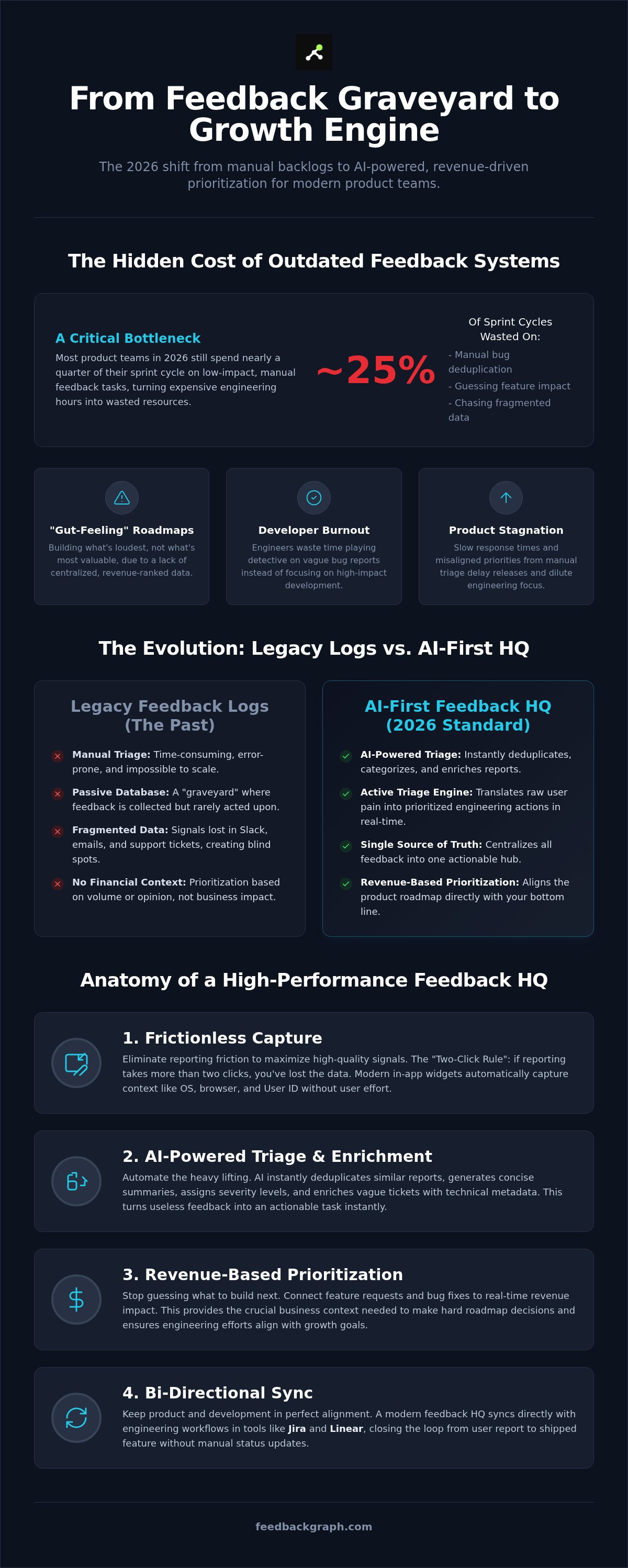
A high-performance feedbackhq alternative isn't a passive bucket for user complaints. It's an active intelligence layer. Most legacy systems fail because they rely on manual input and human categorization. In 2026, the technical standard is defined by four specific pillars: frictionless capture, automated enrichment, intelligent deduplication, and bi-directional synchronization. These components work together to ensure that every signal captured leads directly to a business outcome without wasting engineering resources.
Reducing the distance between a user's pain and an engineer's task is critical. We prioritize the "Two-Click" Rule. If reporting a bug or requesting a feature takes more than two clicks, you've already lost the data. Friction is the enemy of volume. By removing barriers, you increase the flow of high-quality signals that drive your product roadmap. Once the data enters the system, AI takes over to handle the heavy lifting of triage.
Frictionless Capture with In-App Widgets
External forms are where feedback goes to die. They require users to leave your application, manually describe their environment, and often attach screenshots. This process is slow and prone to error. In contrast, modern in-app widgets capture contextual metadata automatically. Every report includes the user's Operating System, browser version, and specific User ID without them typing a single word. This level of detail is standard for teams utilizing FeedbackGraph Use Cases for Customer Feedback to eliminate guesswork. You get the visual data you need while the user stays focused on their workflow.
AI-Powered Triage and Deduplication
Backlog bloat usually starts with duplicates. When five different users report the same laggy interface in five different ways, manual systems create five separate tickets. An AI-powered feedbackhq alternative uses semantic analysis to identify "near-duplicate" reports. It groups similar user pains into a single parent issue. This mechanism stops the noise before it reaches your engineering team. It's about maintaining a clean, actionable backlog.
The AI doesn't just group; it enriches. It analyzes the report to generate concise titles, summaries, and initial severity rankings based on the technical logs captured. This logic ensures that critical regressions are flagged instantly while minor UI tweaks are categorized correctly. You can learn more about these mechanisms in our deep dive on AI Bug Reporting Tools: Automating Triage and Revenue Impact in 2026.
Finally, the system must maintain a bi-directional sync with your dev stack. When an engineer closes a ticket in Jira or Linear, the status must update in your feedback hub automatically. This closes the loop with the customer in real-time. If you're ready to see this automation in action, you can schedule a technical walkthrough to explore our bi-directional integrations.
Comparing Legacy Feedback Logs vs. AI-First FeedbackHQ Platforms
Legacy feedback systems are essentially digital filing cabinets. They store information but don't process it. This creates the "Black Hole" effect where users submit valuable insights and never receive an update. The data is simply too messy for a human to manage at scale. In contrast, an AI-first feedbackhq alternative acts as a live processor. By 2026, these platforms maintain 99.9% data accuracy by automatically cross-referencing semantic user intent with technical telemetry and historical bug patterns. This precision ensures that engineers aren't chasing ghosts or fixing the same issue twice.
Manual triage relies on inconsistent human judgment. One manager might flag a bug as "High" while another sees it as "Medium." This inconsistency leads to misaligned roadmaps and wasted resources. AI-first platforms remove this subjectivity by applying a uniform logic based on your specific business rules and technical logs. The result is a clean, reliable data stream that mirrors the actual health of your application.
Engineering Efficiency and Backlog Health
Manual triage is an expensive drain on senior talent. It often requires recurring meetings where lead engineers debate ticket severity and reproduction steps. AI-first platforms eliminate this overhead. By providing zero-touch triage, teams reduce the time spent on these meetings by up to 80%. Enriched reports provide the exact stack trace and environment data needed for immediate action, cutting down the discovery phase of the fix. You can explore how this transition impacts your engineering velocity in our guide on Bug Reporting Software in 2026: From Manual Tickets to AI-Driven Revenue Growth. A healthy backlog isn't just about length; it's about the actionability of every item it contains.
Customer Transparency and Retention
Bi-directional sync is the standard for high-performance teams in 2026. Most legacy tools require manual status updates, which inevitably fall behind. A modern feedbackhq alternative ensures your Jira, Linear, or GitHub status mirrors what the customer sees in real-time. When a developer moves a ticket to "Done" in their internal tool, the platform triggers an automated notification to the reporting user. This "closes the loop" without human intervention. This level of transparency builds immense trust and significantly reduces churn in enterprise SaaS environments. When customers see their feedback turning into reality, they're far more likely to remain loyal to your platform. It's a direct path from transparency to retention.
Building Your Revenue-Driven Feedback Loop in 5 Steps
Moving from a passive backlog to a growth-oriented triage engine requires a methodical approach. It isn't enough to just collect data; you must structure the flow of information so it directly informs your financial outcomes. If you're implementing a feedbackhq alternative, your goal is to eliminate friction for both the user and the engineer. This five-step framework ensures your feedback loop is built for speed and profitability.
- Step 1: Audit existing silos. Identify where feedback currently hides. Scour Slack channels, support tickets, and email threads to consolidate your historical data into a single source of truth.
- Step 2: Deploy the capture widget. Embed a low-friction widget directly into your SaaS application. This ensures you capture bugs and requests exactly where they occur, maintaining context.
- Step 3: Connect your dev stack. Integrate your hub with Jira, Linear, or GitHub. This turns raw feedback into actionable engineering tasks without manual entry.
- Step 4: Implement revenue ranking. Link your feedback to CRM data. This allows you to see the actual financial weight behind every request.
- Step 5: Automate the sync. Set up automated triggers that notify customers when their reported issues move from "In Progress" to "Live."
Ranking Feature Requests by Financial Impact
Roadmaps often fail because they treat every user request as equal. In a product-led growth model, this is a dangerous oversight. By integrating your feedback hub with CRM data, you gain immediate visibility into which accounts are requesting specific features. You can prioritize bugs that affect your highest-paying customers or identify requests that are blocking high-value renewals. This profit-first approach ensures your engineering team works on the tasks that drive the most revenue. For a deeper dive into this strategy, see our Revenue-Based Feature Ranking: 2026 Profit-First Guide.
The Bi-Directional Sync Advantage
One-way integrations are the primary cause of feedback death. When data only flows from the customer to the developer, the loop remains open and users feel ignored. A high-performance feedbackhq alternative solves this through bi-directional mapping. When an engineer updates a task in Linear or closes a GitHub issue, the status reflects instantly in the customer-facing portal. This transparency reduces support volume and builds long-term user trust. You can see the technical details of this architecture in our breakdown of FeedbackGraph Features: How it Works. It's about ensuring the voice of the customer lives where the code is written.
Why FeedbackGraph is the Ultimate FeedbackHQ Alternative for 2026
FeedbackGraph stands alone as the definitive feedbackhq alternative for teams that value engineering precision over simple data collection. It's built for the 2026 software reality, where manual triage is a bottleneck and data without financial context is noise. By prioritizing AI-first workflows, the platform transforms the way product teams interact with their users. It's not just a repository; it's an active intelligence layer that ensures your roadmap is always backed by technical evidence and business value.
The core of this efficiency lies in our AI Bug Triage. Unlike legacy systems that require manual entry for every field, FeedbackGraph enriches every report automatically. It pulls technical metadata, browser logs, and stack traces the moment a user clicks. This wealth of data allows the system to perform intelligent deduplication and severity classification before a human ever sees the ticket. For teams focused on product-led growth, our Revenue-Based Feedback Ranking provides the missing link. It connects your feedback loop directly to your CRM, allowing you to see the exact financial impact of every feature request or bug fix.
We've also built for the future of development. FeedbackGraph includes a unique MCP Server integration, allowing advanced dev environments to interact with feedback data through standardized protocols. Whether you're a lean startup or a massive enterprise, this infrastructure scales with your volume, ensuring your triage engine never slows down as your user base grows.
Seamless Integration with Your Existing Stack
Modern engineering teams don't have time for one-way data dumps. FeedbackGraph eliminates the friction between PMs and Developers through deep, bi-directional Jira and Linear workflows. When a developer moves a task to "In Progress" or "Resolved" in their internal tool, the update reflects instantly in the feedback hub. This automation keeps everyone aligned without a single status update meeting. You can explore the full range of our technical capabilities and API hooks in the FeedbackGraph Documentation. It's about making the feedback loop a natural extension of your existing sprint cycle.
Get Started with the AI-First Headquarters
Transitioning to an intelligent feedback system shouldn't take months. Our rapid implementation process allows you to deploy the capture widget and connect your dev tools in minutes. You can start with a free trial to see how quickly AI-powered enrichment cleans up your existing backlog. Turn your fragmented logs into a high-velocity revenue engine today. We've designed the onboarding experience to be as frictionless as the software itself, ensuring you see immediate value from your first automated triage.
Modernize Your Feedback Workflow for 2026
The era of manual feedback management is over. Teams that continue to rely on passive logs are sacrificing engineering velocity and customer trust. By adopting a modern feedbackhq alternative, you replace operational noise with high-fidelity product signals. You've seen how AI-powered triage eliminates the burden of manual categorization while bi-directional Jira sync keeps your development and product teams in perfect alignment. This isn't just about saving time; it's about ensuring every engineering hour spent translates into tangible business value.
Prioritizing your roadmap based on revenue impact isn't just a luxury; it's a strategic necessity in a competitive SaaS market. FeedbackGraph provides the infrastructure to turn raw user pain into prioritized execution. Stop letting valuable insights disappear into a backlog graveyard. It's time to build a feedback headquarters that actually drives growth and retention. Your users are talking. It's time you had the tools to listen at scale and act with precision.
Take the first step toward a smarter, revenue-driven product strategy today. We're ready to help you eliminate friction and accelerate your release cycles.
Frequently Asked Questions
What is the difference between a feedback HQ and a simple bug tracker?
A feedback HQ is a strategic intelligence layer that manages the entire lifecycle of user input, whereas a simple bug tracker is just a storage database. While a tracker stores issues, a feedbackhq alternative like FeedbackGraph enriches data with AI and ranks it by business value. It bridges the gap between customer success and engineering. This ensures your team builds what actually drives revenue rather than just clearing a list of technical debt.
How does AI help in deduplicating customer bug reports?
AI deduplication uses semantic analysis to identify near-duplicate reports based on user intent and technical metadata. Instead of creating five separate tickets for the same UI glitch, the system groups them into a single parent issue automatically. This mechanism stops backlog bloat before it reaches your developers. By analyzing technical logs and historical patterns, it maintains 99.9% data accuracy. It saves hours of manual triage meetings every week.
Can I connect a FeedbackHQ alternative directly to Jira or Linear?
Yes, you can connect a modern feedbackhq alternative directly to Jira, Linear, or GitHub through bi-directional integrations. When you capture a report, it routes the issue to your existing dev workflow instantly. Status updates in your project management tool sync back to the customer portal in real-time. This ensures that your engineering team stays focused in their preferred environment while users receive automated progress updates without manual intervention from product managers.
How do you rank feature requests by revenue impact?
Revenue-based ranking works by integrating your feedback hub with CRM data to quantify the financial weight of every request. The system identifies which high-value accounts or renewal-risk customers are asking for specific features. This allows you to prioritize your roadmap based on actual profit potential rather than loud voices. It ensures your engineering resources are allocated to tasks that protect your bottom line and drive product-led growth across the competitive Indian market.
Does an AI bug reporting tool require technical knowledge to set up?
Setting up an AI bug reporting tool like FeedbackGraph is designed to be frictionless and requires minimal technical effort. You can deploy the capture widget by embedding a small snippet of code into your SaaS application. Connecting to tools like Jira or Slack involves a standard OAuth process that takes minutes. Most teams are up and running within a single afternoon. You don't need a dedicated DevOps engineer to maintain the system once it is active.
What happens to a user report once it is captured by the widget?
Once captured by the widget, a user report is instantly enriched with technical metadata like browser logs, OS details, and User IDs. The AI then generates a concise title, summary, and severity ranking based on the captured data. It checks for duplicates and groups similar issues together. Finally, the enriched report is synced to your dev tool, like Linear or GitHub, where it enters your standard engineering triage process for immediate action.
How do status updates sync back to the customer in a bi-directional workflow?
Status updates sync back to the customer automatically through bi-directional mapping between your dev tool and the feedback hub. When an engineer moves a task to "Done" in Jira or Linear, the system triggers a real-time notification to the reporting user. This closes the loop without any manual effort from your support team. It builds trust by showing customers that their feedback directly impacts the product roadmap and results in tangible fixes.
Is it possible to capture visual data like screenshots with a feedback widget?
Yes, the FeedbackGraph widget captures visual data like screenshots and technical telemetry automatically when a user submits a report. This eliminates the need for users to manually attach files or describe their environment. Every ticket arrives with the visual context an engineer needs to reproduce the issue. By capturing the exact state of the application, it reduces the discovery phase of bug fixing and helps your team ship updates much faster.


