

Most product teams treat customer feedback as a liability to be managed rather than an asset to be liquidated into revenue. You've likely felt the friction of a broken customer feedback loop for product teams, where high-value insights disappear into a black hole and manual triage eats up hours of your PM's week. It's a systemic failure that leaves customers ignored and engineers buried in low-priority noise.
We agree that the status quo is unsustainable. You shouldn't have to choose between manual data entry and losing touch with your users. This guide promises a better way. You'll learn how to transform raw feedback into high-integrity engineering tasks and measurable revenue growth using automated AI workflows. We're moving beyond simple collection to a system of intelligent action. We'll explore how to route feedback to dev tools automatically, rank feature requests by their financial impact, and trigger status updates back to customers without lifting a finger. It's time to turn your backlog into a precision-engineered revenue engine.
Key Takeaways
- Replace friction-heavy forms with a two-click widget to capture contextual data and eliminate the "feedback black hole" that kills customer trust.
- Leverage AI to automate bug triage and deduplication, ensuring that only high-integrity engineering tasks reach your development backlog.
- Optimize the customer feedback loop for product teams by ranking feature requests according to their financial impact and account value.
- Enable bi-directional synchronization between dev tools and customer-facing interfaces to provide automatic status updates when issues are resolved.
- Shift from a passive collection model to an active revenue engine by integrating feedback data directly into your strategic roadmap decisions.
Beyond "Thank You": Redefining the Customer Feedback Loop for 2026
The old way of managing feedback relies on a "thank you for your input" email that leads nowhere. In high-growth SaaS, this approach is a recipe for churn. A modern customer feedback loop for product teams isn't just a communication channel; it's a structural requirement for survival. When feedback enters a "black hole," where customers never hear back and product teams never see the data, trust erodes instantly.
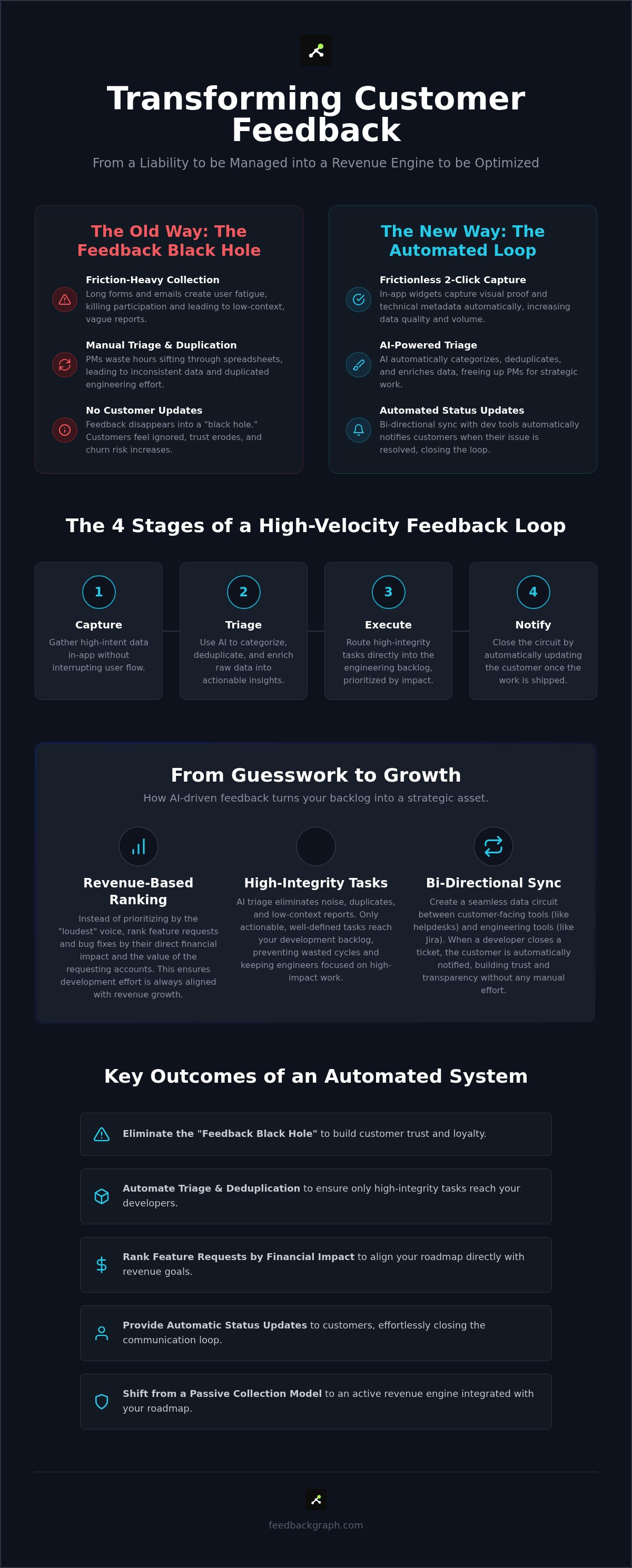
To scale in 2026, teams must move from reactive support to proactive iteration. This requires a loop with four distinct, automated stages:
- Capture: Gathering high-intent data without interrupting the user's flow.
- Triage: Using AI to categorize, deduplicate, and enrich raw data.
- Execute: Routing tasks directly into the engineering backlog.
- Notify: Closing the circuit by updating the customer once the work is shipped.
This framework builds on foundational Voice of the Customer (VoC) methodologies but adds the speed required for modern software lifecycles. It transforms feedback from a static data point into a dynamic driver of development.
Why Manual Feedback Loops Fail at Scale
Spreadsheets and manual data entry are the enemies of velocity. When PMs spend hours triaging bug reports or feature requests, they aren't building products. Manual loops suffer from inconsistent data quality because raw submissions often lack context. There's a persistent disconnect between Customer Success tools and Engineering backlogs, leading to duplicated efforts and missed opportunities. This friction costs more than just time; it costs market share. Without automation, the sheer volume of data makes it impossible to distinguish between a minor annoyance and a critical revenue risk.
The 2026 Standard: The Bi-Directional Feedback Loop
A closed feedback loop is a continuous data circuit that links user pain directly to the product roadmap. In this model, customer input triggers development action, and development completion automatically triggers a customer notification. It eliminates the manual "middleman" that usually causes data to stall or get lost in translation.
By leveraging bi-directional integrations, teams ensure that the engineering team stays focused on high-impact tasks while customers feel heard. AI maintains the integrity of this loop by performing the heavy lifting of classification and prioritization. This ensures that every piece of feedback is accounted for, ranked by value, and resolved without manual intervention. This level of transparency is no longer a luxury; it's the baseline expectation for software users who demand immediate progress.
Automated Triage: Eliminating Friction in Feedback Collection
Traditional collection methods fail because they prioritize the team's need for data over the user's need for speed. Long forms and complex dropdowns create friction that kills participation. An effective customer feedback loop for product teams starts with radical simplicity. By using a two-click capture widget, you reduce the cognitive load on the reporter while actually increasing the data quality.
In-app feedback capture ensures contextual accuracy by automatically grabbing technical metadata, console logs, and visual states. This means the user doesn't have to explain what happened; the system already knows. This transition from manual reporting to automated capture is the first step in building a high-velocity product engine.
Capturing High-Signal Data Without User Fatigue
Shorter widgets lead to higher volume and better quality reports. When a user can highlight a bug directly on the screen, the ambiguity of a text-only report vanishes. Visual bug reporting captures exactly what the user sees, eliminating the "it works on my machine" stalemate between support and engineering. You can explore our customer feedback use cases to see how this transition from forms to widgets accelerates capture rates across different user segments.
The AI Triage Engine: From Noise to Insight
Capturing data is only half the battle. The real challenge is processing it without drowning your Product Managers in triage tasks. An AI-driven triage engine acts as an intelligent filter. It performs automated severity classification based on the report's content and urgency, ensuring critical blockers jump to the front of the line. This automation removes the human bottleneck from the customer feedback loop for product teams, allowing for near-instant prioritization.
AI also solves the clarity problem. It generates concise, actionable titles and summaries for engineering tickets, replacing vague user descriptions with technical precision. It specifically targets deduplication. By identifying near-duplicate reports, it prevents the same bug from being logged ten times, effectively silencing the noise in your backlog. For a deeper dive into these mechanisms, see our guide on AI Bug Reporting Tools: Automating Triage in 2026.
If your current process feels like a manual chore, you can request a technical demo to see automated triage in action.
Revenue-Based Ranking: Turning Feedback into a Strategic Asset
Prioritization is the most political part of product management. In many organizations, the "Loudest Voice" bias dictates the roadmap. This happens when the most vocal customer or the most aggressive salesperson wins the argument, regardless of actual business value. It's a dangerous way to run a software company. A high-integrity customer feedback loop for product teams must replace volume with value to ensure engineering resources target the highest ROI opportunities.
Linking feedback reports to customer account value and potential revenue transforms the backlog from a list of complaints into a strategic asset. It allows you to quantify the cost of a bug versus the value of a feature request with mathematical precision. When you can prove that a specific friction point is blocking a high-value renewal, the decision to prioritize it becomes objective rather than emotional.
Beyond Sentiment: Quantifying Financial Impact
Sentiment analysis tells you how a user feels; revenue analysis tells you what a user is worth. By mapping feedback reports directly to Monthly Recurring Revenue (MRR), you can prioritize churn-risk bugs over minor UI polish. If three Enterprise accounts with a combined ARR of $1.2M report the same friction point, that task instantly jumps to the top of the backlog. This isn't just about fixing bugs; it's about protecting capital. For a deeper dive into this methodology, read our Revenue-Based Feature Ranking: 2026 Profit-First Guide.
The Profit-Led Roadmap Framework
A strategic roadmap requires a matrix of effort versus revenue impact. High-effort features that only serve low-value accounts are distractions. Conversely, low-effort fixes that unblock major deals are high-priority wins. Using this data allows you to justify your roadmap to stakeholders with evidence rather than intuition. It also changes how you communicate with users. Instead of a vague "we're looking into it," you can provide clear reasoning for why certain requests are prioritized based on strategic value. You can learn about revenue-based feedback ranking to see how this data integration works in real-time.
Quantifying these values ensures that the customer feedback loop for product teams remains a profit engine. It moves the conversation from "what should we build?" to "what drives the most growth?". This shift in perspective is what separates high-performing product teams from those that simply react to the loudest noise in the room.
Bi-Directional Sync: Closing the Loop Between Customers and Engineering
Most "integrations" are just one-way data dumps. Sending feedback to Jira is easy; getting a status update back to the customer is where most teams fail. A true customer feedback loop for product teams requires a bi-directional data circuit. Without it, your support team spends half their day manually checking ticket statuses to update frustrated users. This manual overhead creates a bottleneck that slows down development and irritates your highest-value customers.
Automation solves this. When an AI triage engine classifies a report, it shouldn't just create a ticket. It should route that issue to the specific workflow where it belongs, whether that's a Jira sprint, a Linear project, or a GitHub repository. This ensures the right engineering team sees the right data immediately, with all the technical context they need to start working. By removing the manual "handoff" between product and engineering, you maintain the structural integrity of your feedback data.
Connecting Feedback to Your Existing Dev Stack
Efficiency depends on meeting your engineers where they already live. Setting up a Jira or Linear sync allows for instant ticket creation, complete with console logs, visual attachments, and severity rankings. You can also configure Slack integrations for real-time internal alerts, ensuring that high-priority revenue risks aren't buried in a dashboard. This visibility keeps the entire organization aligned on the user's pain. For a detailed technical implementation plan, consult our Connect Customer Feedback to Dev Tools: 2026 Guide.
Automating the Last Mile: Customer Notifications
The most critical part of the customer feedback loop for product teams is the final notification. When a Jira issue moves to "Done," the system should automatically trigger a personalized update to the original reporter. This "last mile" automation eliminates manual drafting and ensures that no user is left wondering if their issue was ever addressed. It closes the circuit without requiring a single minute of a PM's time.
Closing the loop this way turns a negative experience, like a bug, into a positive CX moment. It demonstrates that you value their input and act on it. By personalizing the follow-up without manual intervention, you build long-term loyalty while maintaining a lean operational footprint. This is how you transform a support burden into a competitive advantage.
Implementing a Frictionless Feedback Infrastructure with FeedbackGraph
Speed is the primary metric for a successful implementation. You don't have months to build a custom integration; you need a system that works on day one. Deploying the FeedbackGraph two-click capture widget takes less than five minutes. This rapid deployment ensures you can start building a high-integrity customer feedback loop for product teams without diverting engineering resources from your core product roadmap.
Once the widget is live, you configure AI triage rules to match your team’s unique internal logic. You define the parameters for severity, component mapping, and priority. The AI then acts as an automated gatekeeper. It analyzes incoming reports, enriches them with technical metadata, and routes them to the correct developer tools. This isn't just about moving data; it's about ensuring every ticket in your backlog is actionable and accurately categorized from the moment it arrives.
To maximize strategic impact, you must integrate FeedbackGraph with your CRM. By pulling in real-time revenue data, the system automatically ranks feature requests and bug reports by their financial weight. You stop guessing which tasks matter and start executing on the ones that drive growth. Measuring the ROI of your new customer feedback loop for product teams becomes a matter of tracking reduced triage hours, faster time-to-resolution, and the direct correlation between resolved feedback and account retention.
Step-by-Step Setup Guide
The setup process is designed for immediate utility. After deploying the widget, you can customize the look and feel to match your brand's UI, ensuring a native experience for your users. The next step involves mapping feedback categories directly to your engineering components in Jira or Linear. This creates a seamless transition from a user's report to a developer's task. For a detailed walkthrough of every configuration option, you can check out our documentation for setup steps.
Scaling Your Feedback Culture
A robust infrastructure changes how your entire company views the customer. You move from a defensive posture of "handling complaints" to a collaborative model of "building together." This cultural shift is supported by technical tools like the MCP server, which allows modern product management workflows to interact directly with your feedback data in real-time. This transparency builds trust across departments and ensures that the voice of the customer is never silenced by operational friction.
Start your free trial of FeedbackGraph today
Building the Revenue-Driven Product Engine
High-growth SaaS requires a shift from passive listening to automated execution. You've seen how AI-powered triage enriches every report automatically and how bi-directional sync with Jira, Linear, and GitHub eliminates the manual handoff. By ranking feature requests by their impact on your MRR, you replace political guesswork with evidence-based prioritization. This transformation moves your team away from the "black hole" of manual triage and toward a high-velocity development cycle.
Optimizing the customer feedback loop for product teams is no longer a manual communication task. It's a structural necessity for maintaining velocity and protecting your revenue. Implementing these automated workflows ensures your engineering team stays focused on high-integrity tasks while your customers feel the immediate impact of their input. The technology to close the circuit exists; the only variable left is your implementation speed.
It's time to stop managing spreadsheets and start building a roadmap that scales. Your users are talking. It's time to listen with precision and act with authority.
Frequently Asked Questions
What is a customer feedback loop for product teams?
A customer feedback loop for product teams is a structural process that ensures every user insight is captured, prioritized, and resolved. It starts with the initial report and ends only when the user is notified of a resolution. This system eliminates the "black hole" where data gets lost. By automating the triage and notification stages, teams maintain high velocity without the burden of manual data entry.
How does AI help in closing the feedback loop?
AI automates the most labor intensive parts of the cycle by enriching raw data instantly. It generates technical titles, assigns severity levels, and creates concise summaries for engineering teams. This ensures that every report in the customer feedback loop for product teams is actionable from the moment it arrives. AI also handles deduplication, preventing redundant tickets from slowing down your development sprints and cluttering your backlog.
Why is bi-directional sync important for Jira and Linear?
Bi-directional sync ensures that information flows seamlessly between your feedback platform and your development tools. When an engineer moves a task to "Done" in Jira or Linear, the system triggers an automatic update to the original reporter. This creates total transparency without requiring manual status checks. It bridges the gap between customer facing teams and engineering, ensuring everyone works from a single source of truth.
How do you prioritize feature requests by revenue?
Prioritizing by revenue involves linking individual feedback reports to the account value stored in your CRM. FeedbackGraph maps these insights to Monthly Recurring Revenue (MRR), allowing you to see exactly which features or bugs impact your bottom line. This data driven approach removes the "loudest voice" bias. It ensures your roadmap focuses on high value requests that drive the most significant financial growth for your business.
What is the difference between a support ticket and a product feedback loop?
Support tickets are typically reactive, one off resolutions for individual users, whereas a product feedback loop is an iterative system for roadmap development. While a support ticket aims to fix a single person's problem, a feedback loop analyzes systemic issues to improve the product for everyone. It treats every interaction as a data point that informs long term strategic decisions rather than just a task to be closed and forgotten.
Can I use FeedbackGraph for internal team feedback as well?
Yes, FeedbackGraph is designed to handle internal team feedback alongside external customer reports. Internal stakeholders like sales, success, and QA often have high context insights that are critical for product growth. By using the same two click widget, your internal team can submit reports that are automatically triaged and routed to your dev tools. This keeps all product insights in one unified, high integrity system for better decision making.
How do I prevent my engineering backlog from getting cluttered with feedback?
You prevent backlog clutter by implementing AI triage rules that filter and rank incoming reports before they reach your developers. The system deduplicates near duplicate submissions and assigns severity rankings based on the report's content. This ensures that only high integrity, unique tasks enter your engineering workflow. By filtering out low priority noise, your developers stay focused on the work that actually moves the needle on product quality.
What happens if a customer submits a duplicate bug report?
When a customer submits a duplicate bug report, the AI identifies it as a near duplicate of an existing issue. It then merges the new data into the original ticket rather than creating a new one. This maintains the structural integrity of your backlog and ensures that all relevant user data is consolidated in one place. It also allows you to notify all reporters simultaneously once the underlying issue is resolved.


