

Your product backlog isn't just full; it's lying to you. Five customers request the same feature using different words. Your roadmap sees five minor tasks rather than one major revenue driver. This fragmentation buries high-impact features under noise. Engineering teams eventually ignore the backlog entirely. Using AI for deduplicating user feedback stops the five-hour weekly drain of manual triage. It's time to stop letting fragmented data stall your progress.
You know manual triage is a losing battle. This article explains how AI-powered deduplication eliminates manual labor, merges hidden insights, and reveals the true financial weight of every request. We'll show you how to build a clean, automated backlog that routes insights directly to Jira, Linear, or GitHub. You'll learn to quantify user demand with precision and turn backlog noise into a high-velocity product signal.
Key Takeaways
- Discover how semantic vector embeddings identify duplicate requests even when users use different terminology or languages.
- Learn to use AI for deduplicating user feedback to reclaim hours spent on manual ticket merging and backlog triage.
- Uncover the true revenue potential of your roadmap by aggregating fragmented votes into a single, high-priority signal.
- Streamline your product lifecycle by automating the flow of deduplicated, high-signal insights directly into Jira, Linear, and GitHub.
What is AI for Deduplicating User Feedback?
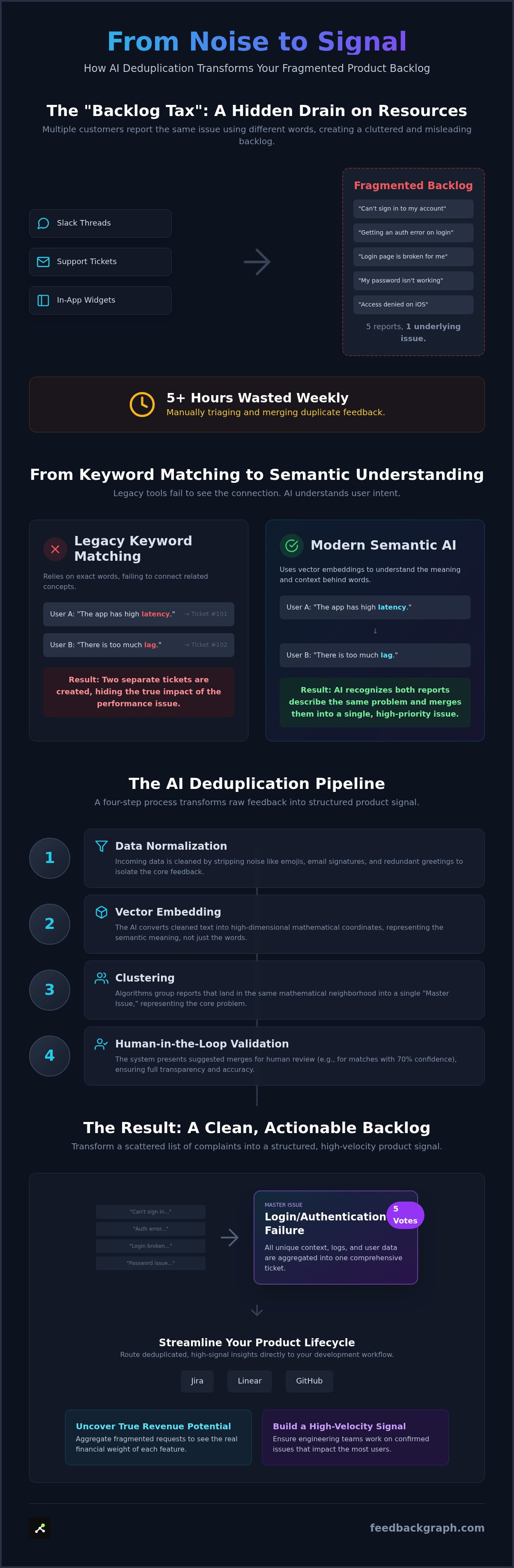
AI for deduplicating user feedback is a machine learning process designed to identify, group, and merge near duplicate reports into a single, actionable entity. In 2026, feedback arrives from every direction. Slack threads, support tickets, and in app widgets create a constant stream of unstructured data. Traditional systems rely on exact string matching, which fails when two users describe the same problem using different words. AI moves beyond the surface level to understand the intent behind the text.
The core goal is to establish a single source of truth for every unique user problem. This process builds on the technical foundation of record linkage, applying entity resolution to the messy world of human conversation. By identifying that two distinct tickets actually describe the same underlying friction, product teams can stop chasing ghosts and start solving confirmed issues. It transforms a scattered list of complaints into a structured roadmap.
The Evolution from Keyword Matching to Semantic AI
Legacy tools look for specific keywords. If one user says "latency" and another says "lag," a keyword system sees two different problems. Modern Natural Language Processing (NLP) recognizes these as semantically identical. AI for deduplicating user feedback uses vector embeddings to map phrases into a mathematical space where similar meanings sit close together. This allows the system to handle varying levels of technical detail and even different languages simultaneously. Whether a user provides a detailed technical breakdown or a short frustrated comment, the AI captures the core intent and clusters it with related data points.
The Business Case for Automated Triage
Manual deduplication is an expensive distraction. We call this the "Backlog Tax." When engineering teams have to sift through dozens of duplicate tickets to find one unique bug, development velocity drops. Automated triage eliminates this friction. It ensures that every unique feature request or bug report is accurately quantified. When five different users report the same issue, the system merges them into one ticket with five "votes." This provides an immediate, data driven view of customer feedback urgency. You gain a clear understanding of which problems affect the most users without spending ten hours a week in manual spreadsheets.
How AI Deduplication Works: Under the Hood
Transforming raw text into structured product signal requires a multi-stage pipeline. The process of using AI for deduplicating user feedback is more than just a search function. It's a sophisticated data engineering workflow that ensures every piece of information is captured without creating clutter. The system moves through four distinct phases to reach a clean state.
- Step 1: Data Normalization. This strips the noise from incoming data. It removes Slack emojis, email signatures, and redundant greetings that distract from the core issue.
- Step 2: Vector Embedding. The AI transforms cleaned text into high-dimensional mathematical coordinates. This represents the semantic meaning of the feedback rather than just the words used.
- Step 3: Clustering. Algorithms identify reports that land in the same mathematical neighborhood. These are grouped into a "Master Issue" that represents the singular problem.
- Step 4: Human-in-the-loop Validation. The system presents these groups as suggestions. This ensures transparency by allowing product managers to confirm a merge rather than letting the AI delete data silently.
Semantic Similarity vs. Fuzzy Matching
Fuzzy matching is a legacy approach that looks for character overlaps and typos. It often leads to false positives where "login" and "logging" are merged incorrectly because they look similar. Modern AI for deduplicating user feedback uses Large Language Models (LLMs) to interpret context. An LLM understands that a "login bug" is distinct from a "signup bug" even if the descriptions are brief. It also evaluates metadata. If one report is on iOS and another is on Android, the AI determines if they are the same cross-platform issue or two independent regressions. This precision prevents your engineering team from chasing incorrect leads.
Handling Near-Duplicates Without Losing Nuance
The threshold for merging is critical. If a match reaches a 95% confidence score, the system can trigger an auto-merge. If it falls to 70%, it flags the report for a quick review. Merging does not mean losing data. The AI enriches the master ticket by pulling unique log snippets, browser versions, or screenshots from every duplicate. This creates a more comprehensive view of the problem than any single report could provide. You can see this enrichment in action during a live walkthrough. Every original reporter remains linked to the master issue, preserving the communication trail so you can close the loop with everyone once the fix is deployed.
The Strategic Advantage: Deduplication as a Revenue Driver
Stop viewing deduplication as a janitorial task. It is a strategic financial filter. Fragmented feedback hides the true cost of inaction by spreading a single problem across dozens of disconnected tickets. When you use AI for deduplicating user feedback, you aggregate the financial weight of every report. A single bug might look minor when viewed as an isolated support ticket. Once merged, that same issue reveals itself as a major revenue blocker affecting multiple high-value accounts. This shift allows you to move from simple "Backlog Cleanup" to sophisticated, revenue-based prioritization.
Deduplicated data is the foundation of a profit-led roadmap. It helps you identify "Silent Killers." These are low-frequency bugs or feature gaps that only affect a small number of users, yet those users represent your most significant enterprise contracts. In a noisy, manual backlog, these signals are often dismissed as outliers. AI ensures these high-stakes requirements are grouped and elevated, providing the clarity needed to protect your most valuable revenue streams. You stop guessing what to build next and start investing in the features that drive the highest return.
Quantifying the Revenue Impact of Every Bug
Effective prioritization requires mapping customer feedback directly to their subscription value. AI aggregates the Annual Contract Value (ACV) of every user linked to a master issue. This data clarifies the stakes immediately. While ten feature requests from free-tier users might generate noise, two requests from enterprise accounts represent a critical retention or expansion opportunity. By merging these duplicates, the system presents a unified dollar value for every item in your backlog. This transparency ensures that your product team isn't just busy, but is actively working on the tasks that move the needle for the business.
Reducing Engineering Friction
Engineering teams lose momentum when they have to parse redundant or conflicting information. A clean, deduplicated backlog restores trust in the product roadmap and significantly improves developer velocity. AI automates the severity classification process by analyzing the frequency and financial urgency of similar reports. Instead of forcing an engineer to read fifty separate complaints, the system provides a single "Master Summary" that synthesizes all unique technical details and logs. This streamlined approach to AI bug triage allows your developers to focus on shipping high-impact code rather than performing manual data entry.
Implementation: Connecting AI Deduplication to Your Workflow
Moving from a chaotic backlog to a high-signal roadmap requires a structured implementation plan. You don't need a massive engineering overhaul to begin using AI for deduplicating user feedback. The transition happens in four clear steps that prioritize automation and visibility. It starts with how you capture the data and ends with how you communicate the resolution.
- Step 1: Install the Capture Widget. Use a two-click widget to standardize incoming reports. This ensures you collect the necessary metadata and logs right from the start, preventing fragmented or incomplete entries.
- Step 2: Configure AI Triage Rules. Set your parameters for auto-summarization and deduplication. The AI will immediately begin grouping similar reports, allowing you to review clusters instead of individual tickets.
- Step 3: Establish Bi-directional Sync. Connect your feedback hub to Jira, Linear, or GitHub. This ensures that when a product manager merges duplicates, the engineering team sees a single, enriched issue.
- Step 4: Enable Status Sync. Define rules that automatically notify all original reporters when the master issue is resolved in your dev tools.
Jira and Linear: The Bi-directional Sync Advantage
A one-way push to your development tools is a recipe for communication breakdown. If your engineering team closes a ticket in Jira, your customers shouldn't be left in the dark. Bi-directional sync ensures that status updates flow naturally from the dev environment back to the customer success team and the end users. You can automate Jira issue creation directly from feedback to save hours of manual entry. This removes the "Status Update" burden from Product Managers, allowing them to focus on strategy while the AI handles the logistics of keeping everyone informed.
Closing the Feedback Loop
The real power of AI for deduplicating user feedback is the ability to communicate at scale. When you resolve a single "Master Issue," you are effectively solving the problem for every user linked to that cluster. Instead of manually emailing dozens of people, you can send a unified update. This builds immense trust through transparency. Telling a customer, "We fixed the issue you and 45 others reported," proves that you are listening and acting on data. Leveraging bi-directional Jira feedback sync creates a real-time communication channel that keeps customers engaged without adding to your support team's workload.
FeedbackGraph: The AI-First Solution for Deduplicated Feedback
FeedbackGraph isn't just a feedback repository; it's an intelligent assistant that processes every incoming signal in real time. Most teams struggle with a backlog that grows faster than they can prune it. Our platform uses AI for deduplicating user feedback to ensure that your engineering team only ever sees unique, high-value tasks. By the time a ticket reaches your development environment, it has already been enriched with an automated title, severity rating, and technical summary. This proactive approach to AI Bug Triage stops the flood of redundant data before it can disrupt your development cycle.
The platform's true power comes from its ability to translate technical issues into business value. Through ranking feature requests by revenue, you move beyond simple vote counts. You see exactly how much Annual Contract Value (ACV) is tied to a specific request or bug. This financial transparency ensures your roadmap is built on profit, not just volume. Our bi-directional sync with Jira, Linear, and GitHub keeps your entire organization aligned, ensuring that every update in the dev tool is reflected in the feedback hub instantly.
Why Teams Choose FeedbackGraph Over Manual Triage
Modern product teams are abandoning manual ticket merging because it doesn't scale. Most managers report saving 10 or more hours per week by automating their triage process. This isn't just about reclaiming time. It's about gaining 100% visibility into the revenue impact of every backlog item. When you eliminate the noise, you reveal the critical signals that drive retention and expansion. Explore the full list of FeedbackGraph features to understand how we standardize data flow across your entire product lifecycle.
Getting Started with AI-Powered Deduplication
The transition from messy spreadsheets to an automated system is seamless. Our "No-Friction" promise ensures you can connect FeedbackGraph to your current stack in minutes. The two-click capture widget provides a frictionless experience for your users, encouraging high-quality reporting without interrupting their workflow. This standardization is the first step toward effective AI for deduplicating user feedback. Check out our use cases for bug tracking to see how we help teams turn chaotic support threads into a streamlined engineering queue. It's time to stop managing noise and start delivering impact.
Reclaim Your Roadmap with Automated Triage
The era of manual backlog grooming is over. You've seen how semantic vector embeddings identify the signal within thousands of fragmented support tickets. Implementing AI for deduplicating user feedback isn't just about cleaning up data. It's about making every engineering hour count toward your bottom line. By centralizing intent and mapping it to account value, you gain an evidence-based roadmap that engineers trust and customers appreciate.
FeedbackGraph provides the intelligent assistant you need to automate triage, sync with your dev stack, and prioritize by revenue. Standardizing your feedback loop creates a massive competitive advantage. You move faster, decide with more confidence, and ensure that your developers are focused on the highest-leverage tasks. This process turns a source of operational friction into your most powerful strategic asset. It's a pragmatic shift that delivers immediate results for high-growth SaaS teams.
It's time to stop chasing noise and start shipping the features that drive growth. Your team deserves a clean, actionable backlog that reflects the true needs of your most valuable customers. Start building with precision today.
Frequently Asked Questions
How accurate is AI at identifying duplicate user feedback?
Modern AI models achieve high accuracy by analyzing semantic intent rather than just matching keywords. By mapping text into a multi-dimensional vector space, the system recognizes that "the app is lagging" and "performance is slow" describe the same friction. This method significantly outperforms legacy fuzzy matching. It effectively filters out noise while ensuring that similar reports are grouped correctly, allowing your team to focus on resolution rather than manual discovery.
Can AI deduplication distinguish between similar-looking but distinct bugs?
Yes, advanced Large Language Models (LLMs) are trained to interpret technical context and nuance. They can distinguish between a login failure caused by a database timeout and a signup error triggered by a frontend validation bug. By evaluating metadata like browser versions, operating systems, and specific error logs, the AI ensures that distinct technical regressions are kept separate. This precision prevents incorrect merges that could otherwise mislead your engineering team.
Does deduplicating feedback mean I lose the original user’s context?
You don't lose any data when merging reports. AI for deduplicating user feedback enriches a master issue by consolidating unique details from every duplicate submission. This includes specific log snippets, screenshots, and user comments. Every original reporter remains linked to the master ticket. This preservation allows you to maintain a complete communication trail and notify every individual user automatically once the engineering team deploys a fix.
How does AI deduplication integrate with tools like Jira or Linear?
FeedbackGraph uses bi-directional sync to bridge the gap between customer feedback and your development environment. When the AI identifies a duplicate, it merges the data and routes a single, enriched issue to Jira, Linear, or GitHub. Any status change in your dev tool reflects back in the feedback dashboard instantly. This automation ensures that your product and engineering teams stay aligned without requiring manual status updates or cross-platform data entry.
Will AI for deduplicating feedback help me prioritize my roadmap?
This technology is a primary driver for revenue-based prioritization. By aggregating the Annual Contract Value (ACV) of every user who reports a specific issue, the AI reveals the true financial weight of your backlog items. You can quickly identify high-value bugs that affect enterprise accounts but might have low report volume. This data allows you to build a roadmap based on tangible business impact rather than just the loudest voices.
Is AI deduplication safe for sensitive customer data?
FeedbackGraph is built as a secure SaaS platform designed for modern enterprise standards. The AI triage process focuses on technical intent and metadata to perform deduplication, ensuring that sensitive customer data is handled according to strict privacy protocols. Because the system uses a two-click widget for capture, it standardizes the data flow and minimizes the risk of accidental exposure. Your team maintains full control over which insights are merged or shared with development tools.


