

Your product roadmap isn't a strategy; it's a graveyard of expensive guesses. When 49.2% of product professionals cite resource constraints as the primary cause of strategy misalignment, the problem isn't a lack of vision. It's a data integrity crisis. Most leaders feel the friction of disconnected data between their CRM and engineering tools, leaving them to guess which features actually move the needle. If you're still manually quantifying every request, you're falling behind. Modern revenue driven roadmap software must do more than visualize tasks. It must automate the link between raw feedback and financial value.
You've likely felt the pain of a bloated backlog that makes high-value opportunities invisible. Defending a roadmap without fiscal logic is a losing battle. This guide shows you how to transform that backlog into a financial blueprint that prioritizes growth. We'll explore how to automate ranking by revenue impact and build a roadmap that executives actually trust. By the end, you'll have a clear path to integrating these systems directly into your existing dev workflows for seamless, data-driven execution.
Key Takeaways
- Transition from feature-first planning to a profit-led blueprint that aligns every development task with specific financial outcomes.
- Discover how AI-powered triage eliminates manual backlog bloat by automatically generating summaries and severity levels for incoming reports.
- Identify the critical differences between visual presentation tools and data-driven decision engines when selecting your revenue driven roadmap software.
- Master a two-step framework for connecting billing data to your backlog to map user profiles directly to measurable growth.
- Streamline engineering workflows with bi-directional integrations that ensure status updates reach stakeholders automatically.
The Shift from Feature-First to Revenue-Driven Roadmapping
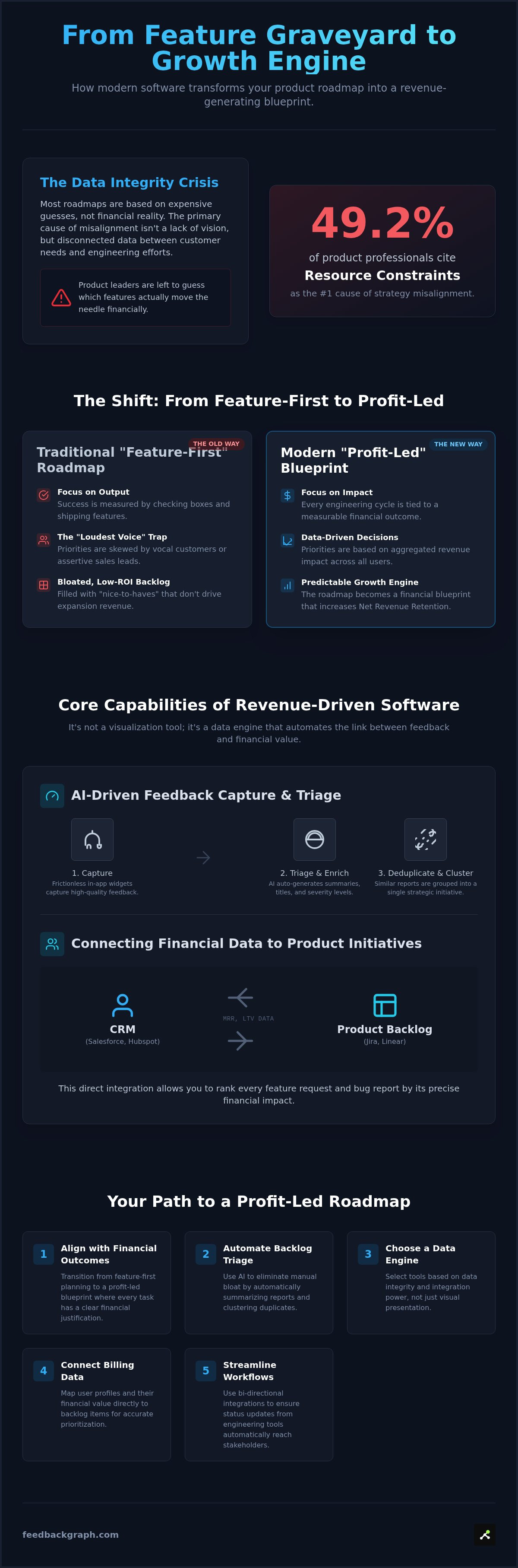
Modern product management has outgrown the static technology roadmap. In 2026, high-performing teams treat every line of code as a capital allocation decision. Revenue driven roadmap software is a specialized system that aligns development tasks with financial outcomes. It moves the conversation from what you can build to what will drive growth. Traditional feature-first roadmaps focus on output, checking boxes on a list of requests. Modern profit-led blueprints focus on impact, ensuring that engineering cycles yield measurable ROI.
Qualitative feedback often creates a "Loudest Voice" trap. A single vocal enterprise customer or an assertive sales lead can easily derail a product strategy. Without hard data, teams prioritize low-ROI features that satisfy one user while ignoring broader market opportunities. This creates a bloated backlog filled with nice-to-haves that never result in expansion revenue. Revenue-based prioritization is the process of assigning a dollar value to every backlog item to maximize MRR growth.
Why Traditional Roadmaps Fail in 2026
The gap between sales data and engineering reality is a primary source of operational friction. Data silos between Sales (CRM), Support (Zendesk), and Engineering (Jira or Linear) prevent accurate valuation of feature requests. Manual spreadsheets are obsolete by the time they're shared. They lack the real-time connectivity required to track shifting customer values. This lack of transparency creates immediate friction during budget reviews. CFOs in 2026 no longer accept intuition as a justification for engineering headcount. They demand a clear, data-backed link between the product backlog and the company's financial health.
The Business Case for Profit-Led Prioritization
Prioritizing by revenue isn't just about sales; it's about ruthless efficiency. Focusing on high-value customer needs directly increases Net Revenue Retention (NRR) by solving the problems that keep your most profitable users paying. It eliminates engineering waste by purging low-impact feature requests before they reach a sprint. This alignment ensures that technical initiatives support executive business goals. When every feature has a price tag, the roadmap becomes a predictable growth engine. It fosters a culture of accountability where every developer understands how their work impacts the bottom line.
Core Capabilities of Modern Revenue Driven Roadmap Software
Visualization is often confused with strategy. While a clean timeline looks impressive in a slide deck, the true power of revenue driven roadmap software lies in its underlying data engine. It replaces the manual burden of backlog management with automated pipelines that connect customer sentiment directly to financial reality. This transition ensures that every item in your sprint has a documented business case. By shifting from a static document to an active decision engine, product leaders gain the transparency needed to justify engineering costs to stakeholders.
AI-Driven Feedback Capture and Enrichment
Data integrity begins with frictionless entry. Modern systems use two-click in-app widgets to capture bugs and feature requests exactly where users encounter them. This accessibility ensures a high volume of quality data without disrupting the user experience. Once captured, the AI takes over the administrative heavy lifting. It automatically generates concise titles, summaries, and severity levels for every report. This automation prevents the "backlog bloat" that occurs when engineers have to manually triage hundreds of vague tickets. You can learn how to manage product feedback to see how this enrichment keeps your development pipeline clean and focused.
Deduplication is another critical AI function. Instead of seeing dozens of individual reports for a single UI glitch, the software clusters near-duplicate submissions into a single strategic initiative. It aggregates the total business impact across all affected users, providing a clear picture of the problem's scale. This clustering allows teams to address the root cause of customer friction rather than playing whack-a-mole with isolated tickets. It transforms raw feedback into actionable intelligence that drives expansion revenue.
Linking Financial Data to Product Initiatives
A roadmap is only as strong as the data that powers it. Leading platforms integrate directly with your CRM to pull real-time account values, such as MRR and LTV, into the product backlog. This allows you to rank requests by their actual financial weight. When you can see that a specific feature request is tied to $250k in potential expansion revenue, prioritization becomes objective. This approach aligns with proven prioritization methodologies by quantifying the cost of delay. If you don't ship a specific fix, you know exactly how much revenue is at risk.
This financial mapping also enables quantifiable reporting for the executive team. You can visualize the total dollar value of the current backlog, providing a clear ROI for engineering headcount. Bi-directional sync with tools like Jira and Linear ensures that as work progresses, the roadmap and financial forecasts update automatically. This creates a seamless loop where engineering effort is always visible and valued. If you want to see how these data layers work in a live environment, schedule a platform walkthrough to explore the integration ecosystem.
Evaluating Roadmap Tools: Data Integrity vs. Visual Fluff
Most roadmap tools on the market are built for optics, not outcomes. They offer beautiful Gantt charts and drag-and-drop interfaces that hide a fundamental lack of data integrity. When selecting revenue driven roadmap software, you must prioritize the data engine over the UI. A presentation tool might help you survive a board meeting, but only a decision engine will help you scale MRR. Evaluating these tools requires looking beneath the surface at how data actually enters and moves through the system.
To identify a true decision engine, use these three non-negotiable criteria:
- Bi-directional Sync: Does it integrate deeply with Jira, Linear, and GitHub? If updates don't flow both ways, your roadmap is a static document, not a live strategy.
- AI-Led Triage: Does the software require manual tagging for every ticket? Modern systems use AI to automate the triage process, generating summaries and severity levels without human intervention.
- Account-Level Mapping: Can it pull data from your CRM to rank items by specific customer account value? Ranking by "perceived impact" is a guess; ranking by $500k in at-risk LTV is a strategy.
The Problem with Manual Prioritization Frameworks
Traditional frameworks like RICE often fail because they rely on subjective inputs. "Impact" and "Confidence" scores are usually just gut feelings dressed up as data. This subjectivity frequently derails the product management process, leading to misaligned priorities. Manual tools also suffer from rapid data decay. If your roadmap doesn't sync in real-time with dev tools, it becomes obsolete within days. For a deeper dive into avoiding these pitfalls, check out our Revenue-Based Feature Ranking: 2026 Profit-First Guide.
Integration Depth: Beyond Simple Webhooks
Simple webhooks are insufficient for 2026 engineering standards. They often break or fail to capture the full context of a development sprint. Bi-directional sync is essential to ensure engineering efficiency; when a ticket is closed in Linear, the roadmap should update instantly. This automation allows you to close the feedback loop by notifying customers the moment their request ships. Forward-thinking teams are now implementing an MCP server for product management. This allows AI agents to interact directly with your data, ensuring your revenue driven roadmap software acts as an active, intelligent assistant rather than a passive list of tasks.
Implementing a Profit-Led Prioritization Framework
Scaling a SaaS product in 2026 requires moving beyond intuition. A profit-led framework replaces the gut feeling of product managers with hard financial data. Implementing this starts with choosing the right revenue driven roadmap software to act as your central source of truth. This system must bridge the gap between customer success, sales, and engineering. When these teams share a single data layer, the roadmap stops being a source of friction and becomes a strategic asset.
The implementation follows a logical, five-step sequence designed for speed and clarity:
- Centralize and Triage: Pull every feedback channel into a single AI-powered dashboard. Whether feedback comes from Slack, email, or in-app widgets, it must land in one place for processing.
- Revenue Mapping: Connect your CRM or billing data. This allows the system to pull real-time MRR and LTV data for every user who submits a request.
- AI Categorization: Use AI to deduplicate near-identical requests. The system should automatically group these into strategic themes or initiatives, saving hours of manual tagging.
- Strategic Ranking: Rank the backlog by total revenue impact. This visualizes the difference between "Quick Wins", low effort with high revenue, and "Strategic Bets" that require significant investment but offer massive long-term scale.
- Workflow Integration: Sync prioritized items directly to Jira, Linear, or GitHub. This ensures the engineering team is always executing on the most financially significant tasks.
Quantifying the Revenue Impact of Bug Reports
Not all bugs are created equal. In a traditional setup, engineering often prioritizes by technical severity alone. A profit-led approach identifies bugs affecting high-value enterprise accounts first. This quantification helps you measure the "Churn Risk" associated with unresolved technical debt. If a bug impacts a segment representing a significant portion of your revenue, it's no longer just a ticket; it's a financial liability. For more on this, read our Measuring Bug Revenue Impact: 2026 Profit-Led Triage Guide. This method justifies maintenance sprints to executive leadership by showing the revenue saved.
Closing the Feedback Loop Automatically
Customer frustration often stems from a lack of communication. Automated notifications solve this by alerting users the moment their request is planned, started, or shipped. This level of transparency significantly reduces support ticket volume. Users don't need to ask for updates when the system provides them proactively. You can explore use cases for internal and external feedback to understand how automated status updates improve both customer satisfaction and internal team alignment. By closing the loop, you turn feedback into a collaborative growth engine.
FeedbackGraph: Automating the Link Between Feedback and Revenue
FeedbackGraph is the only revenue driven roadmap software engineered specifically to turn customer feedback into a financial blueprint. It eliminates the friction between high-level strategy and technical execution. Most tools force you to choose between data accuracy and user adoption. FeedbackGraph delivers both. Our two-click widget allows users and sales reps to capture bugs or feature requests instantly without leaving their workflow. This frictionless entry ensures your data is always current. It stops the cycle of chasing sales leads for missing context.
The AI Triage dashboard acts as your intelligent assistant. It enriches every submission by automatically generating titles, summaries, and severity levels. This process saves hundreds of manual engineering hours every quarter. Instead of developers sifting through vague bug reports, they receive prioritized, well-documented tickets. Our bi-directional integration ecosystem ensures this data flows seamlessly between Slack, Jira, Linear, and GitHub. When a developer moves a ticket to "Done" in Linear, the roadmap reflects that progress in real-time. This status update also travels back to the original reporter automatically; closing the feedback loop requires no human intervention.
Revenue-Based Ranking in Action
FeedbackGraph doesn't just list features. It calculates a specific revenue impact score for every request in your backlog using our Revenue-Based Feedback Ranking. By connecting directly to your CRM, the platform maps customer account values to specific feedback items. This allows you to visualize the "Revenue at Risk" in your current engineering backlog. You can identify exactly which unresolved bugs are threatening high-value renewals. To see how this transforms your prioritization, see the full list of FeedbackGraph features. This transparency gives your CFO the confidence to approve engineering budgets because the ROI is undeniable.
Built for Engineering and Product Synergy
The primary goal of FeedbackGraph is the elimination of backlog noise. Engineers often struggle with feature bloat that distracts from core stability. Our AI-powered triage ensures that only high-impact initiatives reach the development cycle. This synergy ensures that no high-value customer request ever falls through the cracks again. Product managers gain a data-backed defense for their roadmap; engineers gain a clear, focused backlog. It's a no-nonsense remedy for the misalignment that plagues modern software teams. Stop guessing and start building for growth. Every line of code should be an investment in your company's future.
Start your free trial of FeedbackGraph
Scale Your Growth with Data-Backed Roadmap Execution
The era of intuition-based product management is over. Executives in 2026 demand a transparent link between engineering effort and financial growth. By adopting revenue driven roadmap software, you eliminate the friction of disconnected data silos and subjective prioritization frameworks. You move from a passive list of features to an active, profit-led blueprint that CFOs trust and engineering teams actually support. It's time to treat every line of code as a capital allocation decision.
Implementing AI-powered triage saves over 10 engineering hours per week by automating the triage and deduplication process. Bi-directional sync with Jira, Linear, and GitHub ensures your strategy remains a living document; status updates flow to stakeholders without manual intervention. High-growth SaaS teams use revenue-based ranking to identify high-impact wins and mitigate churn risks before they affect the bottom line.
Stop defending your backlog with subjective guesses. Transform your product development into a predictable, data-backed revenue engine today.
Frequently Asked Questions
What is revenue driven roadmap software?
It is a strategic system designed to align software development tasks with specific financial outcomes. Unlike traditional roadmapping tools that focus on feature output, this software connects product feedback directly to CRM and billing data. This connection allows teams to prioritize their backlog based on measurable impact, such as MRR growth or churn reduction. It transforms the product roadmap into a financial blueprint for the business.
How does AI help in ranking feature requests by revenue?
AI automates the enrichment and categorization of raw feedback by scanning incoming reports and matching them with customer profiles. This process calculates a revenue impact score instantly by aggregating the LTV or MRR of the reporting users. It identifies which features or fixes affect your highest-value accounts without requiring manual data entry. This removes subjective bias and creates an objective hierarchy based on hard fiscal data.
Can I sync revenue-driven roadmaps with Jira or Linear?
Yes, modern revenue driven roadmap software integrates bi-directionally with tools like Jira, Linear, and GitHub. When you prioritize a feature based on its financial value, the system pushes a ticket directly to your engineering issue tracker. As developers update the status in their local tool, the roadmap reflects those changes automatically. This ensures that sales and product teams stay aligned without constant manual status checks.
How do you quantify the revenue impact of a single bug?
Quantification happens by mapping the bug report to the specific customer accounts it affects. By integrating your billing system, you can see the total recurring revenue tied to the users experiencing the issue. This helps you identify "Revenue at Risk" for every ticket in your backlog. You can then prioritize a critical blocker affecting an enterprise account over minor cosmetic issues that have no impact on retention.
Does revenue-based prioritization ignore user experience?
It actually enhances user experience by focusing resources on the problems that matter most to your most valuable users. High-value customers typically report the most critical friction points in your application. Solving these issues improves retention and creates expansion opportunities. Profit-led prioritization ensures you don't waste engineering cycles on "nice-to-have" features that don't solve core user problems or contribute to the long-term health of the business.
Is it possible to automate the feedback triage process?
Automation is a core capability of modern platforms like FeedbackGraph. AI-powered triage automatically generates descriptive titles, summaries, and severity levels for every incoming report. It also deduplicates near-identical requests to prevent backlog noise and bloat. This automation saves your product and engineering teams hours of manual review every week. It ensures that only high-quality, enriched data reaches the prioritization stage for final decision-making.
What is the difference between a roadmap tool and an issue tracker?
A roadmap tool focuses on strategy and financial alignment, answering the "why" and "when" behind product decisions. It aggregates feedback and links it to business goals. An issue tracker like Jira or Linear focuses on execution, managing the granular tasks of the development sprint. Bi-directional sync ensures these two systems stay aligned; the roadmap provides the strategic direction while the tracker manages the technical implementation.
How do bi-directional integrations help product teams?
Bi-directional integrations eliminate manual data entry and ensure real-time accuracy across the entire organization. Status updates from engineering flow back to the roadmap automatically, which can trigger notifications to customers when their requests ship. This closes the feedback loop without human intervention. It reduces the need for constant sync meetings and ensures that every department is working from a single, accurate source of truth regarding product progress.


