

Your product roadmap isn't a democracy; it's a financial ledger. Most SaaS teams treat feature requests like a popularity contest, letting the loudest customers or the most recent Slack pings dictate where engineering hours go. It's a reactive cycle that drains resources on low-value bugs while high-churn risks sit ignored in the backlog. You know the frustration of building a "highly requested" feature only to see it move the needle exactly zero percent on your bottom line.
We agree that gut feelings and decibel levels are poor substitutes for hard data. You need a system that proves a specific ticket is worth more than the five others competing for attention. This guide shows you how to stop the guesswork by linking customer feedback to MRR. You'll learn how to quantify the financial impact of every request and transform your roadmap into a high-precision growth engine. We're walking through a clear framework for revenue-based prioritization that reduces backlog noise and builds lasting stakeholder trust. It's time to stop chasing voices and start building for value.
Key Takeaways
- Identify why the "loudest customer" trap leads to wasted engineering resources and learn to distinguish between feedback volume and actual financial value.
- Master the technical mechanics of linking customer feedback to MRR by mapping user IDs directly to billing systems like Stripe and Chargebee.
- Learn how to weight feature requests by subscription tier to ensure your roadmap prioritizes the needs of your high-value Enterprise and Pro users.
- Implement a four-step framework to centralize feedback capture and enrich every ticket with automated AI metadata and real-time billing status.
- Discover how AI-powered triage eliminates manual backlog noise, allowing you to scale a revenue-driven roadmap without increasing administrative overhead.
The Myth of the 'Loudest Customer': Why Volume Does Not Equal Value
Your backlog is lying to you. Most product teams prioritize by volume, assuming that 50 requests for a feature automatically makes it a priority. This is the "Squeaky Wheel" trap. Often, these requests come from low-tier or free users who have the most time to submit tickets but contribute the least to your growth. Revenue-based product prioritization flips this. It maps every decision to financial outcomes. By linking customer feedback to MRR, you ensure your engineers build what keeps the lights on and the revenue growing.
The High Cost of Misaligned Roadmaps
Engineering hours are your most expensive resource. Wasting them on low-value bugs or niche requests from your smallest accounts is a strategic failure. There is a hidden danger here: the silent churn of high-value customers. While the noisy minority fills your Slack channels, your Enterprise partners might be quietly looking for alternatives because their critical needs aren't being met. Public voting boards often exacerbate this. They encourage a "generic" product path that satisfies everyone a little but satisfies your biggest revenue drivers not at all. You end up with a mediocre product and a shrinking bottom line.
Feature Popularity vs. Feature Profitability
- Popularity: A dark mode request from 200 trial users. It looks like a win on a public board but generates zero expansion revenue.
- Profitability: A specific API endpoint requested by three Enterprise accounts. It’s invisible to the public but secures $50,000 in annual renewals.
The difference is clear. Popularity feels good in the short term, but profitability sustains the business. Real growth happens when you stop counting heads and start counting dollars. It's about moving from a reactive stance to a proactive financial strategy.
Reframing Feedback as Financial Data
Stop asking "What do they want?" and start asking "Who wants this and what do they pay?" This requires shifting your perspective to user segmentation. Every piece of feedback should be viewed through the lens of Customer Lifetime Value (CLV). When you treat feedback as financial data, you can identify "Revenue at Risk" before it’s too late. It’s about visibility. Without linking customer feedback to MRR, your backlog is just a list of opinions. With it, your roadmap becomes a calculated investment strategy. You can see exactly which features will drive retention and expansion, allowing you to ignore the noise with total confidence. This shift transforms your customer feedback process from a chaotic inbox into a predictable growth engine.
The Mechanics of Linking Customer Feedback to MRR
Building a revenue-driven roadmap requires more than just listening. It requires a precise technical bridge. The process of linking customer feedback to MRR starts with a shared identifier. By using a unique User ID as the primary key, you create a direct line between your feedback widget and your billing platform, whether you use Stripe, Chargebee, or a custom internal system. This connection transforms a vague text request into a concrete financial data point that your product team can actually use.
The Data Pipeline: From Widget to Roadmap
When a user submits feedback, your system must capture more than just their comments. It needs rich metadata captured at the point of origin. This includes the User ID, their current subscription tier, and their total account value. Capturing this data at the source prevents the information decay that happens when support tickets are manually moved between tools. It also allows you to quantify revenue impact of bugs by instantly seeing the MRR of every affected account. If a high-value Enterprise client is blocked by a technical issue, that ticket should automatically bypass the noise of low-tier feature requests.
Real-time data sync is non-negotiable for this pipeline. Stale data leads to misinformed prioritization. If a customer upgrades from a Pro to an Enterprise plan, their feedback weight should update across your roadmap immediately. This level of visibility ensures that your engineering resources are always allocated to the highest-value opportunities. To see how this automated data flow looks in practice, you can book a personalized walkthrough of the platform.
Revenue-Based Scoring Models
Standard frameworks like RICE (Reach, Impact, Confidence, Effort) often fail because they rely on subjective "Impact" scores that vary between product managers. You can eliminate this bias by adding a literal "M" factor for MRR. Instead of guessing impact, you aggregate the actual dollar value of every user who has requested or upvoted a specific feature. This creates a customer-driven product backlog that reflects your true business priorities rather than just the most popular opinions.
Effective models also differentiate between "New Revenue" potential and "Retention" value. A request from a churn-risk account with a high MRR has a different strategic weight than a request from a happy customer looking for an incremental improvement. By weighting requests by subscription tier, you ensure that your Enterprise partners receive the attention their investment deserves. This mechanical approach to linking customer feedback to MRR turns your roadmap into a transparent, evidence-based strategy that stakeholders can finally trust.
Myth-Busting: 3 Lies About Revenue-Based Prioritization
Resistance to revenue-driven product management usually stems from outdated assumptions. Many teams fear that prioritizing by dollars will alienate their community or create a technical nightmare for their engineers. These fears are based on myths that ignore the reality of modern SaaS growth. To build a truly resilient product, you must separate these misconceptions from the data-driven truth.
Myth 1: The "Equality" Trap
The most common lie is that revenue-based prioritization hurts your relationship with smaller customers. In reality, treating all feedback as equal is a disservice to your power users. When you ignore the specific needs of the customers who fund your growth, you risk losing the very capital that allows you to improve the product for everyone. Prioritization isn't about ignoring the "little guy." It's about strategic allocation. By ensuring your highest-paying accounts are satisfied, you secure the resources needed to refine general UX and maintain a stable platform for your entire user base. A healthy roadmap balances core revenue protection with broad usability improvements, but it never confuses noise for value.
Myth 2: The Complexity Barrier
Many product managers believe they need a dedicated data science team to start linking customer feedback to MRR. They envision manual spreadsheets and endless cross-referencing between support tickets and billing logs. This is no longer the case. Modern revenue driven roadmap software automates the heavy lifting. These tools sync your feedback directly with your CRM and billing systems, providing an instant financial weight for every request. The shift from manual triage to automated AI analysis means you get clear, actionable insights without the administrative overhead. You don't need a complex data pipeline; you just need the right integration layer to surface the numbers that already exist in your stack.
Myth 3: Bugs are Just Technical Debt
The final lie is that bugs are purely technical debt and shouldn't be part of the revenue conversation. This perspective is dangerous. A bug isn't just a code error; it's a friction point that threatens your MRR. When you view AI bug triage as a profit-led strategy, you stop fixing issues in the order they arrive. Instead, you prioritize the fixes that impact your high-value segments first. Linking customer feedback to MRR allows you to see that a minor UI glitch for an Enterprise account might be more critical than a functional bug for a free-tier user. Treating bugs as revenue opportunities ensures that your maintenance work directly supports your retention goals.
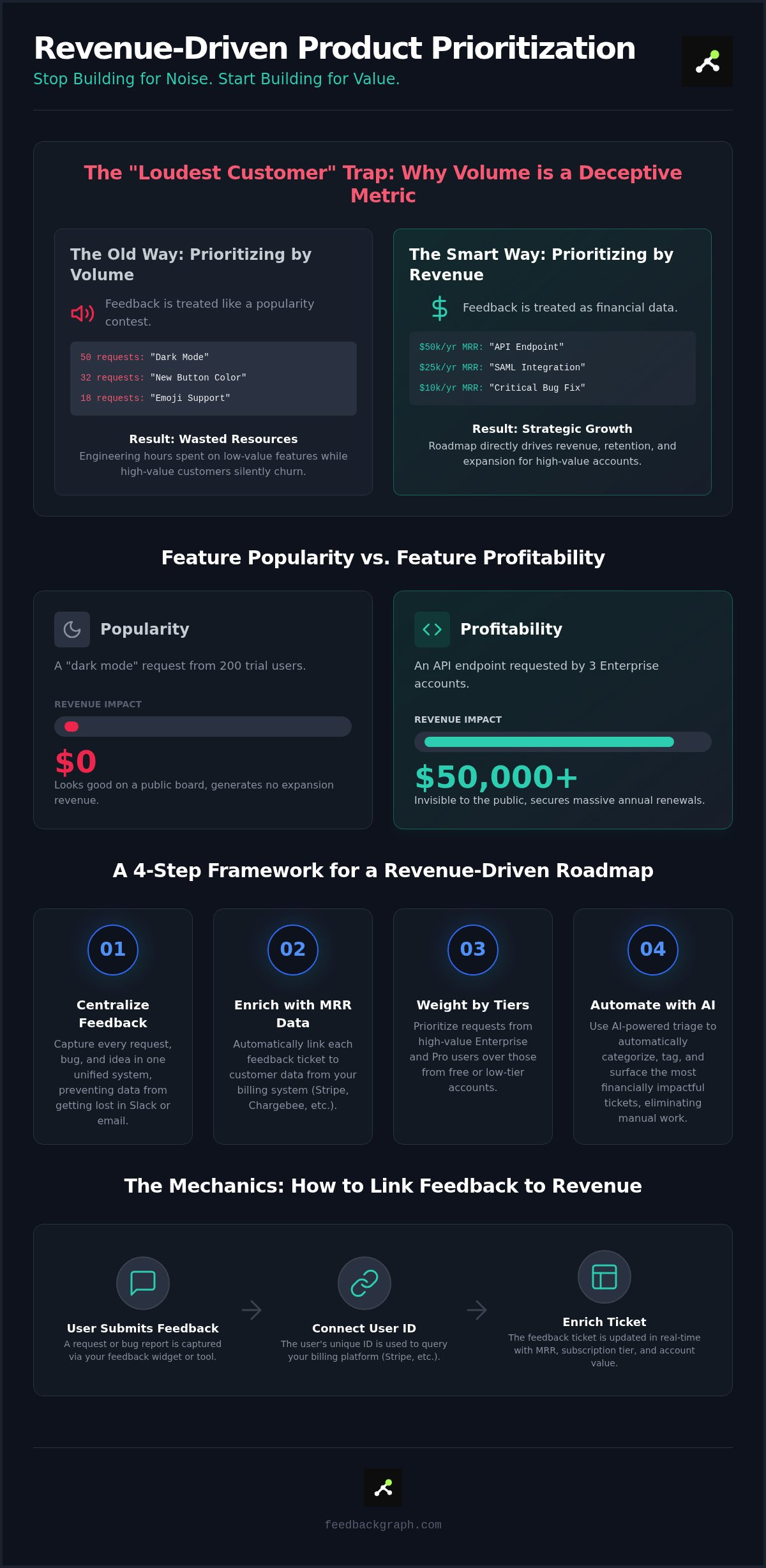
A 4-Step Framework for Revenue-Driven Product Prioritization
Execution is where most product strategies fail. You can understand the theory of revenue-driven roadmapping, but without a repeatable process, you'll revert to chasing the loudest voices. This framework moves you from reactive firefighting to proactive growth. By linking customer feedback to MRR through a structured pipeline, you turn every user insight into a documented business opportunity.
Step 1 & 2: Capturing and Enriching Data
Centralization is the first requirement. Manual entry is the enemy of scale; it creates data silos and leads to information decay. Use an in-app widget to capture feedback at the moment of user friction. This ensures high-quality data and automatically attaches critical metadata like User ID and plan type. AI then takes the lead, deduplicating incoming requests and summarizing sentiment instantly. This eliminates the "noise" of repetitive tickets that usually clogs your backlog.
Your enrichment process must also include internal feedback from your sales and customer success teams. These frontline employees often hold the keys to expansion revenue and churn prevention. By linking their insights directly to the user's billing status, you create a 360-degree view of account value. You no longer see a "feature request"; you see a specific dollar amount at risk or a clear path to an upgrade.
Step 3 & 4: Ranking and Syncing
Once your data is enriched, you need a Revenue-First view. Your triage dashboard should rank requests dynamically based on the total MRR of the requesting users. This view allows you to see exactly which features will move the needle for your Pro and Enterprise segments. It provides the evidence you need to say "no" to low-value requests with total confidence. Prioritization becomes a transparent, logical calculation rather than a subjective debate between stakeholders.
The final step is execution through bi-directional sync. Your prioritized items should flow directly into dev tools like Jira or Linear. This keeps your engineering team focused on high-impact tasks without forcing them to leave their preferred environment. When the feature is live, use your data bridge to close the loop. Notify the high-value customers who requested the update. This demonstrates that you value their investment, which directly improves retention and builds long-term trust. Linking customer feedback to MRR ensures that every release is a strategic win for your bottom line.
Automation: Scaling Your Revenue-Driven Roadmap
Scale introduces chaos. As your user base grows, the volume of feedback grows exponentially, but your product team's capacity remains fixed. Manual systems collapse under this weight. Automation is the only viable path for linking customer feedback to MRR at scale. It removes the bottleneck of human review and replaces it with an objective, data-driven engine that protects your most valuable accounts. You stop being a filter and start being a strategist.
Why Manual Triage Fails at Scale
Manual systems lead directly to the "Backlog Graveyard." This is where high-value requests go to die because they're buried in unmanageable spreadsheets or disconnected Slack threads. Humans are naturally biased; they often prioritize the most recent or most emotionally charged feedback rather than the most financially significant. AI-MRR mapping eliminates this subjectivity. It provides an evidence-based look at your backlog. You can capture customer feedback through multiple channels without adding friction to the dev team. The system handles the heavy lifting, ensuring that every ticket is weighed against the actual revenue it represents in real-time.
Implementing FeedbackGraph for Immediate ROI
FeedbackGraph automates the entire lifecycle of a request. It starts with a two-click widget that captures high-quality reports without disrupting the user experience. The platform uses AI to deduplicate entries and generate concise, technical titles and severity levels. This saves your engineers hours of manual investigation and clarification. By integrating directly with your billing stack, it handles the complex task of linking customer feedback to MRR automatically. You don't have to guess which bugs are costing you the most; the dashboard shows you the dollar value at risk instantly.
This creates a proactive revenue protection layer. Instead of reacting to churn threats after they happen, your roadmap anticipates them. You see the financial impact of every bug and feature before you commit a single line of code. This is the foundation of a "Profit-First" engineering culture. It aligns your technical team with your business goals, ensuring that every sprint delivers maximum ROI. You aren't just shipping features; you're securing your company's financial future through automated, intelligent prioritization. The result is a roadmap that stakeholders trust and a product that high-value customers never want to leave.
Build a Roadmap for Revenue, Not Noise
Stop letting the loudest voices dictate your engineering spend. Your backlog should be a strategic asset, not a collection of unverified opinions. By linking customer feedback to MRR, you transform every feature request into a measurable financial decision. This shift ensures your team builds for the high-value Enterprise and Pro users who drive your long-term growth. You don't have to guess where your resources will have the most impact; you'll have the hard data to prove it.
Implementing a revenue-driven model provides the clarity needed to say "no" to low-value distractions with total confidence. Using a system that offers AI-powered triage and bi-directional Jira or Linear sync allows you to automate the friction out of your workflow. A revenue-based ranking dashboard gives you the transparency to defend your roadmap to every stakeholder. It's time to move beyond popularity contests and start building for profitability.
Start Ranking Feature Requests by Revenue with FeedbackGraph
Secure your SaaS growth by putting profit at the center of your product lifecycle. You have the framework and the technical path. Now it's time to execute. Build the features that matter and protect your bottom line today.
Frequently Asked Questions
How do you calculate the MRR impact of a single feature request?
You calculate MRR impact by aggregating the monthly subscription values of every unique user who has requested or upvoted the item. This requires a direct link between your feedback platform and your billing system. If ten users on a $500 monthly plan request a specific feature, the MRR impact is $5,000. This calculation provides an objective dollar value that allows you to compare requests with financial precision.
Can I prioritize by revenue if I have a Freemium model?
Yes, and it is essential for converting free users into paying customers. You should track feedback from free users separately but prioritize items that have high intent from current Pro or Enterprise accounts. By linking customer feedback to MRR, you can identify which features free users are actually willing to pay for. This allows you to build expansion pathways that drive conversion rather than just increasing server costs.
What is the difference between RICE and revenue-based prioritization?
RICE relies on subjective impact and confidence scores that often lead to internal bias. Revenue-based prioritization replaces these guesses with hard financial data. While RICE measures reach and effort, it does not account for the dollar value of that reach. Revenue-based models ensure that a request from a high-value account carries more weight than requests from low-tier users, aligning product work with business survival.
Does revenue-based prioritization lead to building only for whales?
Not necessarily, but it ensures your high-value segments don't churn. A balanced roadmap uses revenue as a primary signal while still addressing general UX debt that affects the entire user base. However, ignoring your highest-paying segments to satisfy a noisy minority of low-value users is a recipe for business failure. linking customer feedback to MRR helps you visualize the financial risk of ignoring specific requests, allowing for a more transparent distribution of resources.
How do dev tool integrations like Jira help with MRR tracking?
Bi-directional integrations ensure that engineering teams see the financial context of every ticket without leaving their preferred environment. When a bug or feature is linked to a specific MRR value in Jira, developers can prioritize their sprint based on business impact. This sync eliminates manual data transfer between product and engineering, reducing the risk of working on low-value tasks while high-revenue items languish in the backlog.
How much engineering time can AI triage actually save?
AI triage can save hours of manual effort per sprint by automatically deduplicating requests and generating technical summaries. Instead of engineers sifting through vague support tickets to find the root cause, AI identifies patterns and assigns severity based on user metadata. This allows teams to move directly to implementation. Automated systems handle the repetitive administrative tasks, letting your most expensive talent focus on building and shipping code.


