

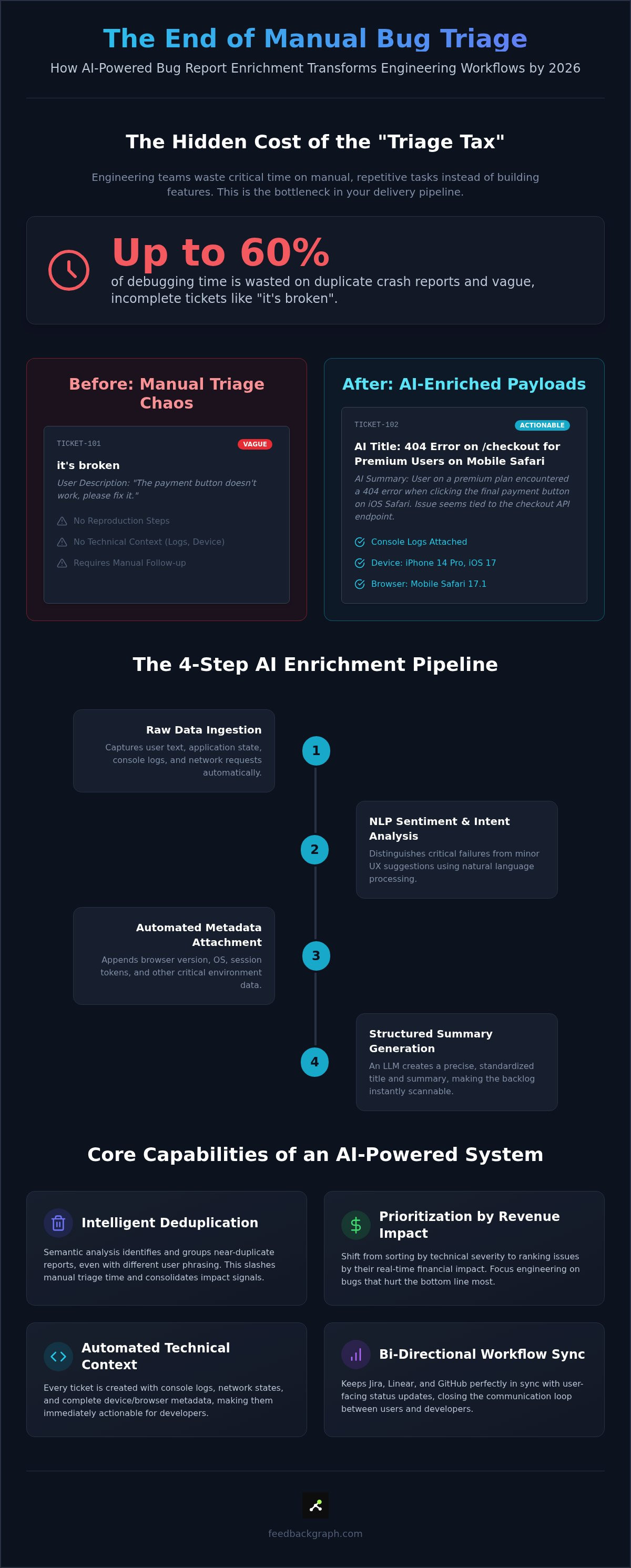
Engineering teams currently waste up to 60% of their debugging time on duplicate crash reports and vague "it is broken" tickets. You know the frustration of spending hours every week manually deduplicating Jira tickets or hunting for metadata that was never attached. This manual triage tax is the single biggest bottleneck in your delivery pipeline. However, bug report enrichment with AI is changing the math for 2026. It's no longer about just collecting feedback. It's about transforming raw noise into actionable intelligence.
We agree that your engineers should spend their time shipping features, not playing detective with incomplete data. This guide will show you exactly how to implement a zero-manual-triage workflow that actually scales. You'll learn to automate the capture of logs and device data while ranking your backlog by actual financial impact. We're moving past the era of guessing which bugs matter most. By the end of this article, you'll understand how to turn every user report into a high-fidelity engineering payload that prioritizes revenue over noise. We'll cover the specific technical integrations and AI strategies required to move from manual chaos to a streamlined, automated pipeline.
Key Takeaways
- Learn how bug report enrichment with AI automates the transition from vague user feedback to structured, high-fidelity engineering payloads.
- Discover how semantic analysis identifies near-duplicate reports to slash manual triage time and eliminate the "triage tax" on your developers.
- Shift your prioritization strategy by ranking backlog items according to real-time revenue impact rather than just technical severity.
- Master the implementation of bi-directional workflows that keep Jira, Linear, and GitHub synced with user-facing status updates.
- Automate the collection of technical context, including console logs and metadata, to ensure every ticket is immediately actionable for your team.
What is Bug Report Enrichment with AI?
Bug report enrichment with AI is the automated process of using Large Language Models to transform raw, unstructured user feedback into high-fidelity engineering tickets. It replaces the traditional manual triage process by injecting technical context, severity levels, and logical structure at the moment of submission. While a legacy bug tracking system acts as a passive database, AI-driven enrichment turns it into an active intelligence layer. This shift moves teams away from deciphering vague text toward executing on structured payloads that contain everything needed for a fix.
By 2026, manual triage has officially become an engineering anti-pattern. Teams that continue to sort tickets by hand are effectively choosing to move slower than the market. AI bridges the persistent communication gap between non-technical users and developers by translating human frustration into machine-readable data. It ensures that your engineers never have to ask "what does this mean?" again, providing a clear path from problem detection to resolution.
The Problem: The Hidden Cost of the Triage Tax
Manual triage is a silent productivity killer that drains engineering velocity. Research indicates that development teams can waste up to 20% of their weekly capacity simply categorizing and deduplicating incoming reports. The primary source of this friction is the "vague report" problem. When a user submits a ticket with a title like "it's broken" and zero reproduction steps, the entire workflow grinds to a halt. Traditional bug trackers are fundamentally flawed because they assume the user knows what information the developer needs. Without bug report enrichment with AI, your senior developers spend hours acting as expensive data entry clerks, trying to replicate issues with zero context and no clear starting point.
The Solution: Enrichment at the Point of Capture
True efficiency starts with enrichment at the point of capture. Instead of a static form that accepts any input, an AI-powered capture widget acts as a first-line triage agent. It analyzes user input in real-time and asks intelligent clarifying questions to fill in the gaps before the user hits submit. Simultaneously, the system extracts critical environment data, console logs, and network states in the background. This holistic approach to bug report enrichment with AI ensures that every submission is a complete technical brief. You're no longer receiving complaints; you're receiving actionable payloads that allow for immediate debugging, drastically reducing the time between a bug being reported and a fix being deployed.
Technical Mechanics: How AI Transforms Raw Feedback
The process of bug report enrichment with AI follows a rigorous four-step pipeline that begins the moment a user interacts with the customer feedback widget. First, the system performs raw data ingestion, capturing not just the user's words but the entire state of the application. Second, Natural Language Processing (NLP) engines analyze the submission for sentiment and intent. This distinguishes a critical functional failure from a minor UX suggestion. Third, the system executes automated metadata attachment, appending browser specs, OS details, and session tokens to the report. Finally, an LLM-driven engine generates a structured summary and title, ensuring every item in your backlog is immediately understandable.
Academic research into automating the bug triage process confirms that the most effective systems don't just store data; they proactively organize it. By shifting the burden of data collection from the user to the machine, you eliminate the friction that usually leads to incomplete reports. This technical handshake between the user's browser and your dev stack creates a comprehensive payload that is ready for immediate engineering action.
AI-Generated Titles and Summaries
Standardized backlogs are essential for maintaining development velocity. AI moves your team beyond useless titles like "System is down" or "Broken link." Instead, it generates precise, descriptive headlines such as "404 Error on /checkout for Premium Users on Mobile Safari." This level of detail provides immediate clarity for product managers and developers. By synthesizing the core issue into a concise summary, AI saves engineers between 5 and 10 minutes per ticket during the initial review phase. This consistency is particularly valuable for global teams where differing naming conventions often lead to backlog fragmentation and confusion.
Automated Technical Context Attachment
True enrichment goes deeper than text. High-performance systems automatically capture DOM snapshots and console errors at the exact moment of failure without requiring user intervention. This data is then linked to specific code versions, commit hashes, or active feature flags. By cross-referencing user actions with real-time stack traces, the AI identifies the specific microservice or UI component at fault with high precision. This eliminates the "works on my machine" excuse that often stalls progress. If you're ready to see this level of automation in action, book a personalized walkthrough to see how your stack can benefit from these enriched payloads.
Intelligent Deduplication and Severity Classification
A cluttered backlog is where engineering velocity goes to die. Traditional systems rely on basic keyword matching, which frequently fails when users describe the same issue using different terminology. One user might report a "payment failure," while another says they "can't complete checkout." Without bug report enrichment with AI, these appear as separate tickets. Semantic analysis solves this by identifying the underlying intent and technical signature of a report. It groups dozens of disparate user complaints into a single, high-fidelity engineering issue, ensuring your team isn't chasing ghosts or repeating work.
By clustering these "near-duplicate" reports, AI reduces the sheer volume of noise your developers face. Instead of 50 individual tickets, a lead engineer sees one master ticket enriched with 50 different session logs and environment profiles. This consolidation provides a statistically significant view of the bug's reach without the manual overhead of sorting through a messy inbox. It's a fundamental shift from reactive ticket management to proactive problem resolution.
Eliminating Engineering Backlog Noise
Keyword matching is a relic of the past. It creates a "Jira overload" where multiple squads might investigate the same root cause across different functional areas. This fragmentation leads to developer burnout and wasted sprint cycles. Modern teams use systems that deduplicates customer bug reports in real-time. By leveraging bug report enrichment with AI, the system identifies overlaps the moment a user starts typing. It prevents redundant tickets from ever reaching your primary dev tools, keeping your backlog clean and your engineers focused on unique, high-value fixes.
Predictive Severity and Impact Scoring
Technical severity is often misinterpreted by users who feel their specific issue is always a "blocker." AI acts as a neutral arbiter by analyzing error logs and network states against the user's description. It distinguishes between a critical API failure that halts transactions and a minor UI glitch that only affects aesthetics. By training on your historical data, the AI predicts urgency based on system impact and user reach. High-severity bugs are automatically routed to P0 Slack channels, while lower-impact issues are queued for the next sprint. This automation ensures that your most expensive problems get immediate attention without requiring a human to sound the alarm.
Ranking AI-Enriched Reports by Revenue and Urgency
Technical severity is a one-dimensional metric. For a growing SaaS company, a minor UI glitch on a high-value Enterprise account is often more critical than a P1 crash affecting a single user on a free trial. Bug report enrichment with AI provides the multidimensional context needed to make these strategic calls. It links every incoming report to specific customer account values and subscription tiers. This creates a "Revenue at Risk" metric that aligns engineering effort with business survival. AI identifies which cohorts are hitting specific errors, allowing you to protect your highest-paying segments before they churn.
By integrating financial data directly into the triage process, you move beyond technical guesswork. The system analyzes the impact of a bug across your entire user base, highlighting issues that threaten your most valuable contracts. This level of visibility ensures that your team isn't just fixing bugs, but is actively defending the company's annual recurring revenue. It transforms the engineering team from a cost center into a strategic partner in customer retention.
The Profit-First Triage Framework
Development teams often struggle to justify roadmap changes to stakeholders during heated sprint planning sessions. By using AI to quantify the revenue impact of every bug in your backlog, you replace intuition with hard data. Imagine the clarity of prioritizing a minor formatting issue for a ₹80,00,000 annual contract over a major functional bug for a single user on a free plan. This isn't just triage; it's portfolio management. You gain the evidence needed to win stakeholder debates and ensure your team works on what actually moves the needle for the company's bottom line.
Visualizing Business Impact in the Triage Dashboard
The traditional "First-In, First-Out" approach is a recipe for stagnation. Modern triage dashboards move toward a "Highest-Impact, First-Out" model. FeedbackGraph ranks feature requests and bugs by revenue automatically, pulling data from your CRM and billing systems. This bridges the gap between the Product Manager's strategic vision and the Engineer's daily task list. It ensures that every line of code written is a direct response to a financial risk or opportunity. Engineers see the business value of their work, and PMs see a backlog that reflects the company's true priorities. This alignment reduces friction and accelerates the delivery of high-value fixes.
Implementing AI-Enriched Workflows in Your Dev Stack
Integrating bug report enrichment with AI into your existing ecosystem is the final step in eliminating operational friction. It's not enough to generate high-fidelity data; that data must flow seamlessly into the tools your engineers already use. By connecting enriched feedback to Jira, Linear, and GitHub through bi-directional synchronization, you ensure that every ticket remains the single source of truth throughout the development lifecycle. This automation removes the need for manual status updates, allowing your team to focus on shipping code rather than managing administrative overhead.
The transition to an AI-enriched workflow should be incremental to avoid disrupting active sprint cycles. Start by mapping your current triage stages to automated triggers. This allows the system to handle the heavy lifting of data collection and initial categorization while your lead engineers maintain final oversight. The goal is to create a self-sustaining pipeline where raw feedback enters, gets enriched with technical context, and arrives in the developer's queue as a fully actionable payload.
Bi-directional Sync: Closing the Feedback Loop
One-way integrations are a primary cause of support silos and user frustration. When a developer closes a ticket in Jira, the customer support team often remains unaware, leading to delayed communication. A bi-directional sync ensures that status updates in the dev tool reflect back to the user automatically. This is how FeedbackGraph connects customer feedback to dev tools without manual intervention. You can automate "Bug Fixed" notifications the moment a pull request is merged, providing a professional experience for your users while saving your support team hours of manual follow-up.
The Future: MCP Servers and AI-Native Triage
In 2026, the Model Context Protocol (MCP) has emerged as the standard for connecting AI models to local data sources. An MCP server allows your AI-driven IDE or agentic workflows to access enriched bug data directly within your coding environment. This integration means AI agents can now "self-triage" bugs using the technical payloads generated during the enrichment phase. By integrating FeedbackGraph as an intelligent layer in your AI-native product management environment, you allow the machine to understand code-level context alongside user-reported issues. This reduces the cognitive load on lead engineers and allows for faster, data-backed decision-making.
Getting Started: A 2-Click Setup
Modernizing your triage process doesn't require a total overhaul of your current stack. You can begin by deploying the FeedbackGraph widget to start capturing enriched data immediately. The setup is designed to be zero-friction, allowing you to establish your first revenue-based prioritization rules within minutes. This phased approach ensures that you start seeing value without disrupting existing workflows. If you're ready to align your engineering efforts with business growth and eliminate the manual triage tax, book a demo to see AI enrichment in action today.
Ship Faster by Automating the Triage Tax
The transition to automated triage is a strategic necessity for high-performing teams. You've seen how bug report enrichment with AI transforms vague user feedback into high-fidelity payloads that include logs, metadata, and clear reproduction steps. By leveraging semantic deduplication and AI-powered severity classification, you can finally eliminate the manual sorting that drains engineering capacity. This guide has shown you how to rank your backlog by revenue at risk, ensuring your highest-paying cohorts are always protected.
With instant bi-directional sync to Jira and Linear, your team gains a seamless workflow that bridges the gap between support and development. You're no longer just fixing bugs; you're actively defending your company's growth. It's time to stop playing detective with incomplete data. Start shipping at full velocity with a backlog that prioritizes financial impact over technical noise.
Your team is ready for a zero-friction workflow. Take the first step toward a cleaner, revenue-aligned backlog today.
Frequently Asked Questions
How does AI enrichment improve bug report quality?
AI enrichment improves quality by automatically appending console logs, network states, and environment metadata to every submission. It eliminates the need for developers to request missing reproduction steps by asking the user clarifying questions in real-time. This process ensures that bug report enrichment with AI transforms a vague one-sentence complaint into a high-fidelity technical brief. The result is an immediately actionable ticket that reduces the initial investigation time for your engineering team.
Can AI-enriched bug reporting integrate with Jira and Linear?
Yes, full bi-directional integration with Jira, Linear, and GitHub is a core feature of modern triage systems. When an engineer updates a ticket status or adds a comment in Jira, those changes sync back to the original report automatically. This keeps your development and support teams perfectly aligned without manual data entry. It ensures that the feedback loop remains closed, keeping users informed of progress the moment a fix moves through your pipeline.
Does AI bug reporting work for mobile SaaS applications?
AI-powered bug reporting is fully compatible with mobile SaaS environments through specialized SDKs for iOS, Android, and cross-platform frameworks. These tools capture mobile-specific metadata like device model, OS version, and battery state at the moment of failure. By using bug report enrichment with AI, mobile developers can replicate device-specific crashes that are often impossible to catch with manual reports alone. This visibility is essential for maintaining high app store ratings and user retention.
What is the difference between manual triage and AI-powered triage?
Manual triage relies on human review to categorize reports, which is slow, subjective, and prone to error. AI-powered triage uses semantic analysis and LLMs to instantly assign severity, generate summaries, and attach technical context. While manual processes often lead to backlog bloat, AI triage ensures that only unique, structured, and prioritized tickets reach your engineers. This shift eliminates the "triage tax" and allows your team to focus exclusively on high-impact development tasks.
How does revenue-based ranking work for bug reports?
Revenue-based ranking works by cross-referencing incoming bug reports with your CRM and billing data to identify the financial weight of each issue. The system calculates "Revenue at Risk" by analyzing which customer cohorts are affected by a specific bug. This allows you to prioritize a minor fix for an enterprise client over a major bug affecting free-tier users. It aligns engineering resources with your company's growth goals and annual recurring revenue targets.
Is user data safe when using AI for bug report enrichment?
User data security is maintained through strict data handling protocols and compliance with regional regulations like the EU AI Act and India's Digital Personal Data Protection Act (DPDPA). AI enrichment focuses on technical metadata and system logs rather than personal identifiable information. Most platforms offer configurable scrubbing tools to mask sensitive data before it reaches the LLM. This ensures your engineering team gets the context they need while maintaining the highest standards of data privacy.
How do I reduce engineering backlog noise with AI?
You reduce backlog noise by using AI to filter out non-bugs, feature requests, and low-priority UI glitches before they reach your dev tools. The system acts as an intelligent gatekeeper, ensuring that only high-fidelity, actionable tickets are promoted to your primary backlog. By automating the initial classification and deduplication phases, you prevent the "Jira overload" that typically leads to developer burnout. This keeps your engineering focus on unique problems that require human expertise.
Can AI automatically deduplicate similar bug reports?
AI uses semantic clustering to identify near-duplicate reports that traditional keyword matching misses. By analyzing the intent and technical signature of a submission, the system can group dozens of different user complaints into a single engineering ticket. This prevents redundant investigations and ensures that your team isn't fixing the same root cause multiple times. It provides a consolidated view of a bug's total reach, allowing for more accurate prioritization and faster resolution across the board.


