

Your product backlog isn't just cluttered; it's likely hemorrhaging revenue because your team can't separate critical signals from repetitive noise. With 81% of consumers now viewing AI as a standard part of the service experience, relying on a manual customer feedback loop for product teams is a strategic liability that slows down innovation. You're likely drowning in duplicate bug reports while struggling to prove the financial impact of a single feature request. It's a frustrating cycle where high-value users feel ignored and your engineers waste time on low-impact tasks instead of driving growth.
We understand that managing feedback at scale feels like an uphill battle against data fragmentation and manual overhead. This article provides a 2026 AI-first framework to build a high-velocity feedback loop that uses automation to eliminate backlog noise and prioritize features by their impact on your ₹ revenue. You'll learn how to bridge the gap between customer voice and engineering workflow, transforming messy raw data into precise, revenue-linked development tickets. We'll explore how AI-powered triage and bi-directional integrations can finally turn your feedback loop into a predictable engine for product excellence.
Key Takeaways
- Transition from manual collection to an automated customer feedback loop for product teams that triages and enriches input in real-time.
- Eliminate engineering noise by using AI to deduplicate reports and generate precise technical summaries for every incoming ticket.
- Prioritize your roadmap by financial impact using revenue-based ranking that connects feature requests to specific account value in ₹.
- Close the loop automatically through bi-directional sync with Jira and Linear, triggering customer updates as soon as development status changes.
The Anatomy of a High-Velocity Customer Feedback Loop
A feedback loop isn't just a buzzword; it's a structural requirement for modern software survival. It functions as a continuous cycle where product teams capture user input, analyze it for actionable insights, and deploy changes that are communicated back to the user. By 2026, the traditional manual approach has become a liability. High-performing organizations have moved toward an automated, AI-first triage system. This transition ensures that the customer feedback loop for product teams operates at a velocity that matches rapid development cycles. Speed is the primary differentiator here. Fast loops reduce churn and accelerate your path to product-market fit by ensuring you build what users actually pay for.
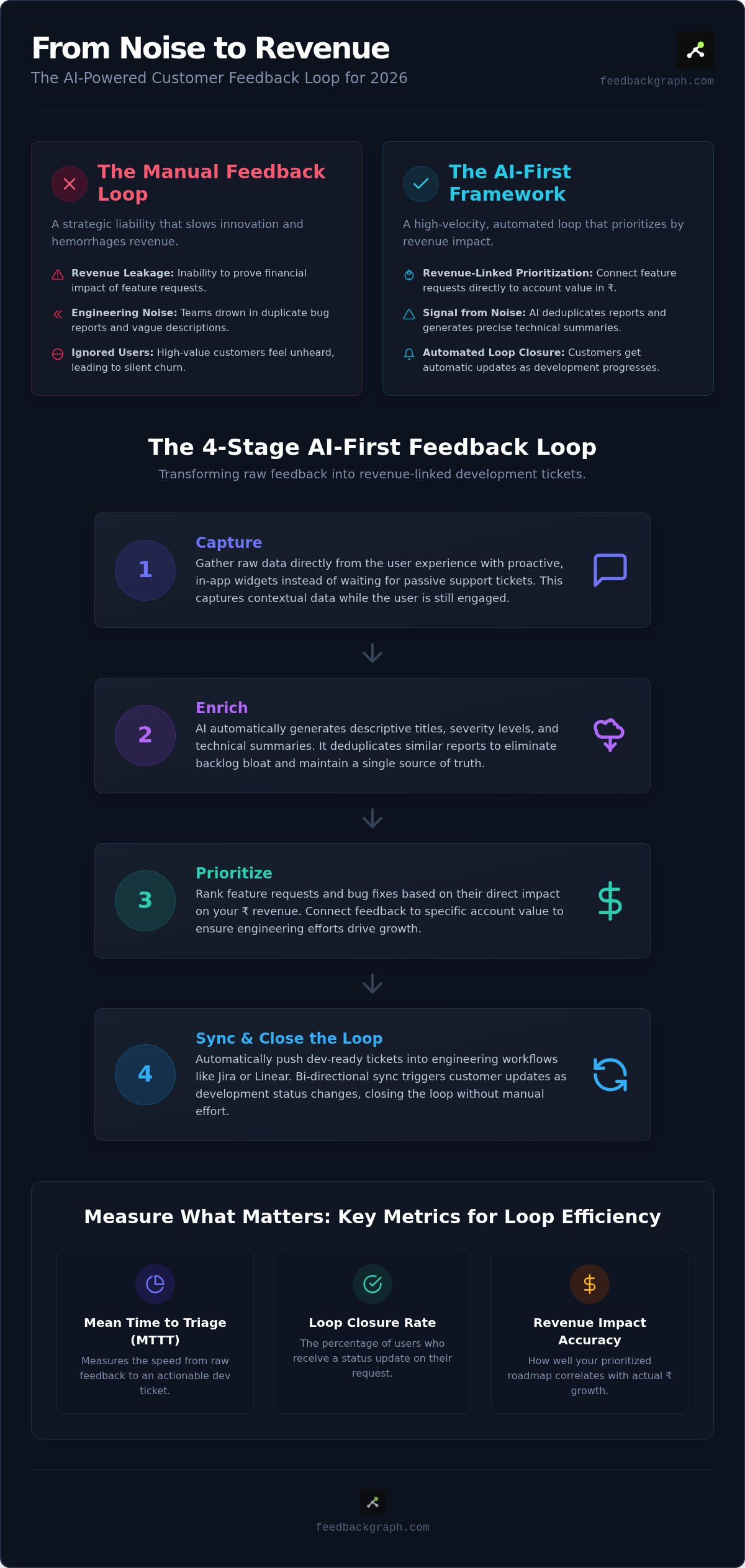
To build a loop that scales, you must master four distinct stages. First is Capture, where you gather raw data directly from the user experience. Second is Enrich, where AI generates technical summaries and severity levels. Third is Prioritize, which involves ranking requests based on their impact on your ₹ revenue. Finally, Sync ensures that these insights flow directly into your engineering tools like Jira or Linear. This structured flow eliminates the friction that typically stalls product innovation.
The Shift from Passive to Active Feedback
Waiting for support tickets is a losing strategy. It relies on "survivor bias," where you only hear from the users who haven't given up yet. Modern teams use active loops. By deploying in-app widgets, you capture contextual data while the user is still engaged with the product. This proactive approach identifies "silent churn" before it's too late. When you make it easy to report an issue, you gain visibility into the frustrations that usually lead to a quiet exit. You can explore how these automated features bridge the gap between user frustration and engineering action.
Key Metrics for Loop Efficiency
You can't manage what you don't measure. To evaluate your customer feedback loop for product teams, focus on three specific metrics. First, track your Mean Time to Triage (MTTT). This measures how quickly raw feedback is transformed into an actionable dev ticket. Second, monitor your Loop Closure Rate. This is the percentage of users who receive a status update once their request is processed. Finally, assess your Revenue Impact Accuracy. This evaluates how well your prioritized roadmap actually correlates with ₹ growth. If your loop is efficient, these numbers should show consistent improvement, proving that your product decisions are backed by hard data rather than intuition.
Eliminating Feedback Noise with AI-Powered Triage
High-volume feedback is a double-edged sword. While data is valuable, duplicate reports and vague bug descriptions paralyze engineering teams. This is the "Noise Problem." Manual triage fails when hundreds of users report the same UI glitch or performance lag. Since 85% of CX leaders report that customers abandon brands over unresolved issues on first contact, speed is critical. By using an AI-powered bug reporting tool, teams can automate the heavy lifting. This shift is essential for a functional customer feedback loop for product teams in 2026.
AI enrichment turns raw, messy input into structured data. Instead of "it's broken," the system automatically generates descriptive titles, severity levels, and technical summaries. It identifies near-duplicate submissions instantly. This prevents backlog bloat. It also handles automated routing. If a user reports a CSS issue, the system sends it to the Frontend team. If it's a slow API response, it goes to Backend. This precision ensures that Closing the Customer Feedback Loop becomes a streamlined operational process rather than a manual chore.
Automating the Triage Workflow
Implementing an automated triage workflow follows a logical sequence. First, capture raw input through intelligent widgets that don't disrupt the user journey. Second, let AI classify severity by analyzing user behavior and technical logs. Third, automatically merge duplicates to maintain a single source of truth. This sequence removes human bias from the initial assessment. It ensures that critical issues surfacing in the customer feedback loop for product teams are flagged immediately, not buried under minor requests.
Transforming Messy Input into Dev-Ready Tickets
Engineering teams need clarity, not complaints. AI acts as a translator. It converts non-technical user feedback into clear engineering requirements. It captures essential metadata like browser version, OS, and user ID automatically. This eliminates the endless back-and-forth between PMs and customers for clarification. When a developer opens a ticket, they have everything they need to start. This efficiency directly impacts your bottom line by reducing wasted dev hours. To see how this works in practice, you can book a personalized walkthrough of our triage engine.
Beyond Intuition: Prioritizing Feedback by Revenue Impact
Prioritization is often a battle of opinions. The loudest users usually get the most attention, but they aren't always your most valuable customers. Relying on gut feel or basic voting systems creates a distorted roadmap that ignores business reality. To build a truly effective customer feedback loop for product teams, you must anchor every request in financial data. Revenue-Based Ranking connects incoming feedback directly to the MRR or ARR of the reporting user. This shift ensures that your engineering resources focus on the issues that impact your ₹ bottom line most significantly.
The opportunity cost of building the wrong feature is high. When you prioritize by revenue, you identify "high-value friction." These are the specific bugs or missing features that threaten your largest accounts. This evidence-based approach moves product management away from intuition and toward strategic growth. It allows you to calculate the cost of delayed features versus immediate bug fixes with precision. By making these connections visible, you ensure that the customer feedback loop for product teams serves the business as much as it serves the user.
Frameworks for Revenue-First Prioritization
Traditional models like the RICE method (Reach, Impact, Confidence, Effort) often rely on subjective estimates for impact and confidence. Revenue-Based Ranking replaces these guesses with hard data. It highlights high-value friction by surfacing issues reported by accounts with the highest contract values. This allows you to differentiate between a request from a free-tier user and a critical blocker for a multi-lakh ₹ enterprise account. By anchoring feature requests in hard financial data, product teams transform subjective debates into objective business cases that align stakeholders instantly.
Quantifying the Cost of Backlog Noise
Backlog noise isn't just an administrative headache; it's a financial leak. Engineers waste hundreds of hours annually on un-triaged tickets or building features that no high-paying customer actually requested. This misallocation of talent slows down your 2026 growth trajectory and increases the risk of churn among your most important users. You can use this Revenue-Based Feature Ranking guide to calculate these deep-dive opportunity costs for your own team. When the customer feedback loop is tied to revenue, every sprint becomes a documented investment in account retention and expansion.
The Bi-directional Sync: Closing the Loop Without Manual Effort
Most product teams suffer from the "Black Hole" problem. Users submit thoughtful feedback and never hear back. This silence signals to users that their time isn't valued. It effectively kills the customer feedback loop for product teams. By 2026, manual follow-up is no longer a viable strategy for growing companies. You need a technical mechanism that bridges the gap between engineering progress and customer communication. Automation is the only way to ensure every reporter feels heard without drowning your PMs in administrative tasks.
Bi-directional sync is that mechanism. When a developer updates a status in Jira or Linear, that change should trigger an immediate, automated notification to the original reporter. This transparency reduces the volume of "where is my feature?" support tickets. It saves your team thousands of ₹ in support overhead by automating the most repetitive communication tasks. Status updates from "In Progress" to "Shipped" keep the user engaged throughout the entire development lifecycle. It transforms a passive reporting process into an active, transparent partnership.
Integrating Feedback into the Engineering Workflow
Mapping the customer voice directly to Jira issues or Linear cycles ensures that no context is lost in translation. Developers shouldn't have to leave their primary tool to understand a user's pain point. When a ticket is enriched with metadata, browser logs, and account value, engineers can solve problems faster. This integration ensures that the engineering team stays aligned with the most profitable roadmap priorities. You can read our full breakdown on connecting customer feedback to dev tools to see how these integrations function at a technical level.
Automating Customer Follow-up
Automating the final step-the "Shipped" notification-has a profound psychological impact on user retention. It turns a frustrated user into a loyal advocate. They see that their input directly influenced the product roadmap. Setting up triggers that notify users when a specific bug they reported is fixed creates a powerful positive feedback loop. These updates can be personalized to maintain a human touch at scale. When a user receives a "We fixed it" notification, it validates their loyalty and significantly reduces the risk of churn. It's a high-impact, low-effort way to prove your product's commitment to its community.
Implementing an AI-First Feedback Strategy with FeedbackGraph
FeedbackGraph functions as the central intelligence engine for your product's growth. It automates the entire customer feedback loop for product teams, transforming raw user input into a structured, revenue-linked roadmap. We've established that manual triage is a bottleneck that slows down innovation. FeedbackGraph removes this friction by acting as a bridge between the customer voice and your engineering workflow. It ensures that every report is enriched with technical context and ranked by its impact on your ₹ revenue before it ever reaches your development queue.
Capture rates often fail because of high-friction feedback forms. Our 2-click capture widget maximizes user participation without interrupting their experience. It automatically gathers essential metadata, browser logs, and user IDs, so your customers don't have to provide technical details manually. Once a report is submitted, the AI Bug Triage engine takes over. It generates precise titles and severity levels while identifying near-duplicates instantly. This automation allows your team to focus on solving high-value problems rather than managing data entry.
Getting Started with FeedbackGraph
Setting up your new feedback infrastructure is remarkably fast. You can deploy the capture widget in under five minutes with a simple code snippet. Once it's live, you can configure custom AI rules to automate severity and prioritization based on your specific business goals. This setup turns your messy backlog into a clean, prioritized list of opportunities. You can invite your team to the AI-Powered Triage dashboard to begin seeing real-time, actionable insights from your users immediately.
Scaling Your Product Discovery
Scaling your product requires moving from reactive bug fixing to proactive discovery. FeedbackGraph allows you to close the loop for thousands of users without adding a single headcount. The bi-directional sync ensures that when a developer updates a status in Jira or Linear, the customer is notified automatically. This transparency builds trust and significantly reduces the volume of repetitive support tickets. You can book a demo to see the revenue-based ranking in action and understand how to align your engineering resources with your most profitable account needs.
Mastering the AI-First Product Roadmap
The transition to an automated, intelligent system is no longer optional for teams that value speed and efficiency. You've seen how AI-powered deduplication and revenue-based ranking transform raw user noise into a high-impact development strategy. By 2026, a high-velocity customer feedback loop for product teams isn't just about listening; it's about acting with financial precision. You now have the framework to eliminate backlog bloat and prioritize features that drive actual ₹ growth.
Implementing a bi-directional Jira or Linear sync ensures that your customers are never left in the dark. This technical bridge closes the loop without adding a single hour of manual work to your PMs' schedules. It's time to move away from subjective roadmapping and toward a methodical, evidence-based approach that respects both your engineering resources and your customers' time. This shift turns your feedback process into a predictable engine for product excellence and account retention.
Your team is ready to build faster and smarter. Start automating your triage today and focus on the innovations that truly move the needle for your business.
Frequently Asked Questions
What is a customer feedback loop for product teams?
A customer feedback loop for product teams is a continuous cycle designed to capture, analyze, and act on user input to drive product evolution. It functions as a structural bridge between the user experience and the engineering roadmap. By systematically processing feedback, teams ensure that development priorities align with actual market demand. This loop is only complete when the user who provided the input receives a final update on their request.
How do you close the feedback loop with customers automatically?
You close the loop automatically by integrating your feedback platform with engineering tools like Jira or Linear. When a developer moves a ticket to "Shipped" or "Resolved," the system triggers an automated notification to the original reporter. This bi-directional sync eliminates the need for manual emails. It ensures that users are updated in real-time, reducing support overhead and proving that their contributions directly influence the product's growth.
What are the stages of a product feedback loop?
A modern feedback loop consists of four critical stages: Capture, Enrich, Prioritize, and Sync. First, you gather raw data via in-app widgets. Second, AI enriches this data by generating technical summaries and severity levels. Third, you prioritize the requests based on their impact on account revenue in ₹. Finally, you sync these insights into your development workflow. This structured approach ensures that messy input becomes actionable engineering requirements without manual intervention.
How does AI improve the customer feedback loop?
AI improves the customer feedback loop for product teams by automating the triage process and eliminating manual noise. It identifies duplicate bug reports instantly, preventing backlog bloat before it starts. Additionally, AI generates technical summaries and severity levels from vague user descriptions. This enrichment reduces the back-and-forth between product managers and customers. It allows teams to focus on high-value feature development rather than administrative data entry, accelerating the innovation cycle.
Why is revenue-based prioritization better than the RICE method?
Revenue-based prioritization is superior because it uses objective financial data instead of subjective estimates. While the RICE method relies on guessed impact scores, revenue ranking connects feedback to the actual MRR or ARR of the reporting account. This ensures you address high-value friction first. By focusing on the needs of your most profitable customers, you maximize account retention and ensure your engineering resources generate the highest possible ₹ return on investment.
How do I reduce duplicate bug reports in my backlog?
You reduce duplicate reports by implementing an AI-powered triage engine that identifies near-identical submissions in real-time. When a user reports a bug, the system compares it against existing tickets in your backlog. If a match is found, the reports are merged into a single source of truth. This prevents engineers from wasting time on redundant issues. It keeps your development queue clean and ensures that the total impact of a bug is visible.
Can I sync customer feedback directly with Jira or Linear?
Yes, you can sync feedback directly using bi-directional integrations that connect your capture tool to Jira or Linear. This setup ensures that developers receive full technical context, including browser logs and account metadata, without leaving their primary workspace. Status updates in the dev tool flow back to the feedback platform automatically. This technical bridge maintains alignment between customer success and engineering teams, ensuring everyone works from a unified, data-driven roadmap.
What is the difference between a positive and negative feedback loop in product?
In a product context, a positive feedback loop reinforces a specific behavior or growth trend, while a negative feedback loop acts as a self-correcting mechanism. Bug reporting is a classic negative loop; it detects friction and triggers a correction to restore product stability. Both are essential for maintaining a healthy, high-performing software ecosystem. While positive loops drive adoption, negative loops ensure the product remains reliable and meets the high standards of your enterprise users.


