

Your product roadmap is currently held hostage by a spreadsheet that's too bloated to open. It's a common trap. You spend hours every week manually tagging rows, chasing lost feature requests across siloed tabs, and guessing which bugs actually impact your bottom line. This friction-heavy process doesn't just waste time; it actively kills your product velocity. Finding a scalable replacement for manual feedback spreadsheets is no longer a luxury for growing teams in 2026; it's a requirement for survival.
We understand the frustration of losing high-value insights in a sea of unorganized cells. You need a system that works as fast as your engineers do. In this guide, you'll discover how to transition to an automated, AI-driven feedback system that scales with your ambitions. We'll show you how to implement automated bug triage, quantify revenue impact instantly, and establish a seamless bi-directional sync with tools like Jira and Linear. It's time to stop managing rows and start shipping features that matter.
Key Takeaways
- Identify the hidden operational costs of "VLOOKUP hell" and why static files cannot scale with 2026 product cycles.
- Automate feedback triage using AI enrichment to generate summaries, severity scores, and tags without manual input.
- Follow a structured framework for implementing a replacement for manual feedback spreadsheets, starting with a data silo audit and taxonomy mapping.
- Quantify the business impact of transitioning from manual data entry to automated, revenue-based feedback ranking.
- Bridge the gap between customer feedback and engineering execution through bi-directional sync with tools like Jira and Linear.
The Hidden Cost of Manual Feedback Spreadsheets in 2026
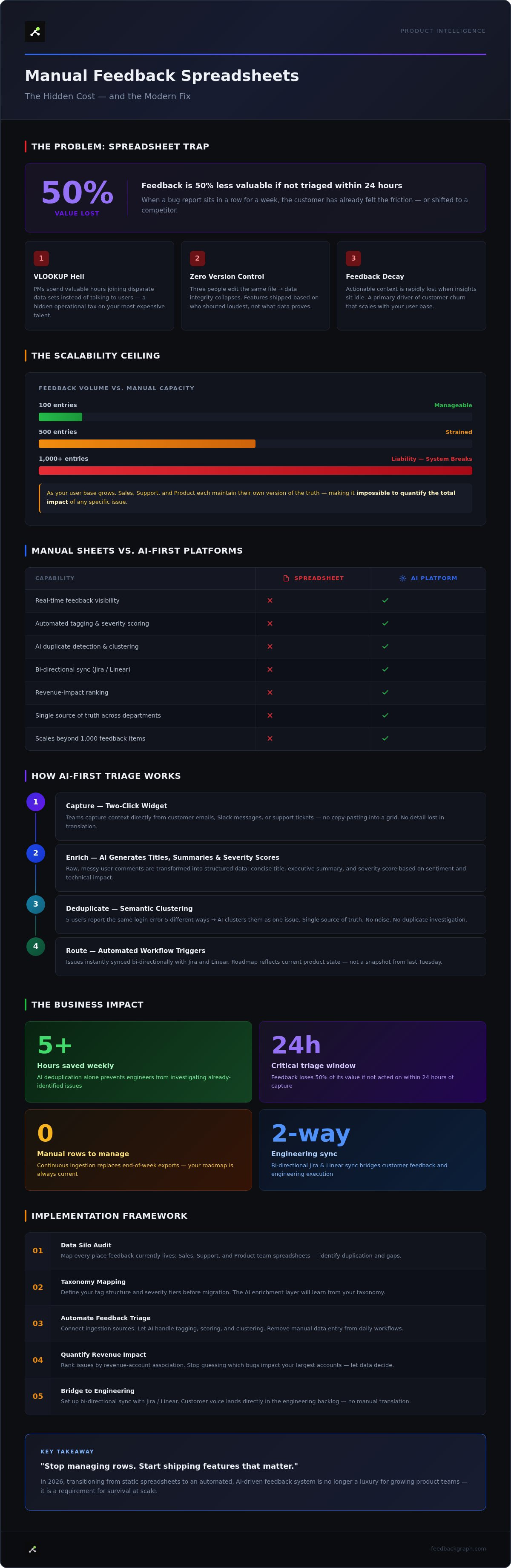
Most product teams fall into the "Spreadsheet Trap" without realizing it. In the high-velocity SaaS environment of 2026, static files simply cannot keep pace with the continuous stream of user data. When you rely on manual entry, your feedback loop is dead on arrival. The data is often obsolete by the time it's saved. This creates a state of "VLOOKUP Hell," where product managers spend their most valuable hours joining disparate data sets instead of talking to users. This manual data joining creates a hidden operational tax that suffocates your most expensive talent. It's a high price to pay for a system that offers zero real-time visibility.
Feedback is 50% less valuable if your team doesn't triage it within 24 hours. In 2026, users expect immediate acknowledgement and rapid iteration. When a bug report sits in a row for a week, the customer has already felt the friction or shifted to a competitor. This delay fuels "Product Manager Burnout." PMs become data janitors, scrubbing columns and chasing duplicates, rather than acting as strategists. They desperately need a modern replacement for manual feedback spreadsheets to reclaim their strategic focus and stop the revenue leak.
This drive for digital efficiency is universal; for instance, companies seeking to modernize their workplace safety protocols can explore Compliance Genie - SaaS health and safety software to transition from manual EHS spreadsheets to an integrated digital platform.
Why Spreadsheets Kill Product Velocity
Manual tagging is a massive bottleneck for engineering sprints. It stops progress cold because the context behind a ticket is often buried in a hidden tab or an outdated comment. Spreadsheets lack version control and a single source of truth. When three different people edit the same file, the data loses integrity. This creates a dangerous disconnect between the customer's actual voice and the engineering backlog. You end up shipping features based on whoever shouted loudest in the sheet, rather than what the data proves is necessary. It's a reactive cycle that prevents proactive bug tracking and long-term planning.
The Scalability Ceiling of Manual Processes
Managing 100 feedback entries is a manageable chore; managing 1,000 is a liability. As your user base grows, data silos emerge naturally. Just as global enterprises rely on Computer Market Research to automate and streamline channel management, product teams need dedicated platforms to eliminate fragmentation between sales, support, and engineering. This fragmentation makes it impossible to quantify the total impact of a specific issue. We define feedback decay as the rapid loss of actionable context that occurs when insights sit idle, ultimately serving as a primary driver of customer churn. Implementing a robust replacement for manual feedback spreadsheets is the only way to maintain visibility across departments. Without automation, you're just guessing which bugs are actually tied to your largest revenue accounts.
How AI-First Systems Automate Feedback Triage
Modern software teams can't afford the lag of manual data entry. Transitioning to an AI-first system provides a scalable replacement for manual feedback spreadsheets by removing the human bottleneck. Instead of copy-pasting customer emails or Slack messages into a grid, teams use two-click widgets to capture context directly from the source. This immediate capture ensures no detail is lost in translation. The system doesn't just store data; it thinks about it.
From Manual Tagging to AI-Powered Triage
AI enrichment transforms raw, messy user comments into structured data instantly. The system automatically generates concise titles, executive summaries, and severity scores based on the user's sentiment and technical impact. This level of granularity helps engineering teams prioritize high-impact fixes without reading through hundreds of individual threads. For a deeper dive into these mechanisms, see our guide on SaaS Product Feedback Systems: The 2026 Guide to AI-First Triage.
Manual searching for duplicate bugs is a massive drain on productivity. AI-first systems use semantic analysis to group similar reports. If five different users report a login error in five different ways, the AI recognizes the underlying issue and clusters them together. This deduplication creates a single source of truth for every problem. It eliminates the noise that typically clutters a shared Excel file.
Continuous Ingestion vs. Periodic Spreadsheet Exports
Periodic exports are a relic of the past. When you wait until the end of the week to export feedback, you're already five days behind. Continuous ingestion allows you to see customer issues as they happen, creating a real-time feedback loop. Automated routing logic then moves these insights into the appropriate workflow triggers. This shift to a modern replacement for manual feedback spreadsheets allows for immediate action rather than delayed reaction. It ensures your roadmap reflects the current state of your product, not a snapshot from last Tuesday.
The shift from manual data management to automated intelligence is a cross-industry trend; for instance, agencies looking to optimize their outreach can use leadopsiq.com to access weekly lead intelligence for the restoration and HVAC sectors instead of relying on manual prospect research.
AI deduplication saves 5+ hours of engineering time weekly by preventing the investigation of already-identified issues. This efficiency allows your team to focus on shipping new features rather than triaging the same bugs repeatedly. If you're ready to see how these automated workflows fit into your existing stack, you can book a personalized walkthrough to explore the integration capabilities.
Manual Sheets vs. Automated Platforms: A Strategic Comparison
Choosing a replacement for manual feedback spreadsheets is a strategic decision that separates high-growth teams from those stuck in operational gridlock. The difference in efficiency is staggering. Manual triage typically consumes 10 to 15 minutes per feedback item once you account for reading, deduplication, and manual tagging. An AI-first platform completes this same process in milliseconds. This isn't just about saving time; it's about data integrity. Humans are inconsistent by nature. One product manager might tag a bug as "High Priority" while another marks it as "Minor Improvement." AI applies a consistent logic across every entry, ensuring your data remains clean and actionable.
Speed of Insight and Response Times
The "Time to Triage" is a critical metric for 2026 product teams. In a manual system, feedback often sits for days before a human reviews it. This delay creates a massive gap between identifying a problem and fixing it. Automated platforms provide instant visibility, allowing you to respond to critical issues before they escalate. Faster feedback loops directly impact your customer satisfaction (CSAT) scores because users feel heard in real-time. For more on how this evolution is changing the industry, read about Bug Reporting Software in 2026.
Visibility in a spreadsheet is inherently subjective. You're looking at a list of complaints with no clear way to measure their financial weight. Modern platforms replace subjective notes with objective, revenue-based ranking. By connecting feedback to CRM data, you can instantly see which feature requests are coming from your highest-paying accounts. This shift transforms your feedback from a cost center into a revenue-driving asset. You stop guessing what to build next and start executing based on hard financial data.
This move toward data-driven operations is universal; for instance, companies seeking to modernize their finances can use EmLedger to transition from manual accounting spreadsheets to an automated platform with tiered subscription plans.
Scalability and Team Alignment
When a product manager leaves the company, the "gut-feel" logic behind their spreadsheet tags often leaves with them. Automated systems solve this by creating a permanent, logic-based analysis that survives team turnover. This ensures long-term alignment across the organization. Everyone from sales to engineering looks at the same prioritized list. Implementing a bi-directional Jira feedback sync removes the friction between product discovery and engineering execution. When a developer closes a ticket in Jira, the status updates automatically for the product team. This level of collaboration is impossible to maintain within siloed spreadsheet tabs. It's the only way to ensure your roadmap remains data-driven as you scale.
Implementing a Replacement for Manual Feedback Spreadsheets
Transitioning to an AI-driven system is a fundamental shift in how your team operates. You're moving from a passive archive to an active intelligence hub. This migration requires more than just importing a CSV; it requires a structural overhaul of your data flow. By following a methodical implementation plan, you can establish a robust replacement for manual feedback spreadsheets that eliminates data decay and restores product velocity.
- Step 1: Audit your existing spreadsheet silos. Map every location where feedback currently lives, including personal Excel files and shared Google Sheets.
- Step 2: Map manual tags to an automated AI taxonomy. Define your core categories so the AI can begin classifying new data with 100% consistency.
- Step 3: Connect customer-facing channels. Integrate your Slack channels and deploy a capture widget to ensure every user insight is caught in real-time.
- Step 4: Establish bi-directional sync. Connect the hub to Jira or Linear to bridge the gap between product discovery and engineering execution.
- Step 5: Transition the team mindset. Shift your focus from "cleaning rows" to "executing on insights" generated by the AI.
Mapping Existing Data to New Workflows
Historical data shouldn't be a burden. When you move your legacy sheets into an AI-powered system, you have a unique opportunity to clean your backlog. Use the AI to filter out the noise from old spreadsheets, such as resolved bugs or outdated feature requests that no longer align with your 2026 roadmap. This process ensures that only high-value, relevant insights make it into your new workflow. You can see how this works in practice by exploring the FeedbackGraph Features for automated mapping and data enrichment.
Connecting the Dots: Jira and Linear Integration
Bi-directional sync is the definitive cure for the spreadsheet data decay discussed earlier. In manual systems, a ticket might be closed in Jira, but the spreadsheet remains unchanged for weeks. This lag creates confusion and kills customer trust. By implementing an automated issue routing system, status updates flow back to the customer automatically. This transparency ensures that everyone stays aligned without a single manual update. For a technical deep dive, consult our Connect Customer Feedback to Dev Tools: 2026 Guide.
FeedbackGraph: Turning Feedback into Revenue-Driving Assets
FeedbackGraph stands as the definitive replacement for manual feedback spreadsheets in the 2026 product ecosystem. While static files act as graveyards for user insights, this platform operates as a living intelligence layer for your entire organization. It eliminates the manual labor of data entry by utilizing a 2-click capture widget. This tool allows your team to gather context directly from the source without disrupting their existing workflow. By removing the friction of copy-pasting, you ensure that every high-value insight actually makes it into your system. It's the first step in moving from a reactive "archive" mindset to an active "execution" strategy.
The platform functions as a virtual team member that handles the heavy lifting of triage. It doesn't just store feedback; it enriches it. Every incoming report is automatically processed through an AI engine that generates summaries and assigns severity scores. This automation ensures that your engineering team receives high-quality, structured data every time. When you integrate this with your existing stack, the bi-directional sync keeps product and engineering in total lockstep. A status change in Linear or Jira reflects instantly in FeedbackGraph, providing a transparent view of progress for every stakeholder involved.
This process of turning raw data into an actionable narrative is a powerful way to preserve context. Similarly, if you want to turn personal stories or team history into something memorable, learn more about The Songai by Songai Media to see how they create custom songs from your personal memories.
Revenue-Based Ranking: Beyond the Spreadsheet
Static sheets treat every row with equal weight, making it impossible to see the financial impact of a specific bug. FeedbackGraph solves this by tying every feature request and bug report directly to account value. This revenue-based prioritization engine allows you to quantify the ROI of your roadmap in real-time. You stop building based on the volume of requests and start building based on the value of the customers making them. This profit-first approach is essential for teams that need to justify every engineering sprint. For a deeper look at this methodology, consult our Revenue-Based Feature Ranking: 2026 Profit-First Guide.
The AI Triage Dashboard: Your New Command Centre
The AI triage dashboard represents the end of manual spreadsheet management. It serves as a centralized command centre where you can visualize trends, track sentiment, and monitor feedback decay across your entire product suite. Because the system enriches every report with zero manual effort, your product managers can finally stop acting as data janitors. They can spend their time on high-level strategy and user research instead of scrubbing columns. This shift in focus is what ultimately drives faster response times and higher customer retention. If you're ready to reclaim your product velocity and eliminate the spreadsheet bottleneck, you can start your free trial of FeedbackGraph to modernize your workflow today.
Modernize Your Product Strategy for 2026
The era of the data janitor is over. Maintaining a static file in 2026 isn't just inefficient; it's a strategic risk that invites customer churn and team burnout. By adopting an automated system, you transform messy user comments into structured, revenue-driving assets. You've seen how AI-powered triage and revenue-based ranking provide the clarity spreadsheets lack. Implementing a robust replacement for manual feedback spreadsheets ensures your product team remains focused on high-impact work rather than row maintenance. This shift guarantees that your engineering sprints are backed by real-time account value rather than subjective gut feelings.
Your roadmap should be driven by hard data and seamless bi-directional sync with tools like Jira and Linear. This transition restores your product velocity and aligns every department around the most profitable features. It's time to stop archiving feedback and start executing on it. You can achieve total visibility and eliminate operational friction with a system built for speed.
Frequently Asked Questions
Why is a spreadsheet a bad tool for customer feedback?
Spreadsheets are static files that fail to scale in dynamic software environments. They create "VLOOKUP hell," lack real-time visibility, and don't integrate with your development stack. This manual approach causes feedback decay, where valuable user insights lose 50% of their actionable value if they aren't triaged within the first 24 hours.
Can I import my existing Google Sheets feedback into FeedbackGraph?
Yes, you can import historical data via CSV to clean up your legacy backlog. FeedbackGraph uses AI to filter noise from old sheets, ensuring only relevant, high-value insights enter your new workflow. This provides a smooth transition when you're ready to implement a replacement for manual feedback spreadsheets without losing your existing data context.
How does AI-powered feedback triage actually work?
AI triage uses semantic analysis to process raw user comments instantly. It generates concise titles, executive summaries, and severity scores without any human intervention. This automation replaces manual tagging and ensures every incoming report is structured, categorized, and immediately actionable for your engineering and product teams.
What is the benefit of bi-directional sync with Jira or Linear?
Bi-directional sync bridges the gap between product discovery and engineering execution in real-time. When a developer closes a ticket or updates a status in Jira or Linear, the change reflects automatically in FeedbackGraph. This ensures that every stakeholder sees the current progress without needing to conduct manual status checks or update rows.
How do I quantify the revenue impact of a feature request?
You quantify impact by connecting feedback directly to account value through Revenue-Based Feedback Ranking. FeedbackGraph ties each request to your CRM data, allowing you to prioritize your roadmap based on ROI rather than just request volume. This replaces subjective "gut-feel" scoring with objective, hard financial data that justifies every engineering sprint.
Is it difficult to move away from a manual feedback process?
Moving to an automated system is straightforward when you follow a structured implementation plan. By auditing your existing silos and mapping your manual tags to an AI taxonomy, your team can transition in days. Our platform is designed to be a frictionless replacement for manual feedback spreadsheets that scales alongside your growing user base.
Does FeedbackGraph deduplicate bug reports automatically?
Yes, the platform uses semantic analysis to cluster similar reports together automatically. If multiple users report the same issue using different language, the AI recognizes the underlying pattern and groups them into a single issue. This deduplication saves hours of engineering time by preventing the investigation of bugs that are already being tracked.
How much time can a team save by replacing manual feedback spreadsheets?
Teams typically save 5 or more hours of engineering time every week by eliminating manual triage and deduplication tasks. Product managers also reclaim significant time previously spent on data entry and manual tagging. This time is better spent on high-level strategy and shipping features that move the needle for your business.


