

Your bug backlog isn't a technical debt problem; it's a hidden revenue leak that your current triage process is actively ignoring. With software failures costing $1.7 trillion annually, the stakes for your development cycle in 2026 have never been higher. Most SaaS teams feel buried under duplicate reports and the constant friction between support and engineering. Learning how to prioritize bug fixes shouldn't feel like a high-stakes guessing game driven by the loudest voice in the room.
It's time to stop treating every report as an isolated incident. In this guide, you'll learn how to move beyond manual triage and use AI-driven, revenue-based frameworks to prioritize bug fixes that drive growth. We will examine the shift from subjective severity levels to objective financial impact, showing you how to streamline your workflow and reduce manual effort in Jira or Linear. By the end, you'll have a clear roadmap for aligning your development team's output with your company's revenue targets.
Key Takeaways
- Move beyond the "squeaky wheel" trap by adopting a structured framework that aligns engineering resources with actual business value.
- Master how to prioritize bug fixes using revenue-based models that move the needle on growth rather than just clearing backlog volume.
- Automate manual triage tasks with AI-driven deduplication and severity ranking to ensure engineers focus only on unique, high-impact issues.
- Create a seamless feedback loop using bi-directional integrations that keep product and engineering teams in perfect sync across Jira and Linear.
- Transform your development team into a growth driver by proactively addressing defects that directly influence customer churn and lifetime value.
Why Traditional Bug Prioritization Fails in 2026
Bug prioritization is the strategic allocation of engineering resources to protect user experience and revenue. It isn't just about cleaning up a list. It's about ensuring every developer hour spent actually moves the needle for the business. While most teams use a bug tracking system to log issues, few have a system for deciding what matters most. In 2026, the gap between logging a bug and understanding its financial impact is where growth dies.
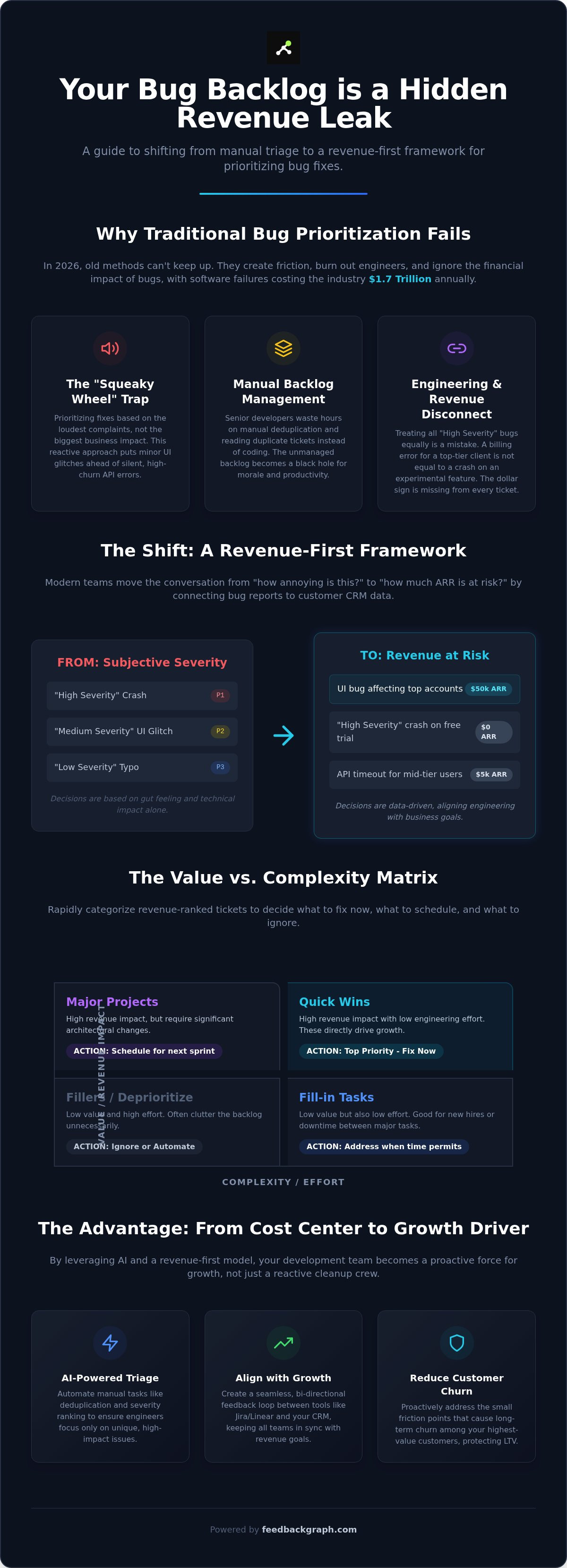
Many organizations still fall into the "Squeaky Wheel" trap. This happens when Marketing or Sales demands a fix because a single loud prospect complained. You pivot your best engineers to solve a minor UI glitch. Meanwhile, a silent API timeout is causing churn among your enterprise accounts. Fixing what people scream about most is a losing strategy. It prioritizes volume over value and noise over data.
The Failure of Manual Backlog Management
Spreadsheets and static lists are obsolete the moment you create them. They can't keep up with the velocity of modern SaaS. For engineering teams, an unmanaged backlog feels like a black hole. It creates a psychological toll that leads to burnout. When senior developers spend hours manually reading duplicate tickets, they aren't coding. This manual deduplication drains resources that should be used for innovation. You can't scale a product when your most expensive talent is acting as a human filter.
The Disconnect Between Engineering and Revenue
Most teams treat all "High Severity" bugs as equal. This is a mistake. A crash on an experimental feature doesn't carry the same weight as a billing error for a top-tier client. Conversely, ignoring "Low Severity" bugs that affect your highest-paying accounts is dangerous. These friction points lead to long-term churn that traditional metrics miss. You need a unified data layer to bridge the gap between customer feedback and your development tools. Understanding how to prioritize bug fixes requires seeing the dollar sign attached to every ticket.
The era of batch prioritization is over. Teams are shifting toward real-time, AI-assisted decision-making to stay competitive. Platforms like FeedbackGraph eliminate the noise of manual triage by enriching raw feedback into structured data. This allows you to stop guessing and start fixing what actually impacts your bottom line.
Modern Frameworks: Ranking Bug Fixes by Value
Traditional frameworks like RICE (Reach, Impact, Confidence, Effort) excel at long-term feature planning. They struggle with the ad-hoc nature of daily bug tracking. Scoring every minor glitch through four variables is slow. It creates a bottleneck that delays critical fixes. For emergency hotfixes, many teams revert to the MoSCoW method (Must have, Should have, Could have, Won't have). While MoSCoW works for triage, it remains subjective. It doesn't solve the core question of how to prioritize bug fixes based on business survival.
Data-driven product teams are 2.9 times more likely to meet their business goals according to 2026 industry benchmarks. To reach this level of performance, you must shift to a Revenue-Impact Model. This framework assigns a direct dollar value to every ticket. It moves the conversation from "how annoying is this?" to "how much ARR is at risk?" By weighting fixes by the total subscription value of affected users, you align engineering output with company growth.
Moving Beyond RICE to Revenue-Led Ranking
Calculating "Revenue at Risk" requires integrating your customer CRM data directly into your bug backlog. When a report arrives, your system should automatically pull the reporter’s Lifetime Value (LTV) and current plan. Revenue-based prioritization is the process of weighting fixes by the total ARR of affected users. This visibility ensures that a "Low Severity" UI bug affecting a $50k enterprise account outranks a "High Severity" crash on a free-tier trial. You can leverage AI-driven ranking to automate this calculation in real-time.
The Value vs. Complexity Framework
Once you understand revenue impact, map those tickets onto a Value vs. Complexity matrix. This allows for rapid decision-making without the overhead of RICE.
- Quick Wins: High revenue impact with low engineering effort. These should be your top priority.
- Major Projects: High revenue impact but require significant architectural changes. Schedule these for your next sprint.
- Fillers: Low value and low effort. These often clutter the backlog. If they don't affect your high-value users, they should be automated or ignored entirely.
Stop letting gut feelings dictate your dev schedule. See how automated ranking can clarify your roadmap today.
Leveraging AI for Automated Bug Triage and Severity
AI transforms how teams handle incoming reports. It enriches raw feedback by extracting technical context that users often forget to include. This automation is backed by a systematic literature review from Carnegie Mellon, which highlights how machine learning optimizes task management in software development. Instead of waiting for a weekly manual grooming session, AI classifies severity in seconds. It analyzes system logs and user sentiment to determine if a bug is a minor annoyance or a critical failure that threatens your bottom line.
In 2026, 78% of organizations have integrated AI-assisted tools into their quality workflows. This isn't just about following a trend; it's about survival in a market where software failures cost trillions annually. When you automate the initial intake, you ensure that every developer hour is spent on verified, high-impact issues. This shift allows your team to move from reactive firefighting to a proactive growth strategy.
Eliminating the Duplicate Ticket Problem
Duplicate reports are the primary source of backlog bloat. When a core feature breaks, you don't get one report; you get fifty. AI identifies these "near-duplicates" by analyzing similar descriptions and comparing screenshots. Grouping fifty reports into a single, high-impact issue changes the math on how to prioritize bug fixes. It reduces noise and ensures engineers only see unique, actionable problems. This efficiency allows senior developers to focus on solving complex architectural issues rather than administrative sorting.
Automated Severity vs. Manual Triage
Manual triage is inherently subjective and prone to human bias. One person's "Medium" priority is another's "Critical" emergency. AI removes this bias by parsing user frustration and technical impact through LLMs. It doesn't just rank issues; it routes them. Critical UI bugs go to Frontend, while data leaks trigger immediate Security alerts. This logic-based routing ensures the right eyes see the right problems immediately. You can explore how AI Bug Triage works to see this mechanism in action.
AI also generates concise summaries and titles for every ticket. This gives developers immediate context without forcing them to read through long customer support threads. By the time an engineer opens a ticket, the problem is already defined, deduplicated, and ranked. This process maintains structural integrity in your development lifecycle and prevents your backlog from becoming a graveyard of forgotten tasks.
Integrating Feedback into the Engineering Workflow
Strategic intake determines the quality of the engineering output. If your intake process is broken, understanding how to prioritize bug fixes becomes an exercise in futility. You need a streamlined four-step process to bridge the gap between user frustration and a resolved ticket. This workflow ensures that data flows naturally from the user's browser to the developer's IDE without human intervention.
- Step 1: Capture high-quality data at the source. Use an in-app widget to collect reports while the issue is fresh.
- Step 2: Establish bi-directional sync. This keeps your product and engineering tools in total harmony.
- Step 3: Map the customer voice directly to GitHub or Linear. Syncing reports directly to issues eliminates manual data entry and reduces the risk of human error.
- Step 4: Automate status updates. When an engineer moves a ticket to "Fixed," the system should notify the customer instantly to close the loop.
Capturing High-Quality Data Without Friction
Long forms kill report volume. A 2-click bug reporting system beats manual entry every time because it removes the cognitive load from the user. High-quality data requires more than a text description. Automated screenshots and console logs provide the technical context engineers need to reproduce issues without endless back-and-forth emails. This visual evidence is critical for modern bug tracking use cases. When the technical data is attached automatically, developers can start fixing immediately rather than hunting for clues.
Bi-directional Jira and Linear Syncing
Most teams treat their project management tools as static destinations. This is a mistake that leads to silos. Bi-directional syncing allows developers to see customer comments directly inside a Jira ticket. They don't have to leave their environment to understand the "why" behind a fix. When the status changes from "In Progress" to "Fixed," the system triggers an update back to the reporter. This transparency improves customer satisfaction and significantly reduces support volume. For a deeper dive into these integrations, read our Real-Time Sync: The Bi-directional Jira Feedback Guide.
Closing the feedback loop is the final piece of the revenue-optimization puzzle. It transforms a one-way complaint into a collaborative improvement process. By automating these updates, you prove to your customers that their feedback has tangible value. This builds trust and reduces the likelihood of churn when users encounter future friction points.
The Competitive Advantage of Revenue-First Prioritization
Adopting a revenue-first approach changes the fundamental nature of your engineering team. In most SaaS organizations, development is viewed as a cost center. By mastering how to prioritize bug fixes through a financial lens, you transform your developers into active growth drivers. This strategy ensures that every line of code written protects your existing ARR and paves the way for expansion. It moves the needle from simple maintenance to strategic asset protection.
Churn reduction is the most immediate benefit of this model. When you fix high-value bugs first, you directly address the pain points of your most profitable customers. This proactive maintenance builds immense trust across the organization. It creates a transparent environment where Product, Engineering, and Sales teams finally speak the same language: revenue. When everyone understands the financial stakes, friction disappears and alignment becomes the default state.
Quantifying the ROI of Every Fix
Executive leadership often struggles to understand the value of technical maintenance. FeedbackGraph solves this by generating detailed reports on the specific revenue protected by each bug fix. You stop arguing over subjective priorities and start presenting data-driven roadmaps that highlight "Revenue at Risk." These reports win executive approval faster because they translate technical debt into clear business risk. You can explore the full range of FeedbackGraph Features to see how these automated insights are generated.
Implementing FeedbackGraph for Rapid Growth
Speed is your greatest asset in 2026. You can't afford months of onboarding or complex manual configurations. Setting up the FeedbackGraph capture widget takes under five minutes. It integrates instantly with your existing stack, including Slack, Jira, and GitHub. This bi-directional flow ensures your team remains focused on building rather than sorting through a messy backlog. It turns your feedback loop into a high-velocity engine for product improvement.
Once you have automated your bug triage, you can apply these same principles to your broader product strategy. Check out our sibling guide on Revenue-Based Feature Ranking: 2026 Profit-First Guide for more on maximizing your development ROI. Stop letting manual triage slow your momentum. Automate your triage process today and pivot your senior engineering talent back to innovation. The competitive landscape moves too fast for gut feelings; let revenue-based data lead the way.
Scale Your SaaS with Data-Driven Bug Management
The days of manual triage and subjective backlog grooming are over. Successful SaaS teams in 2026 are shifting their focus from clearing tickets to protecting revenue. You've seen how integrating a revenue-first framework transforms your engineering team from a maintenance unit into a growth engine. By automating the intake process, you eliminate the friction between product and dev while ensuring every fix contributes to your bottom line.
Mastering how to prioritize bug fixes requires moving beyond gut feelings. It demands a system that leverages AI-powered deduplication and a revenue-based ranking dashboard to surface what matters most. With bi-directional Jira and Linear integrations, you can finally close the feedback loop and build deeper trust with your highest-paying accounts.
Stop letting technical debt dictate your roadmap. Reclaim your engineering time and start building a product that scales with confidence.
Frequently Asked Questions
How do you determine the severity of a bug automatically?
AI determines severity by analyzing technical metadata and user sentiment simultaneously. It checks system logs and error codes to assess the functional impact on your application. It also parses the language of the report to gauge user frustration. This data-driven approach removes human bias from the triage process. It provides a consistent severity score based on the actual technical failure rather than just the reporter's mood.
Can I prioritize bugs based on the revenue of the reporting customer?
You can integrate CRM data to map every ticket to a specific account value. This allows you to calculate Revenue at Risk instantly. When multiple bugs compete for attention, this financial lens shows you exactly how to prioritize bug fixes that impact your ARR. It ensures your highest-paying enterprise clients receive the fastest response times. This strategic alignment protects your most valuable revenue streams from preventable churn.
What is the difference between bug severity and bug priority?
Severity measures the technical impact of a defect on the system. Priority determines the order in which developers should address it. A crash in a legacy feature might have high severity but low priority if no customers use it. Conversely, a broken logo on a checkout page has low severity but high priority because it immediately harms conversion rates. Understanding this distinction is vital for maintaining a healthy development cycle.
How do I handle a backlog with thousands of duplicate bug reports?
AI-powered deduplication groups near-duplicate submissions into single, high-impact issues. This process identifies similar descriptions and screenshots before they clutter your backlog. It reduces noise by up to 90% in some high-volume environments. Instead of senior engineers manually sorting through thousands of tickets, they only see unique, actionable problems that have already been enriched with technical context. This automation saves hundreds of hours of productive coding time every year.
Does AI bug reporting replace the need for a Product Manager?
AI bug reporting doesn't replace Product Managers; it empowers them. It acts as an intelligent assistant that handles the manual labor of triage and deduplication. It provides the data and rankings necessary for faster decision-making. The Product Manager still makes the final strategic choices. AI frees them from the triage tax, allowing them to focus on high-level roadmap planning and customer research rather than administrative backlog grooming.
How can I sync customer feedback directly with Jira or Linear?
Bi-directional integrations allow for seamless data flow between feedback widgets and engineering tools. When a user submits a report, it enriches the data and creates a ticket in your project management system. This bi-directional link ensures that any status changes or developer comments sync back to the original reporter. This keeps your support and engineering teams in perfect harmony without manual data entry, improving overall operational efficiency.
What are the best frameworks for real-time bug prioritization?
The Value vs. Complexity matrix and the Revenue-Impact Model are the most effective for real-time decisions. While RICE works for long-term planning, these models focus on immediate business value. Understanding how to prioritize bug fixes using these frameworks ensures your team stays agile. You should prioritize Quick Wins, which are fixes with high revenue impact and low effort, to keep your most valuable customers satisfied in a fast-moving market.
Is it possible to automate the status update process for customers who reported a bug?
Automation tools trigger instant notifications when a ticket moves from In Progress to Fixed in Jira or Linear. This creates a transparent feedback loop that builds customer trust. It reduces the burden on your support team by eliminating manual follow-up emails. Closing the loop automatically proves to your users that their feedback leads to tangible improvements. This transparency is a powerful tool for reducing churn among your enterprise accounts.


