
AI bug tracking systems can reduce triage time by up to 77 percent, yet many engineering teams still lose hours every week to duplicate reports and vague feature requests. Coding errors now cost companies an average of ₹23.5 crore per year, making the choice of product feedback software for engineering teams a strategic necessity rather than a simple organizational preference. You see the daily frustration in sprint planning when the backlog is cluttered with tickets that lack technical context or a clear link to business value.
It's exhausting to watch your best developers act as manual filters for the support inbox instead of shipping code. This guide shows you how to transform raw customer noise into high-signal, revenue-ranked engineering tasks that sync directly with your existing dev stack. We'll explore how AI-driven triage automatically classifies bug severity, deduplicates reports, and correlates every feature request with account revenue. You'll learn to build a roadmap backed by logic and financial impact, ensuring your team stays focused on the work that actually moves the needle.
Key Takeaways
- Bridge the gap between raw feedback and actionable specs by using AI to automate bug triage and severity classification.
- Prioritize your backlog using financial intelligence, ranking every feature request by its direct impact on account revenue.
- Optimize your tech stack with product feedback software for engineering teams that offers bi-directional sync with Jira, Linear, and GitHub.
- Eliminate manual status updates and support friction by automating the customer feedback loop directly from your development workflow.
The Engineering Signal Gap: Why Generic Feedback Tools Fail
The "Signal Gap" is the structural disconnect between raw customer complaints and actionable engineering specifications. Most feedback tools are designed for marketing teams to measure sentiment, yet they are often forced upon developers. This creates a bottleneck where engineers must manually translate vague grievances into technical tickets. In 2026, the standard for effective product feedback software for engineering teams has shifted. It's no longer enough to be a passive data bucket; your software must act as an active triage assistant that bridges this gap automatically.
Traditional survey tools often create more work than they solve. They dump unstructured data directly into your backlog, forcing high-value developers to spend hours playing detective. Without technical context, a bug report is just a distraction. Engineering-centric feedback requires three specific pillars to be effective:
- Technical Context: Automatic capture of console logs, network requests, and environment metadata.
- Deduplication: Identifying that 15 different reports actually stem from the same root cause.
- Priority: Ranking tasks based on technical severity and actual revenue impact rather than just volume.
The High Cost of Backlog Noise
Backlog noise is a silent productivity killer. When your engineering team has to manually triage duplicate bug reports, they aren't shipping features. Gartner research in 2026 indicates that AI-powered systems can reduce this triage time by up to 77 percent. Every minute spent hunting for reproduction steps or asking a customer for their browser version is a minute of wasted dev time. This context switching penalty stalls the development lifecycle and frustrates your most talented engineers. Missing data doesn't just slow you down; it stops progress entirely.
Moving from Sentiment to Specification
Customer sentiment is a marketing metric, but technical severity is an engineering requirement. Generic tools focus on whether a user is "unhappy." Modern product feedback software for engineering teams focuses on whether the system is "unstable." To be useful, your feedback tool must speak the language of Jira and Linear fluently. It should capture technical metadata at the precise moment of reporting, turning a vague "it broke" message into a structured specification. By enriching every report with high-signal data, you eliminate the back-and-forth and allow your team to move straight to the fix.
AI Bug Triage: Automating the Engineering Workflow
High-performing teams don't have time to decipher cryptic bug reports. When a user submits feedback, the first hurdle is translation. AI Bug Triage eliminates this friction by acting as an intelligent middleware between the user and the developer. It processes the raw input, extracts the technical essence, and formats it into a structured ticket that fits your existing workflow. This isn't just about moving data; it's about interpreting it. It turns a vague complaint into a high-fidelity ticket without human intervention.
Automated Title and Severity Generation
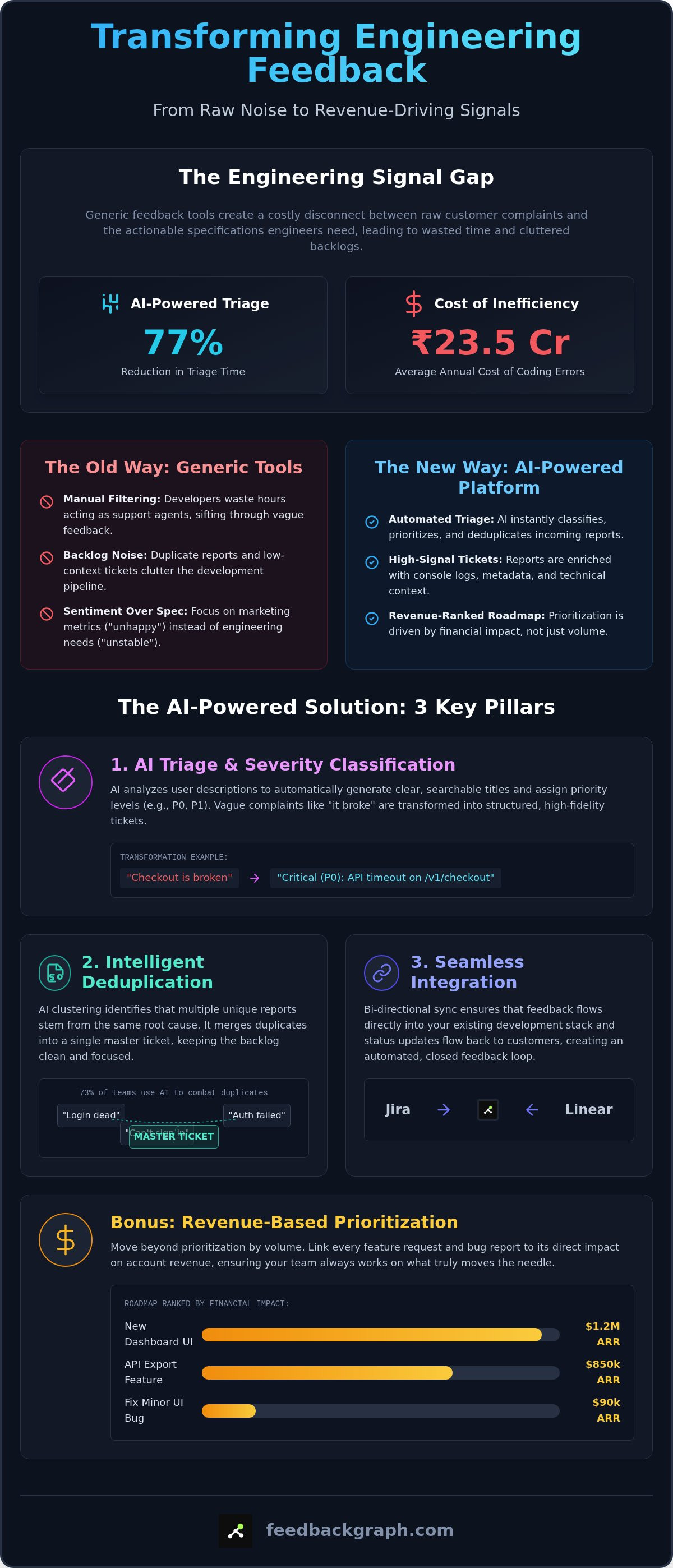
AI analyzes the user’s description to predict the immediate impact on the system. If a report mentions a checkout failure, the system flags it as P0. Conversely, a minor UI alignment issue is categorized as low priority. AI enrichment is the process of adding structured data to unstructured input. This results in standardized bug titles that improve searchability across your entire history. Instead of "Fix this," your backlog shows "Critical: API timeout on /v1/checkout for Android users." This level of precision allows for instant decision-making during sprint planning.
Eliminating the Duplicate Nightmare
Manual deduplication is a massive drain on resources. Research from 2026 shows that 73 percent of software teams are now using AI for bug triage to combat this specific problem. The system uses AI clustering to identify that "The login button is dead" and "I can't sign in" are the same technical fault. The mechanism involves merging these reports into a single, high-signal master ticket. This keeps the engineering view clean and ensures developers aren't chasing the same ghost twice. You can see the technical breakdown of this process on the FeedbackGraph Features page.
Automated enrichment goes deeper than text. It captures the user's browser, OS, and console logs at the exact moment of the crash. This eliminates the "cannot reproduce" status that plagues so many tickets. When you use advanced product feedback software for engineering teams, you give your developers the full context they need to ship a fix on the first try. This methodology reduces the average ₹23.5 crore annual cost of coding errors by speeding up the resolution cycle. If you're ready to automate your triage, schedule a demo to see the system in your stack.
Revenue-Based Ranking: The Ultimate Prioritization Framework
Engineering teams often fall into the trap of prioritizing by volume. In 2026, 92 percent of product leaders own revenue outcomes, yet many still rely on simple vote counts to build roadmaps. This creates a "Loudest Voice" bias where the most vocal users dictate development, regardless of their actual financial contribution. Effective product feedback software for engineering teams must replace sentiment with solvency. By integrating CRM data directly into the triage layer, you shift the focus from "Most Requested" to "Most Valuable." This ensures every sprint maximizes business impact by solving the problems that matter to your highest-paying customers.
Quantifying the Revenue Impact of Every Bug
Every bug carries a specific price tag. When a user reports a crash, the system should immediately identify if they represent a ₹50,000 account or a ₹5,00,000 enterprise partner. Mapping user reports to account value (ACV) and churn risk allows you to visualize "Revenue at Risk" in real-time on your dashboard. This objective data serves as the ultimate tie-breaker during heated roadmap meetings. It removes the emotion from the room and replaces it with logic. You can learn more about Quantifying the Revenue Impact of Customer Bug Reports to see how this technical triage translates directly to the bottom line.
Ranking Feature Requests by Profit Potential
A revenue-led roadmap creates a shared language between engineering and sales. It allows your team to handle high-value requests from enterprise clients without derailing the core product vision. When you can see the profit potential of a feature, prioritization becomes a logical calculation rather than a guessing game. This transparency is essential for various use cases for customer feedback where stakeholder alignment is critical. Instead of debating opinions, your team executes based on evidence-based profit forecasting.
This approach eliminates the friction between product-led and sales-led growth. By surfacing the financial weight of every ticket, you empower engineers to work on tasks that drive the highest ROI. It turns the backlog from a list of complaints into a strategic asset for the entire company. Decisions move faster because the data is undeniable. Your team stays focused, your enterprise clients stay satisfied, and your roadmap remains anchored in reality. This is the difference between shipping features and shipping value.
Bi-directional Integration: Connecting Feedback to the Dev Stack
Most feedback tools treat data as a one-way street. A customer submits a report, it gets pushed to a dev board, and then the connection dies. This is a systemic failure that forces support teams to act as manual relays. Bi-directional sync solves this by ensuring that every status update in Jira or Linear reflects back to the user in real-time. When an engineer moves a ticket from "In Progress" to "Done," the system automatically notifies the original reporter. This creates a transparent, automated loop that saves hours of manual coordination every week.
Modern product feedback software for engineering teams must integrate deeply with the tools your developers already use. Leveraging MCP Servers (Model Context Protocol) allows for sophisticated, AI-driven workflows that go beyond simple data syncing. You can implement complex routing logic to ensure that a technical bug report hits a specific GitHub repo while a UX suggestion goes to a dedicated Slack channel. This precision ensures that your team only sees the signal that is relevant to their specific domain.
Syncing with Jira, Linear, and GitHub
Setting up a bi-directional workflow is a structured process designed for speed. Following these steps ensures your data flows without friction:
- Step 1: Connect your dev tool of choice via OAuth to establish a secure, authenticated link.
- Step 2: Map your feedback categories, such as Bug, Feature, or UX, to specific project boards or teams.
- Step 3: Define trigger rules for automatic ticket creation, ensuring only high-signal reports enter your dev environment.
Closing the Loop Automatically
Closing the feedback loop is often the most neglected part of the product lifecycle. In 2026, 14 percent of software teams still use spreadsheets for bug tracking, leading to massive communication gaps. Automating this process has a profound psychological impact on your users. When they see their feedback being actively worked on through automated status changes, it builds deep institutional trust. You can read more about achieving Real-Time Bi-directional Jira Feedback Sync to understand how this reduces churn and improves customer satisfaction.
This integration layer turns your feedback tool into a functional extension of your dev stack. It eliminates the need for "status check" meetings and keeps every stakeholder aligned without a single manual update. By automating the flow of information, you allow your engineers to stay in their flow state longer, resulting in faster ship cycles and higher code quality.
Choosing the Best Product Feedback Software for Engineering Teams
Selecting the right product feedback software for engineering teams is a strategic decision that directly impacts your development velocity. Most teams fail by choosing tools designed for general marketing surveys instead of technical triage. Your choice must prioritize the elimination of friction for both the user and the developer. A "two-click" capture widget is essential here. If reporting a bug takes more than five seconds, users will skip it or provide low-quality descriptions that stall your sprint. High-quality reporting ensures every ticket enters your system with the metadata required for an immediate fix.
The long-term ROI of reducing engineering backlog noise is substantial. According to Atlassian research in 2026, companies using AI-powered bug tracking save an average of ₹1.5 crore per year in developer time. This financial gain stems from the removal of manual triage and the prevention of duplicate work. By automating the filtering process, you allow your team to focus on high-impact features that drive growth rather than administrative maintenance. This shift transforms your feedback loop from a cost center into a primary driver of efficiency.
The Engineering-First Evaluation Checklist
When auditing potential solutions, move beyond the surface-level UI and focus on the technical data flow. Use this checklist to ensure the tool meets the 2026 standard for engineering excellence:
- Automated Context: Does the tool capture console logs, network requests, and environment metadata without user input?
- Intelligent Deduplication: Can the system identify related reports across different platforms before they hit your dev backlog?
- Financial Intelligence: Can it rank issues by the actual revenue of the reporting accounts to provide objective priority?
Getting Started with FeedbackGraph
FeedbackGraph is designed to sit as the intelligent triage layer between your customers and your Jira, Linear, or GitHub boards. Implementation is built for speed, allowing you to deploy the capture widget in under five minutes. You will see an immediate impact on your workflow within the first 100 reports as the AI begins to cluster duplicates and assign severity rankings automatically. This positions FeedbackGraph as an essential partner for teams that value data-driven decision-making and rapid iteration. It is not just a passive tool; it is an active assistant that ensures your engineering resources are always allocated to the highest-value tasks.
Ship Faster with High-Signal Intelligence
Modern software development moves too fast for manual triage and spreadsheet-based tracking. By deploying AI-powered triage and deduplication, you reclaim up to 77 percent of your team's time. A revenue-based prioritization framework ensures your developers ship the features that drive the highest ROI. This transition from raw noise to high-signal intelligence is the only way to scale in 2026. Decisions become logical calculations instead of emotional debates.
The right product feedback software for engineering teams doesn't just collect data; it routes it. With bi-directional Jira and Linear sync, you eliminate the communication silos that stall progress. You gain a clean, deduplicated backlog that reflects both technical severity and financial impact. It's time to stop guessing and start executing based on objective data. Your team deserves a workflow that prioritizes speed and precision.
Your developers should spend their energy solving complex problems, not hunting for reproduction steps in a cluttered inbox. Build a roadmap that your stakeholders and engineers can both trust and execute with confidence.
Frequently Asked Questions
How does AI bug triage actually work for engineering teams?
AI bug triage acts as an intelligent middleware that processes raw customer input into structured engineering tickets. It uses natural language processing to analyze the report, generate a concise title, and assign an initial severity level based on technical impact. This automation ensures that developers receive high-signal data without manual intervention from support teams. It transforms vague complaints into actionable specifications ready for your next sprint.
Can I sync customer feedback directly with Jira and Linear?
Yes, the platform supports deep, bi-directional integrations with Jira, Linear, and GitHub. You can connect your development tools via OAuth and map specific feedback categories to your existing project boards. This ensures that every high-priority bug or feature request flows directly into your development environment. The sync is not a one-way push; it maintains a live connection between the customer report and the engineering task.
What is revenue-based feedback ranking and why does it matter?
Revenue-based ranking is a prioritization framework that links customer feedback to the financial value of the reporting account. By integrating CRM data, product feedback software for engineering teams can calculate the "Revenue at Risk" for every bug or feature request. This provides an objective tie-breaker for roadmap decisions, ensuring your team focuses on tasks that drive the highest ROI rather than just reacting to the loudest voices.
Does this software capture technical logs and browser data?
Every report captured through the two-click widget automatically includes comprehensive environment metadata. The system enriches feedback with console logs, network requests, browser versions, and OS details at the exact moment of the issue. This eliminates the need for developers to ask for reproduction steps or technical context. Providing these specifications immediately reduces the time spent in the "Cannot Reproduce" cycle and speeds up bug resolution across your stack.
How do you handle duplicate bug reports from different users?
The system uses AI clustering to identify near-duplicate reports across multiple users and platforms. It recognizes that different descriptions often point to the same root cause and merges them into a single master ticket. This keeps your engineering backlog clean and prevents developers from wasting time on redundant tasks. You can view all linked reports under one ticket to understand the full breadth of the issue's impact on your user base.
Is it possible to notify customers automatically when a bug is fixed?
Automated customer notifications are a core feature of the bi-directional feedback loop. When an engineer moves a ticket to a "Done" or "Resolved" status in Jira or Linear, the system triggers an immediate update to the original reporter. This transparency builds user trust and eliminates the manual effort usually required from support teams to close the loop. It ensures your users feel heard without adding any administrative overhead to your workflow.
What are the benefits of a bi-directional feedback integration?
Bi-directional integration ensures that information flows seamlessly between customer-facing teams and the development stack. It eliminates the need for manual status checks and keeps all stakeholders aligned in real-time. When development progress happens in Linear, it reflects back to the feedback dashboard automatically. This reduces communication silos, improves organizational transparency, and allows engineering teams to stay focused on shipping code rather than managing manual status updates for stakeholders.
How much time can engineering teams save with automated triage?
Research from Gartner in 2026 suggests that AI-powered systems can reduce triage time by up to 77 percent. By automating deduplication, enrichment, and severity classification, product feedback software for engineering teams removes the manual burden of backlog grooming. Atlassian data indicates this can save companies an average of ₹1.5 crore per year in developer time. This efficiency allows your team to reclaim hours every week and accelerate your overall product lifecycle.


