

AI can reduce the time your engineering team spends on bug triage by a massive 65%. Most product leads still struggle with backlogs filled with ambiguous titles like "Help" or "Broken link," which stall development velocity and force senior engineers to waste time asking for basic clarification. An AI bug title generator solves this friction by instantly translating messy user feedback into technical, actionable headlines. It moves your team from manual detective work to immediate execution.
You know that a clean, searchable backlog is essential for high-priority focus, but manual cleanup is often a losing battle. You'll learn how specialized AI transforms fragmented complaints into professional, engineer-ready tickets that accelerate your triage process and eliminate duplicate reports. We'll examine how technical enrichment and revenue-based ranking turn a chaotic list of issues into a streamlined roadmap, ensuring your developers spend their energy on the features that actually drive growth.
Key Takeaways
- Discover how an AI bug title generator distills fragmented user feedback into technical summaries that follow the Action-Component-Result formula.
- Understand the hallucination risks of general AI and why specialized tools are necessary to maintain technical accuracy in your engineering backlog.
- Learn the mechanism behind automated enrichment that adds missing app context to every ticket before it reaches your developers.
- Explore how to move from manual spreadsheets to automated capture widgets that sync directly with Jira and Linear.
- See how linking actionable bug titles to revenue-based ranking allows your team to prioritize fixes that impact your bottom line.
What is an AI Bug Title Generator and Why Does It Matter?
An AI bug title generator is a specialized Natural Language Processing (NLP) tool designed to distill chaotic user feedback into structured, technical summaries. Unlike general AI, it doesn't aim for creativity. It aims for utility. It parses raw descriptions to identify the core technical intent hidden behind non-technical language. By extracting the "what" and "where" from a messy complaint, it ensures that every entry in your bug tracking system is immediately actionable.
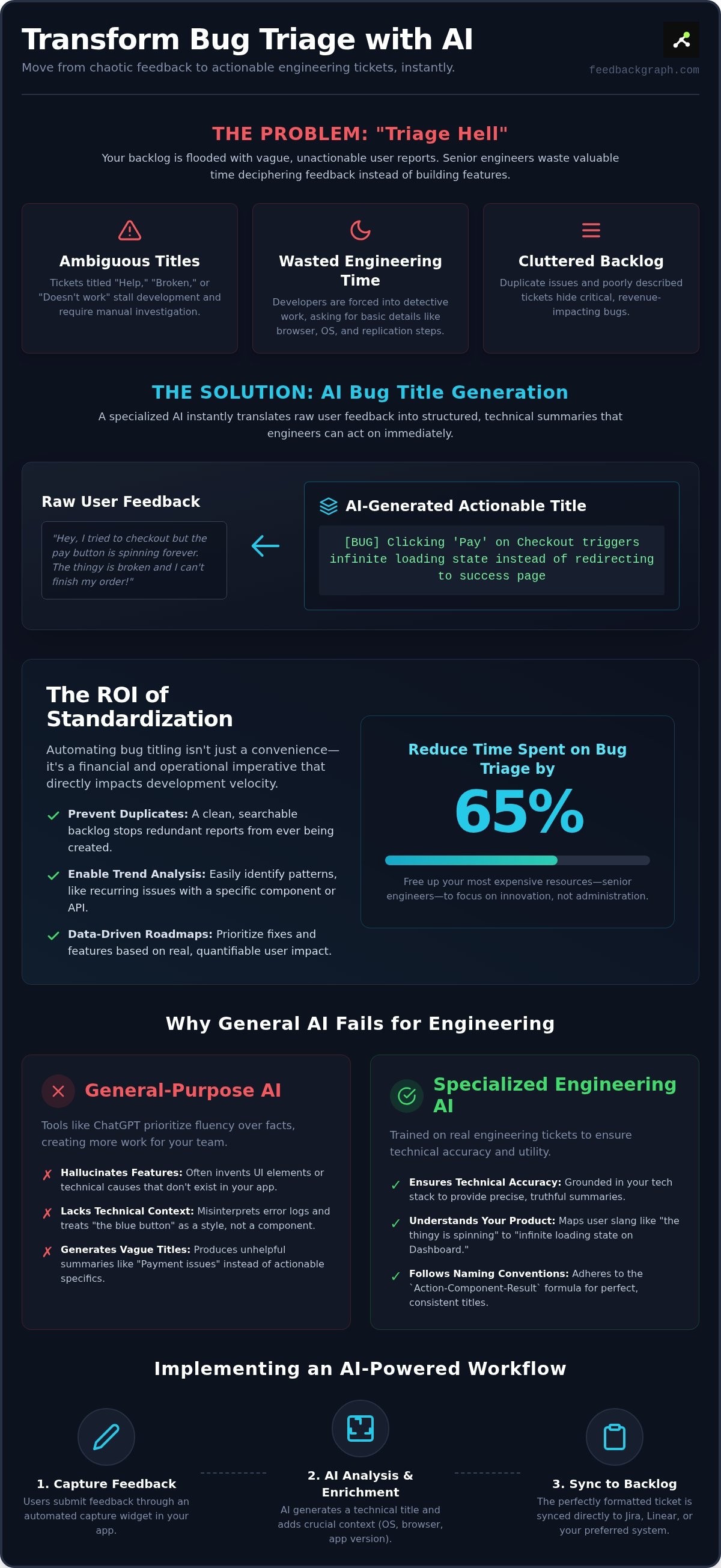
A perfect bug title follows a rigid formula: [Action] + [Component] + [Expected Result] vs [Actual Result]. For example, "Clicking 'Pay' on Checkout redirects to 404 instead of Success Page." This structure gives an engineer everything they need to start debugging without opening the ticket. When users submit reports titled "Help" or "It's broken," they trigger a chain reaction of inefficiency. Your engineering team loses time on manual triage and unnecessary context-switching. These ambiguous entries create noise that masks critical, revenue-impacting issues.
The Difference Between a Catchy Title and a Functional One
General AI tools often prioritize "clickability" or "catchiness," which is the opposite of what a developer needs. An AI bug title generator focuses on precision. It identifies technical entities such as "API endpoints," "Frontend components," or "Database schemas" within a complaint. While a blog title generator might suggest "5 Ways to Fix Your Login," a specialized engineering tool produces "POST /auth/login returns 500 error for legacy users." This level of detail ensures the ticket lands in the right sprint immediately.
The ROI of Standardized Bug Naming Conventions
Standardization isn't just about aesthetics; it's a financial imperative. Research indicates that AI can reduce the time spent on bug triage by 65%. By automating the naming process, you eliminate "Triage Hell" and ensure every ticket is instantly searchable. This prevents duplicate reports from cluttering your backlog. For product managers, consistent naming enables better trend analysis. You can quickly see if a specific percentage of your bugs are hitting the same payment gateway, allowing for data-driven roadmap decisions. Implementing this through automated bug tracking workflows turns a messy feedback loop into a high-velocity development engine.
Why General AI Title Generators Fail for Software Engineering
General-purpose AI models are designed for generative tasks like blog writing or marketing copy. They prioritize fluency and creative flair over technical truth. When you attempt to use a generic tool as an AI bug title generator, you immediately encounter the "hallucination" problem. These models often invent features that don't exist in your UI or suggest technical causes, like an "API timeout," for what is actually a CSS layout glitch. This creates extra work for your engineers, who must debunk the AI's guesses before they can begin the actual fix.
These generic systems also fail to capture and interpret essential technical metadata. A user's feedback string often contains subtle clues about their browser environment, OS, or specific product module. Without being grounded in your specific product terminology and tech stack, a general AI treats "the blue button" as a stylistic descriptor rather than a reference to your primary CTA component. It lacks the logical framework to parse a stack trace or an error log. This makes it a liability in a professional development environment where precision is the only metric that matters. Using a purpose-built AI bug title generator ensures that your technical context remains intact during the summarization process.
Specialized models are trained on thousands of real-world engineering tickets. They recognize the difference between a database timeout and a frontend rendering issue. When a user reports that "the cart won't let me pay," a general AI might write a vague title like "Payment issues." A specialized tool understands your architecture and produces "Checkout component: Stripe API 402 error during card validation." This level of detail eliminates the need for follow-up questions and speeds up the resolution cycle.
The Critical Need for Domain-Specific Context
Engineers need to know the difference between a critical "404 Error" and a minor "UI Glitch" at a glance. Specialized AI understands these distinctions. It maps user slang like "The thingy is spinning" to technical realities like "Infinite loading state on Dashboard." This transformation maintains a professional tone that fits your engineering culture. You can book a demo to see how specialized grounding improves ticket accuracy.
Security and Privacy in Bug Reporting
Sending raw user feedback to a general-purpose AI model is a significant security risk. These models often retain data for training, which could lead to a leak of sensitive user information or internal system architecture. Specialized bug reporting tools use a security-first architecture. They automatically scrub Personally Identifiable Information (PII) before generating titles. This ensures your bug reporting workflow stays compliant with global data protection standards, protecting both your users and your company's reputation.
How Specialized AI Transforms User Feedback into Actionable Titles
Specialized AI doesn't just paraphrase; it enriches. While simple tools might just rearrange a user's words, a dedicated AI bug title generator executes a multi-stage technical workflow to ensure the output is ready for a sprint. The process begins the moment a user hits submit, moving from raw capture to a structured technical summary in milliseconds.
The system immediately associates the report with technical metadata like the current URL, user session state, and component ID. This enrichment fills the gaps that users inevitably leave out. If a user says "it's broken" while on the billing page, the AI knows they are specifically interacting with the "Subscription Upgrade" modal. It doesn't guess. It uses the environment data to ground the summary in reality.
Before the title is finalized, the system performs a deduplication check. It compares the emerging summary against your existing backlog in Jira or Linear. This prevents the noise that occurs when three different users report the same CSS glitch under three different names. Simultaneously, the AI analyzes the functional impact and sentiment to suggest a severity level. This ensures that blocking issues are flagged for immediate triage, while minor visual tweaks are categorized appropriately.
Step 1: Parsing the User Input
The NLP engine parses the input to identify the "Action" and the "Object." It isolates the verb, such as "clicking" or "loading," and the specific UI element involved. The engine filters out noise words, like "please help" or "very frustrated," that provide emotional context but zero technical value. This leaves behind a lean, functional core. It transforms a sentence like "I tried to click the save button but nothing happened and I'm losing work" into the core components of a "Save Functionality" failure.
Step 2: Cross-Referencing with Product Knowledge
Next, the AI cross-references the parsed data with your product knowledge. It learns your team’s preferred naming style by analyzing your historical ticket data. If your engineers prefer a [Module] Action - Result format, the AI adapts its output to match. It uses a "Product Graph" to understand the hierarchy of your features. This ensures that a bug in the footer isn't mislabeled as a site-wide navigation issue. The result is a title that looks and feels like it was written by a senior QA engineer, maintaining consistency across your entire development lifecycle.
Implementing AI Title Generation in Your SaaS Workflow
Transitioning from manual spreadsheets to an automated capture widget is the first step toward operational maturity. Relying on manual entry is an invitation for human error and backlog rot. When you deploy a specialized AI bug title generator, you create a direct pipeline from user frustration to engineering action. This shift eliminates the "middleman" phase where product managers spend hours rewriting tickets before they are even readable for a developer.
Timing is critical when setting up your triggers. You must decide whether the AI generates the title during the initial capture or during the triage phase. Generating the title at the moment of capture allows for immediate deduplication. If the AI identifies a matching issue in your Linear or Jira backlog, it can prompt the user to "upvote" the existing ticket instead of creating a duplicate. This keeps your issue tracker clean from the start, ensuring that your engineering team only sees unique, high-value tasks.
Integration with your existing dev tools should be bi-directional. The AI-generated title, enriched with technical metadata, should sync instantly to your primary workspace. This creates a feedback loop where product managers can edit titles to "teach" the AI over time. By observing these manual corrections, the system refines its understanding of your specific product modules and naming preferences, becoming more accurate with every sprint.
Choosing the Right Capture Method
In-app widgets are superior to email-to-ticket systems because they capture the "User Voice" alongside session data. Email often strips away the technical context the AI needs to be effective. Learn about our customer feedback widget for Jira to see how direct capture provides the raw material for high-precision summaries. Capturing the report at the source ensures that the AI bug title generator has access to the URL, component state, and user actions that preceded the bug.
Configuring the AI Output for Your Team
Every engineering culture has its own standards for ticket documentation. You can configure the AI to follow specific constraints on title length and technical tone. This includes automating the addition of labels and tags based on the content of the generated title. For example, if the AI detects a "401 Unauthorized" error, it can automatically tag the ticket as "Security" or "Backend." The most effective teams train the model on their "Done" tickets, allowing the AI to replicate the exact structure of historically successful bug reports.
Beyond Titles: AI-Powered Triage with FeedbackGraph
A high-quality title is the entry point to a streamlined workflow. However, if a perfectly formatted title sits in a backlog of 500 other "high priority" issues, it doesn't solve your triage bottleneck. FeedbackGraph moves beyond the role of a simple AI bug title generator by adding a financial layer to every ticket. It bridges the gap between engineering output and business outcomes. This prevents "Backlog Bankruptcy," where your team becomes overwhelmed by a volume of issues they can never hope to resolve. By applying logic to the chaos, you regain control over your development roadmap.
Quantifying the Revenue Impact of Every Bug
Most SaaS teams in India prioritize bugs based on gut feeling or the loudest voice in the Slack channel. FeedbackGraph changes this by linking every bug report directly to customer subscription data. This allows you to rank feature requests and bugs by revenue. If a critical payment failure hits a ₹10,00,000 per year enterprise account, the system flags it for immediate attention. Prioritizing bugs that affect your highest-paying accounts first ensures that your retention efforts are focused where they matter most. You move from reactive fixing to strategic revenue protection.
This financial transparency is vital for scaling startups where every churned account impacts the valuation. By assigning a rupee value to every ticket, you provide your engineering leads with the context they need to make hard trade-offs during sprint planning. It turns a technical backlog into a business-aligned priority list. You no longer guess which fix will move the needle; you see the data directly in your triage dashboard.
Frictionless Integration with Your Current Stack
Efficiency requires a unified workflow that doesn't force your engineers to learn new tools. Our AI bug title generator logic lives inside your existing stack. Whether you use Jira, Linear, or GitHub, the system ensures bi-directional sync with latency under five seconds, meeting the 2026 standards for real-time data flow. When an engineer moves a ticket to "In Progress" or "Resolved," the status updates for the reporter automatically. This eliminates the need for manual status changes and follow-up emails.
The bi-directional sync also fosters trust with your user base. Instead of reports disappearing into a black hole, customers receive real-time updates as their specific issues move through your development lifecycle. This level of transparency is a competitive advantage in the crowded Indian SaaS market. It demonstrates that you value customer feedback and are actively acting on it. You automate the repetitive parts of engineering management, freeing your team to focus on shipping high-impact code.
Eliminate Backlog Noise and Scale Development Velocity
Relying on vague user feedback is a hidden cost that stalls your engineering momentum. A specialized AI bug title generator doesn't just rewrite text; it provides the technical grounding and deduplication needed for immediate triage. By shifting from manual detective work to an automated, data-driven workflow, you ensure every ticket in your backlog is actionable and aligned with your business goals.
You've seen how technical enrichment prevents hallucinations and how bi-directional sync keeps your Jira or Linear workspace accurate. More importantly, you now understand how linking these refined tickets to a revenue-based prioritization dashboard protects your bottom line. It's time to stop guessing and start shipping the fixes that impact your highest-paying accounts first. This approach turns your issue tracker from a source of anxiety into a strategic asset for growth.
Empower your team with the structural integrity and visibility they need to maintain high-velocity iteration without the friction of manual triage. Start building a cleaner, more profitable roadmap today.
Frequently Asked Questions
Can an AI bug title generator understand technical error logs?
Yes, specialized models are built to parse technical data like stack traces and console logs. An AI bug title generator identifies specific error codes and component failures within raw logs to create a functional summary. This process transforms a cryptic error string into an actionable headline, allowing your developers to understand the root cause before they even open the ticket.
Will using an AI title generator make my bug reports less personal?
No, the AI serves as a bridge between the customer and the engineer. While it creates a technical title for your backlog, it retains the full original description and user sentiment. This ensures that your team maintains a high degree of empathy for the user's experience while benefiting from the efficiency of a standardized, searchable ticket format.
Does this tool work with Jira and Linear?
Yes, FeedbackGraph integrates bi-directionally with Jira, Linear, and GitHub. The system pushes AI-generated titles directly into your preferred dev environment with latency under five seconds. This integration ensures that status updates in your project management tool are automatically communicated back to the user, creating a frictionless feedback loop without manual status changes or follow-up emails.
How does an AI bug title generator handle duplicate reports?
The system executes AI-driven deduplication by checking every new report against your current backlog history. If the AI bug title generator identifies a match, it prompts the user to contribute to the existing ticket instead of creating a new one. This keeps your issue tracker clean, reduces noise for your engineering team, and ensures high-priority bugs get the visibility they deserve.
Is my data safe when using an AI to summarize customer feedback?
Data protection is integrated into the architecture. Specialized tools scrub PII before summarizing feedback to ensure compliance with modern data regulations and Indian data protection standards. Unlike general models that might retain data for training, these systems use secure environments to process your reports. This protects your sensitive internal technical data and your customers' personal information throughout the triage lifecycle.
Can I customize the format of the titles the AI generates?
Yes, you can set specific constraints to align the AI's output with your internal engineering standards. You can define the required tone, length, and structural formulas, such as [Action] + [Component]. The system can also be trained on your "Done" tickets to learn and replicate the exact naming conventions your senior developers already use and trust.
How much time can my engineering team save with automated bug titles?
Automated triage can reduce time spent on manual ticket review by 65%. By using an AI bug title generator, your engineering leads stop wasting hours on follow-up questions for vague reports. This efficiency shift accelerates your time-to-resolution and ensures that your developers spend their energy on high-impact features rather than administrative backlog cleanup and manual deduplication.


