

Your engineering backlog isn't too big; it's just too loud. Most teams treat triage as a manual endurance test, yet they still end up with a graveyard of duplicate tickets and vague bug reports that lead nowhere. This constant friction doesn't just waste time. It actively kills developer momentum. To reduce engineering backlog noise, you need to stop viewing triage as a human-led process and start treating it as a data integrity challenge.
We know the frustration of seeing high-priority fixes buried under a mountain of "as designed" reports or missing log files. It's a drain on resources that costs Indian tech firms lakhs in lost productivity every sprint. This 2026 guide shows you how to flip the script. You'll learn how to implement AI-powered triage to automatically enrich low-quality reports, deduplicate incoming tickets instantly, and restore your team's focus on shipping code. We're moving beyond simple filters to a system where your backlog self-cleans and prioritizes itself based on real business impact.
Key Takeaways
- Identify why manual triage meetings are a symptom of a broken capture process and how data decay compromises your backlog integrity.
- Compare AI filtering against manual review to see how automated data enrichment provides the technical context engineers need to act immediately.
- Deploy a five-step strategy to reduce engineering backlog noise using a smart capture layer that stops low-quality tickets at the source.
- Eliminate redundant work by implementing AI-driven deduplication that merges near-duplicate reports into a single, actionable thread.
- Shift your prioritization logic toward revenue-based feedback ranking to align engineering output with strategic business outcomes.
What is Engineering Backlog Noise and Why Does it Scale?
Engineering backlog noise is the accumulation of low-context, duplicate, or irrelevant tickets that obscure actionable work. It is the friction that exists between a reported issue and a developer's ability to fix it. In a 2026 development environment, noise is not just a nuisance; it is a systemic failure of data integrity. When your backlog is flooded with "drive-by" reports or half-baked feature requests, the signal that actually drives product value disappears. To reduce engineering backlog noise, you must first recognize that a bloated Jira or Linear instance is usually a symptom of poor requirements management at the point of capture.
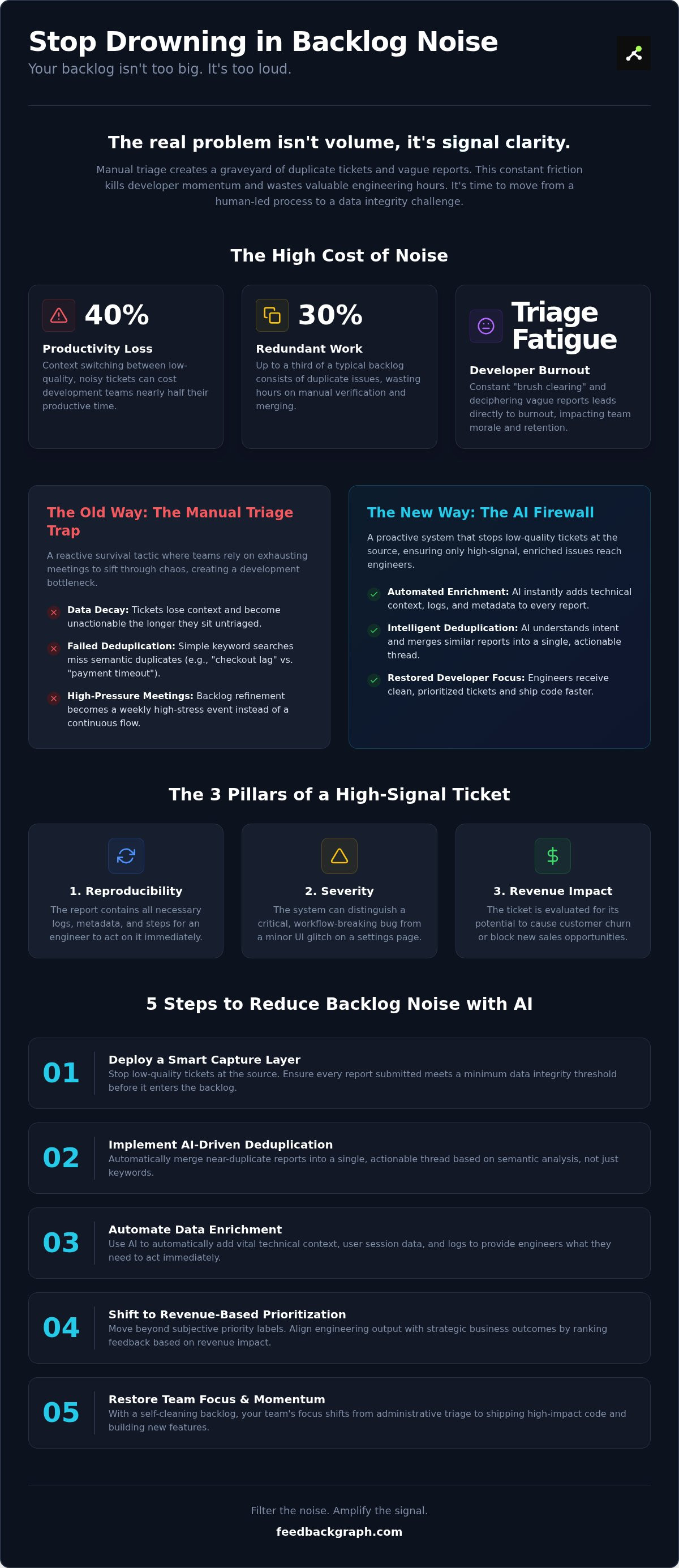
This problem scales aggressively. As your user base grows, the volume of incoming feedback increases. However, the ratio of noise to signal does not stay linear. It grows exponentially. Without automated filtering, your senior engineers spend more time deciphering vague reports than writing code. Research into cognitive load shows that context switching between noisy tickets can cost teams up to 40% in productivity. For a high-growth SaaS firm in India, this translates to lakhs of ₹ in wasted engineering salary every month. Beyond the financial cost, the psychological toll is severe. Triage fatigue leads directly to developer burnout as teams feel they are constantly "clearing the brush" rather than building new features.
The Three Pillars of Backlog Signal
To differentiate signal from noise, every ticket must satisfy three criteria. First is reproducibility. If an engineer cannot act on a report immediately due to missing logs or steps, it is noise. Second is severity. A UI glitch on a settings page is not the same as a broken checkout flow. Third is revenue impact. In a competitive market, you must know if a report represents a churn risk or a minor annoyance. If a ticket lacks these pillars, it should never reach your active sprint.
Identifying the Sources of Friction
- Vague customer reports: Submissions like "it does not work" or "the screen is blank" provide zero technical value without automated enrichment.
- Internal "drive-by" reporting: Fragmented feedback from Slack, email, or casual conversations creates tickets without structured metadata.
- Duplicate issues: Multiple users reporting the same UI glitch creates redundant work. Without automated deduplication, your team wastes hours triaging the same bug five times.
By identifying these friction points, you can begin to implement a "firewall" for your development team. Moving toward an AI-first triage model ensures that only high-signal, enriched tickets make it through to your engineers. This transition is essential to reduce engineering backlog noise and maintain a high velocity as your product matures.
The Anatomy of Noise: Why Traditional Triage Fails
Traditional triage is a reactive survival tactic. Teams rely on exhausting weekly meetings to sift through chaos. This is the manual triage trap. If you are spending hours every Monday deciding what to ignore, your capture process is already broken. Backlog refinement should be a continuous stream; not a high-pressure event. When triage is manual, it becomes a bottleneck that slows down development velocity and delays critical updates.
Data decay is the silent killer. A bug reported on Tuesday without logs is often incomprehensible by Friday. The longer a ticket sits in the "noise pile," the less actionable it becomes. Engineers waste time chasing ghosts or asking for information that users have already forgotten. This lag between reporting and review ensures that context is lost forever, making the eventually triaged ticket useless.
Then there is the "Dreaded Duplicate." Industry patterns suggest that up to 30% of a typical engineering backlog consists of the same few issues reported with different phrasing. Closing these manually is an administrative tax. Every "Won’t Fix" or "Duplicate" resolution requires a human to read, verify, and click. This overhead adds up to significant operational waste that costs Indian software firms thousands of ₹ in lost engineering hours every month.
The Failure of Manual Deduplication
Standard keyword searches in tools like Jira are fundamentally flawed for deduplication. One user reports a "checkout lag" while another cites a "payment gateway timeout." They are the same infrastructure failure. A text-match search will miss the connection every time. Manual review cannot scale when you are receiving hundreds of reports. It creates a massive drag on the product cycle. To reduce engineering backlog noise, you need a system that understands intent, not just keywords.
Inconsistent Severity Labeling
Traditional bug forms are breeding grounds for bias. Every user thinks their specific issue is "High Priority." Without objective criteria, your backlog becomes a list of who shouted the loudest. This biased reporting distracts from critical system failures that might have low user-facing visibility but high architectural risk. It forces engineers to work on "loud" minor bugs while silent, high-risk technical debt accumulates.
Effective teams replace subjective forms with automated technical metadata. Instead of asking a user how important a bug is, you should look at system logs and revenue impact. If you want to see how AI can automate this objective filtering, you can book a demo to explore high-signal triage. Transitioning to an evidence-based model is the only way to reduce engineering backlog noise effectively in 2026.
AI Filtering vs. Manual Review: A Modern Comparison
Manual review is a linear solution trying to solve an exponential problem. In 2026, a growth-stage SaaS might receive 1,000 weekly reports across various channels. A human team triaging ten tickets is manageable; triaging a thousand is a full-time operational drain. AI-driven systems process these inputs in milliseconds. They don't just sort tickets; they evaluate them against your entire historical codebase. This shift is the only way to reduce engineering backlog noise while maintaining a high release cadence.
The health of your backlog depends on your signal-to-noise ratio. Manual review often results in "shallow" triage, where tickets are moved based on keywords rather than technical merit. This leads to an accumulation of Technical Debt because critical infrastructure issues are frequently misclassified as minor UI bugs. AI provides a higher resolution view. It identifies patterns that a human eye would miss, ensuring that your team spends time on high-impact engineering work rather than administrative sorting.
Automated Deduplication Mechanisms
Modern triage uses Natural Language Processing (NLP) to identify "near-duplicate" issues. If three users report a "checkout failure," "payment lag," and "cart timeout," the AI recognizes these as symptoms of the same latent bug. It clusters these similar reports to identify widespread outages before they escalate into a PR crisis. Instead of five separate Jira tickets, the system creates a single "Master Ticket." This consolidation prevents redundant work and keeps your sprint focused.
AI-Powered Report Enrichment
AI adds the technical metadata that users consistently omit. It generates descriptive, technical titles from vague user descriptions like "it's broken." By analyzing system logs and user sentiment, the system performs automatic severity classification. It can distinguish between a frustrated power user and a minor annoyance. Furthermore, it summarizes long, rambling feedback threads into actionable engineering briefs. This enrichment ensures that when an engineer finally opens a ticket, they have everything they need to start the fix immediately.
Implementing automated triage tools in 2026 is a clear financial win for Indian tech firms. When you calculate the hourly rate of a Senior Developer, spending ten hours a week on manual triage costs your company lakhs of ₹ every quarter. Automated systems eliminate this waste. By moving to an AI-first model, you reduce engineering backlog noise and reallocate that expensive human capital toward building new revenue-generating features. It is a strategic upgrade from reactive maintenance to proactive product development.
5 Steps to Reduce Engineering Backlog Noise with AI
Moving from a chaotic backlog to a high-velocity engine requires more than just better habits. It requires a structural shift in how data enters your ecosystem. To reduce engineering backlog noise, you must move the intelligence to the edge of your system. This means filtering and enriching data before it ever reaches your primary project management tool. By implementing a multi-layered AI pipeline, you can transform raw, messy feedback into a prioritized list of actionable engineering tasks.
Step 1: Standardizing the Capture Layer
Open-ended text fields are the primary source of noise. When you allow users or internal teams to submit bugs via unstructured Slack messages or vague forms, you guarantee a data integrity failure. Replace these with AI-assisted widgets that guide the reporter toward clarity. By utilizing FeedbackGraph Features, you can ensure every report includes mandatory technical context. Capturing visual evidence like screenshots or screen recordings automatically removes the ambiguity that usually forces engineers to waste time on clarification. This "Smart Capture" layer acts as a firewall for your backlog.
Step 2: Automating Triage and Routing
Once data is captured, AI-driven deduplication merges incoming reports with existing tickets in real time. This prevents the "duplicate storm" that typically happens during major outages or UI regressions. The system then uses classification models to route issues to the correct squad or developer based on the functional area or code ownership. You don't need a human to decide if a bug belongs to the API team or the Frontend team. AI handles the assignment instantly, reducing the "Triage Lag" from several days to mere seconds. This ensures that high-priority bugs get immediate visibility without manual intervention.
Step 3: Closing the Feedback Loop
Communication overhead is a significant, often overlooked component of backlog noise. When a customer doesn't know their issue is being addressed, they report it again or send follow-up emails to support. Real-time status sync ensures that when a developer moves a ticket to "In Progress" in Jira or Linear, the customer is notified automatically. This bi-directional flow eliminates the need for manual check-ins and reduces the administrative tax on your product managers. You can learn more about optimizing these systems in our guide on Closing the Customer Feedback Loop.
Finally, automate the enrichment of every ticket with technical context and severity tags. By the time an engineer opens a ticket, it should already contain log snippets, user environment data, and a revenue-impact score. This level of automation ensures your team stays focused on shipping code rather than acting as expensive secretaries for your project management software. These five steps collectively reduce engineering backlog noise and restore your team's focus on building features that drive growth in the competitive Indian tech market.
FeedbackGraph: The Ultimate Signal Filter for Engineering Teams
FeedbackGraph acts as the definitive firewall for your development team. It isn't just a feedback tool; it's a high-fidelity AI engine designed specifically to reduce engineering backlog noise. By processing raw customer inputs before they reach your primary trackers, the platform converts unstructured chaos into high-signal engineering tickets. This replaces the traditional, friction-heavy triage meeting with an automated AI Triage Dashboard that provides clear, logical reasoning for every classification. It integrates bi-directionally with Jira, Linear, and GitHub, ensuring your engineers stay in their flow while the noise is handled in a separate, intelligent layer.
Revenue-Based Prioritization
Traditional prioritization often fails because it relies on user sentiment rather than financial reality. FeedbackGraph introduces revenue-based ranking to solve this. It quantifies the ₹ value of every bug or feature request by pulling data from your billing systems and CRM. This allows you to separate "loud" users from "high-value" users who represent actual churn risks or expansion opportunities. Instead of guessing, you get a prioritized list based on the bottom line. You can see this logic in action at FeedbackGraph Use Cases. This data-driven approach ensures your team works on what matters, effectively ignoring the irrelevant clutter that usually fills up a backlog.
Seamless Integration and the MCP Server
Modern product management requires tools that talk to each other without manual intervention. FeedbackGraph leverages MCP servers to facilitate deep, bi-directional integrations across your technical stack. This foundation allows for complex data flows that keep your Jira or Linear instances pristine. By filtering noise in the FeedbackGraph layer, you ensure that only verified, enriched, and deduplicated tickets ever reach your development sprint. It's a proactive defense against the data decay and context loss discussed earlier. This setup allows your team to focus on shipping code rather than managing a bloated database. If you're ready to restore focus and reduce engineering backlog noise, it's time to move beyond manual processes. Book a FeedbackGraph demo today to see how an AI-first triage system can transform your engineering velocity.
Reclaiming Engineering Velocity in 2026
Manual triage is a liability your team can't afford. In 2026, high-performing squads filter signal from noise at the source. You've learned how a smart capture layer and automated enrichment transform a bloated backlog into a strategic asset. By implementing revenue-based feedback ranking, you ensure every sprint aligns with financial goals rather than the loudest user's demands.
It's time to reduce engineering backlog noise and restore your developers' focus. FeedbackGraph provides the infrastructure for this transition. With AI-powered deduplication for Jira and Linear, you eliminate redundant work instantly. Bi-directional status sync keeps your customers informed without manual intervention. This isn't just about cleaning up a list. It's about reclaiming your engineering velocity and driving real product impact.
Stop letting low-quality data dictate your roadmap. Build a high-signal engineering culture that ships faster and scales smarter.
Frequently Asked Questions
What is considered "noise" in an engineering backlog?
Noise refers to the accumulation of low-context, duplicate, or irrelevant tickets that obscure actionable work. When you fail to reduce engineering backlog noise, developers waste hours on vague reports like "it doesn't work." This friction scales exponentially as your user base grows. Automated triage identifies these non-actionable items early, maintaining a high-signal backlog that prioritizes system stability and strategic product growth.
How does AI identify duplicate bug reports if the wording is different?
AI uses Natural Language Processing (NLP) and semantic clustering to identify intent rather than relying on exact keyword matches. The system analyzes technical metadata, system logs, and user descriptions to recognize when multiple reports point to the same root cause. This allows the platform to merge "checkout lag" and "payment timeout" into a single master ticket, preventing redundant work across your engineering team.
Can AI filtering accidentally hide critical system bugs?
Modern AI triage improves visibility for critical bugs by using revenue-based ranking and severity classification. The system doesn't hide data; it enriches it. AI identifies critical failures by cross-referencing user reports with system logs and technical metadata. This ensures that a major infrastructure outage is surfaced immediately rather than being buried under a mountain of minor UI glitches or "won't fix" requests.
How much time can engineering managers save by automating triage?
Managers save five to ten hours per week by replacing manual review meetings with an AI dashboard. Instead of spending half a day every Monday sorting Jira tickets, the system processes 1,000+ reports in seconds. This shift can save Indian tech firms lakhs of ₹ in senior engineering time every quarter. Automation moves the triage lag from days to seconds, allowing leadership to focus on strategic execution.
Does reducing backlog noise actually improve software release velocity?
Yes, because it eliminates the 40% productivity loss caused by context switching. When you reduce engineering backlog noise, developers only receive enriched, high-signal tickets with full reproducibility steps. A clean backlog ensures that every task in the sprint is actionable from the start. This eliminates the "ping-pong" effect between support and engineering, allowing for faster release cycles and more predictable shipping dates.
What is the difference between a bug report and a feature request in the context of noise?
Both are unstructured data risks that can bloat a backlog. A bug report is noise if it lacks technical context; a feature request is noise if it lacks strategic alignment. AI triage distinguishes these categories by analyzing technical metadata for bugs and revenue impact for requests. This ensures that engineers see actionable defects while product managers see feature requests ranked by their actual ₹ value.
How do I integrate an AI triage tool with my existing Jira workflow?
Seamless integration occurs through bi-directional sync and MCP servers. You connect FeedbackGraph to your existing Jira, Linear, or GitHub instance to create an intelligent firewall. The AI captures and enriches feedback through a two-click widget, then routes only high-signal tickets to your development boards. Status updates sync back automatically, closing the feedback loop with customers without requiring any manual intervention from your engineering team.


