

Your product feedback is likely a liability, not an asset. When feature requests are scattered across Slack, email, and messy spreadsheets, they don't drive growth; they create friction. You know the frustration of engineering teams ignoring vague bug reports because the technical context is missing. It's nearly impossible to prove the financial value of a requested update when your data is fragmented. Learning how to manage product feedback in 2026 requires more than a simple collection bucket. You need a high-velocity system that operates with technical precision and moves at the speed of your development cycle.
This guide helps you master an AI-first pipeline that automates triage and prioritizes features based on real revenue impact. We will show you how to build a streamlined path from customer voice to developer ticket, ensuring every request is enriched with actionable data. You'll discover how to use automated deduplication to clear backlog noise and implement ranking systems that executives actually trust. By the end of this guide, you will have a clear roadmap for turning raw feedback into a predictable engine for growth and revenue.
Key Takeaways
- Shift from reactive collection to a continuous feedback loop that eliminates "Feedback Debt" and prevents engineering team burnout.
- Discover how to manage product feedback using AI-driven triage to automatically classify severity and deduplicate reports before they reach your backlog.
- Master revenue-based ranking to prioritize features that drive financial impact rather than just following the loudest voices in the room.
- Streamline your pipeline with bi-directional integrations that sync customer insights directly to Jira and Linear tickets in real-time.
- Build a high-velocity system that transforms scattered Slack messages and emails into a single, automated source of truth.
Beyond the Spreadsheet: Why Manual Feedback Management Stalls Growth
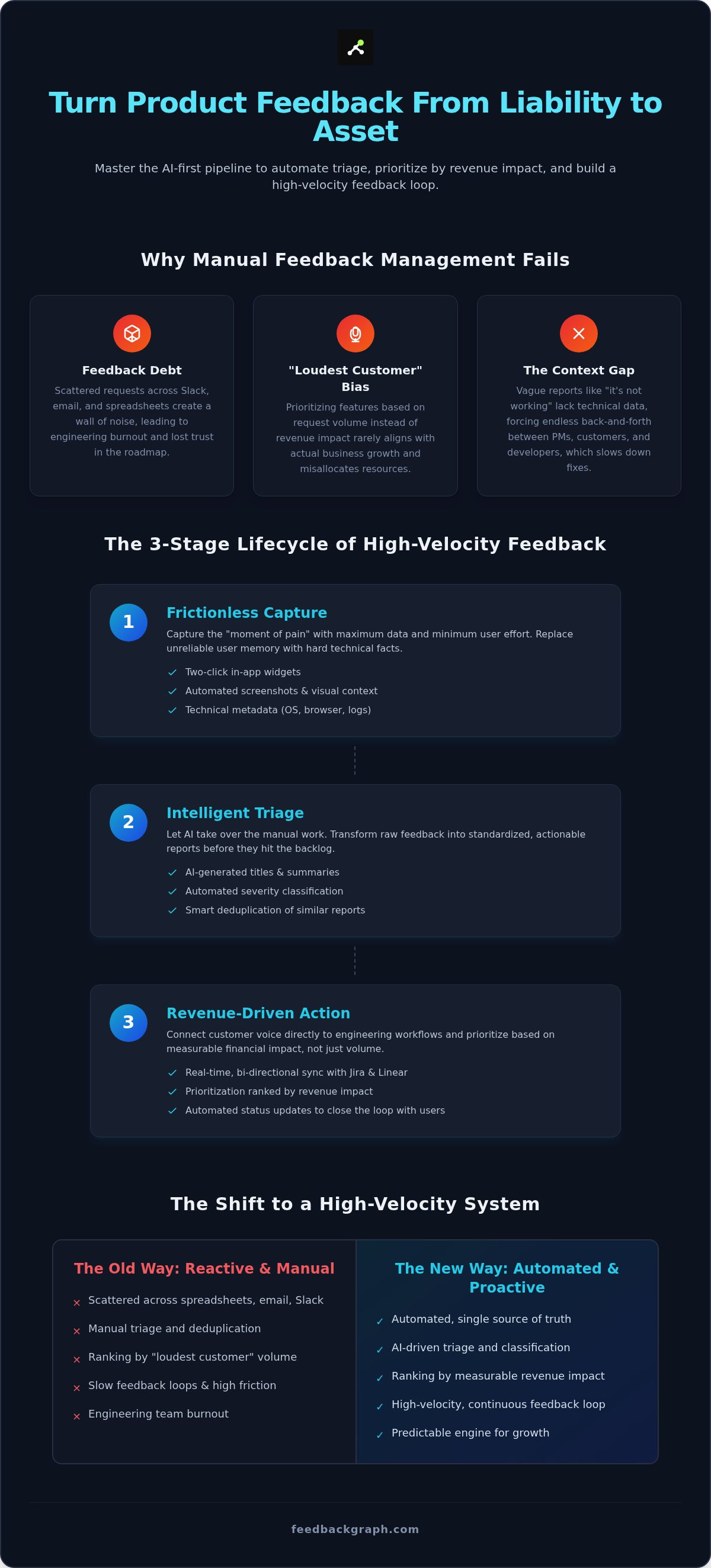
Manual feedback management kills momentum. Many teams treat the Voice of the Customer (VoC) as a collection of static data points tucked away in a spreadsheet. This is a mistake. Professional product management requires a continuous loop, not a seasonal event. When input remains unmanaged, you build "Feedback Debt." This debt accumulates as scattered requests create a wall of noise, eventually leading to engineering churn. Developers lose trust in the roadmap when it's built on vague reports rather than technical reality. Stop using spreadsheets as a graveyard for ideas and start treating feedback as a live data pipeline.
Volume-based prioritization is another trap. It creates a "loudest customer" bias where the most vocal users dictate your roadmap. This rarely aligns with actual growth. To scale, you must move from counting mentions to measuring impact. Learning how to manage product feedback in 2026 means shifting from manual collection to automated data enrichment pipelines that connect customer pain directly to business value.
The High Cost of Feedback Friction
Product managers waste hours every week triaging vague bug reports. This administrative friction has a tangible cost. It creates a "Context Gap" between what a customer says and what a developer needs to see. A customer might report that a feature "isn't working," but a developer needs environment logs, severity levels, and reproduction steps. This gap triggers endless back-and-forth communication. In competitive SaaS markets, these slow loops increase churn. If your response time lags, your customers will migrate to competitors who ship fixes faster.
Why Traditional Tools Fail in 2026
Static survey tools are obsolete for modern technical teams. They capture data but provide zero intelligence. Manual deduplication is impossible when you handle thousands of users. You cannot expect a human to spot five different reports describing the same edge-case UI glitch across different languages or platforms. Traditional tools lack the infrastructure to handle the data volumes we see in 2026. You need AI-native enrichment to standardize incoming data instantly. This automation ensures your team focuses on building features that drive revenue instead of cleaning up messy customer feedback entries. High-velocity growth requires a system that thinks as fast as your users do.
The 3-Stage Lifecycle of High-Velocity Product Feedback
High-velocity product management relies on the speed of the feedback loop. If your capture process is slow, your data is stale. If your triage is manual, your engineers are frustrated. Learning how to manage product feedback in 2026 requires you to treat it as a three-stage lifecycle: Capture, Triage, and Action. Most teams fail because they only focus on the first stage, leaving the rest to rot in a manual backlog. Effective systems automate the transition between these stages to ensure no insight is lost.
Stage 1: Frictionless Capture. Stop asking users to fill out ten-field forms. They won't do it. Move to two-click in-app widgets. This shift ensures you capture the "moment of pain" before it's forgotten. While traditional research from Harvard Business Review suggests that feedback can be skewed by human perception, capturing hard technical data alongside user comments grounds every request in reality. It transforms subjective complaints into objective bug reports.
Capturing High-Fidelity Data In-App
Traditional methods rely on user memory, which is notoriously unreliable. Modern in-app bug reporting for SaaS UX captures visual context automatically. When a user reports an issue, the system should grab a screenshot and technical metadata like browser version, OS, and console logs. This eliminates the back-and-forth between PMs and engineers. It's about maximizing data quality while minimizing user friction. High-fidelity data ensures that when a ticket hits a developer's desk, they have everything they need to start fixing it immediately.
Stage 2: Intelligent Triage. Once data enters the system, AI must take over. It should generate concise titles, assign severity, and summarize the core issue. This is how you understand how to manage product feedback at scale without hiring a massive operations team.
AI Triage: Turning Noise into Signals
Manual triage is the primary bottleneck in scaling product teams. Using automated bug severity classification allows you to route critical issues to developers instantly. AI also handles deduplication. If fifty users report the same login error, the system should cluster them into a single actionable ticket. This turns a chaotic stream of noise into a prioritized signal. AI-generated summaries provide PMs with a quick overview, allowing for rapid-fire approval of roadmap items.
Stage 3: Bi-directional Action. The loop only closes when the data reaches your dev tools. Syncing feedback directly to Jira or Linear ensures that engineers work from a single source of truth. Status transparency is vital here. When a developer moves a ticket to "Done," the original reporter should receive an automated update. This builds trust and encourages future participation. If you're ready to automate this entire pipeline, you can book a demo to see these integrations in action.
Quantifying Impact: Ranking Feature Requests by Revenue, Not Volume
Volume is a vanity metric. If you want to know how to manage product feedback effectively, you must stop counting votes. A feature requested by 100 free-tier users is often less valuable than a fix requested by one enterprise client paying ₹5,00,000 annually. This psychological shift from "Feature Factory" to "Value Driver" is essential for success in 2026. You aren't just managing a list. You're directing capital toward the most profitable outcomes.
The Revenue-Based Prioritization Framework
Traditional teams rank by popularity. Professional teams rank by profit. Compare these frameworks to see the difference in outcome:
- Volume Ranking: Prioritizes the loudest crowd. Result: Incremental bloat and roadmap drift.
- Revenue Ranking: Prioritizes ARR and renewal risk. Result: Strategic growth and executive alignment.
- Effort Ranking: Prioritizes dev capacity. Result: Resource efficiency but potential value loss.
You must quantify the revenue impact of customer bug reports to win executive buy-in. When you present a roadmap backed by financial data, the conversation changes. It's no longer a debate over opinions. It's a discussion about protecting ₹10,00,000 in potential churn or unlocking new market segments. This data-driven approach ensures your engineering resources are never wasted on low-impact tasks.
Eliminating the "Loudest Voice" Bias
High-volume requests from low-value accounts often derail growth. They consume dev time without moving the needle on your bottom line. To solve this, implement a weighting system tied to Customer Lifetime Value (CLV). A request from a high-growth account in the Indian market should carry more weight than a generic suggestion from a trial user. This is the strategic core of how to manage product feedback. By prioritizing product backlog by revenue, you align your development cycle with the financial health of the company. It's about building what pays, not just what's popular.
Building Your Automated Feedback Loop: A Step-by-Step Implementation Guide
Implementation is where strategy meets technical reality. If you want to master how to manage product feedback, you must build a functional engine that operates without manual oversight. Most teams fail because they treat feedback as a side project. Follow these five steps to deploy an automated system that scales with your user base.
- Step 1: Audit and Consolidate. Map every entry point where users interact with your brand. This includes Slack, email, and support tickets. Move these scattered conversations into a single, centralized source of truth.
- Step 2: Deploy AI Capture. Replace long, friction-heavy forms with an AI-powered widget. This ensures every report is standardized with technical metadata and visual context from the first click.
- Step 3: Define Routing Rules. Set logic for automated triage. High-severity bugs should bypass general review and hit the dev queue immediately. Feature requests should route to your revenue-ranking pipeline.
- Step 4: Sync Workflows. Establish a bi-directional link with your task manager. When a PM approves a request, it should automatically create a ticket in Jira or Linear. Use bi-directional integrations to keep your engineering and product teams aligned.
- Step 5: Automate Closure. Configure your system to notify the original reporter the moment a status changes. This ensures the loop stays closed without taking up PM time.
Consolidating Channels Without Losing Data
Data fragmentation is the enemy of rapid growth. You cannot build a roadmap on screenshots buried in Slack threads or vague emails. Use a checklist for SaaS feedback capture to ensure no channel is left behind. The goal is to bridge the gap between informal customer chats and formal engineering requirements. Setting up robust customer feedback loops for product teams creates an environment where every valid insight is captured and enriched by AI before it reaches a human reviewer. This is the only way to manage product feedback effectively when handling thousands of users.
Automating Status Updates and Closing the Loop
Closing the loop is the most important factor in long-term customer satisfaction. Users stop providing input when they feel their voice is ignored. When you automate status updates, you prove that their voice has a direct impact on the product roadmap. Bi-directional sync makes this effortless. When a developer moves a Jira ticket to "Done," the system sends a real-time update back to the customer. This transparency reduces support tickets and improves retention. It transforms your product from a black hole into a collaborative partnership.
Scaling Triage with FeedbackGraph: Connecting Customer Voice to Engineering Workflows
Scaling a product team requires a fundamental shift in how to manage product feedback. You cannot hire enough product managers to manually sift through thousands of reports without sacrificing speed. FeedbackGraph provides an AI-native infrastructure that turns raw customer voice into structured engineering tasks. It eliminates the triage friction that stalls development cycles. By automating the most tedious parts of the feedback loop, your team moves from passive management to aggressive growth execution.
Seamless Dev Tool Integration
Your feedback system is only as strong as its integrations. Shallow, one-way connections leave your data siloed and out of sync. FeedbackGraph allows you to connect customer feedback to dev tools like GitHub, Slack, and Linear with technical precision. We provide MCP servers for modern product management, enabling your AI agents to interact directly with your feedback data flow. The real power lies in our bi-directional Jira feedback sync. When a developer updates a ticket status in Jira, that information flows back to the user instantly. This bi-directional sync ensures real-time transparency without manual status updates.
The FeedbackGraph Advantage: Revenue-First Roadmaps
FeedbackGraph doesn't just collect data; it enriches it. Our system includes an AI bug title generator that transforms "it's broken" into "Critical Error: API Timeout on /v1/checkout for Enterprise Tier." This level of detail saves your engineering team hours of investigation. More importantly, we automate revenue-based ranking. The platform cross-references incoming requests with your CRM data to highlight which features protect your highest-value accounts. This ensures you never lose a ₹10,00,000 renewal over a minor bug. You are always solving for the most profitable outcomes first.
Stop drowning in backlog noise. If you want to master how to manage product feedback at a global scale, you need a system that thinks like a product expert. Execute your growth strategy with data-backed confidence and technical clarity.
Future-Proof Your Product Strategy
Success in 2026 requires moving beyond the friction of manual spreadsheets. Fragmented data creates "Feedback Debt" that stalls engineering and clouds your vision. Mastering how to manage product feedback means replacing manual triage with intelligent automation that prioritizes high-value features over loud voices. This shift transforms raw customer input into a structured revenue engine that drives your roadmap forward.
FeedbackGraph streamlines this entire lifecycle with technical precision. You gain access to AI-powered bug deduplication that clears backlog noise and revenue-based feature ranking that ensures executive alignment. Our bi-directional Jira and Linear sync keeps your engineering team moving without the burden of manual status updates. It's time to stop managing lists and start executing a data-backed growth strategy that executives trust.
Building a world-class product starts with a world-class feedback system. Take the first step toward a friction-free roadmap and watch your retention rates climb as you deliver what truly matters to your users.
Frequently Asked Questions
How do I manage product feedback without a dedicated tool?
You can learn how to manage product feedback using shared spreadsheets, Slack channels, or Trello boards if your team is small. However, manual systems often result in data fragmentation and lost context. As your user base grows, the administrative burden of tracking requests across multiple platforms leads to engineering churn. Transitioning to an automated pipeline ensures that every customer voice is captured and enriched without the need for constant human intervention.
What is the best way to prioritize product feedback?
The most effective method is revenue-based prioritization. Instead of following the loudest crowd or ranking by volume, you should weight requests based on account size and subscription value. This ensures your roadmap protects high-value renewals and targets profitable growth. By linking feedback directly to your CRM data, you can prove the financial impact of every feature request to your executive team and align development with business goals.
How does AI help in managing product feedback?
AI automates the most tedious parts of the triage process. It generates technical titles, assigns severity levels, and summarizes complex user reports instantly. Beyond enrichment, AI identifies near-duplicate submissions and clusters them into single actionable tickets. This reduces backlog noise and allows your product managers to focus on strategic decision-making rather than manual data entry. It turns raw, messy input into structured, high-fidelity engineering signals.
How do I close the customer feedback loop efficiently?
Efficient loop closure is a critical part of how to manage product feedback and requires automated status updates. When a developer moves a ticket to "Done" in your task manager, the system should instantly notify the original reporter. This transparency builds trust and improves customer retention. Using bi-directional integrations ensures that these updates happen in real-time without requiring your product team to send manual emails for every single shipped fix.
Can I sync customer feedback directly to Jira or Linear?
Yes, you can establish a direct, bi-directional sync with Jira, Linear, and GitHub. This connection ensures that customer insights flow directly into your engineering workflow as structured tickets. Because the sync is bi-directional, any status changes made by developers are reflected back in your feedback dashboard. This keeps product and engineering teams perfectly aligned on a single source of truth and eliminates manual status tracking between departments.
How do I handle duplicate feedback submissions?
Handling duplicates manually is impossible at scale. An AI-powered system automatically scans incoming reports for similar language, metadata, and visual context. It then clusters these related reports into one parent ticket. This prevents your backlog from becoming cluttered with repetitive requests and gives you a clearer view of the actual demand for specific features. It ensures that your engineering resources are focused on unique, high-impact problems rather than redundant tickets.
What is revenue-based product prioritization?
Revenue-based prioritization is a framework that ranks features and bugs by their impact on your bottom line. It calculates the total annual recurring revenue or customer lifetime value associated with each request. This allows you to distinguish between high-volume noise and critical requirements from clients paying ₹5,00,000 annually. It ensures resources are allocated where they drive the most financial value, protecting your company against churn in high-value segments.
How do I encourage users to provide high-quality feedback?
Minimize friction by using two-click in-app widgets instead of long, complex forms. When the capture process is easy, users are more likely to report issues in the moment. High-quality feedback also requires technical context, so your widget should automatically attach screenshots and browser metadata. Finally, showing users that their feedback leads to real product changes encourages them to stay engaged and provide detailed input that helps your product grow.


