

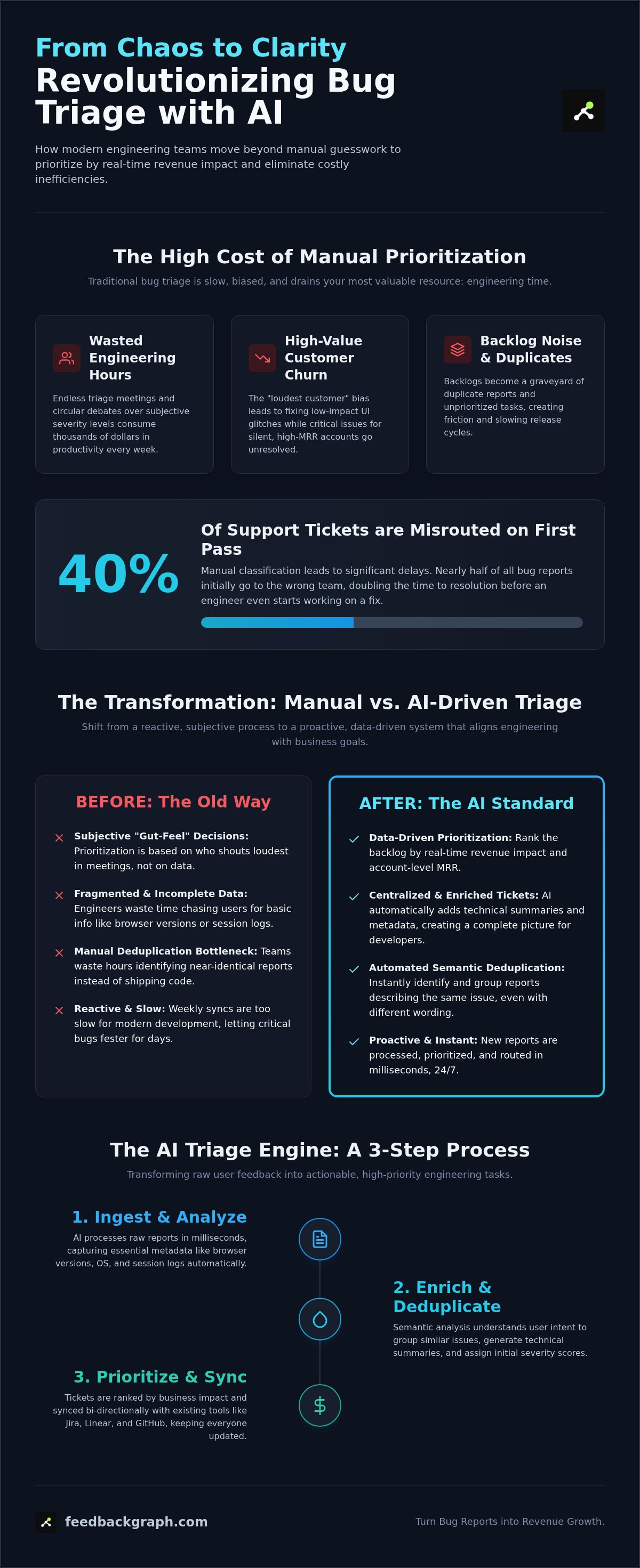
Manual bug triage is a legacy process that costs your engineering team thousands of dollars in lost productivity every single week. You've sat through the same circular meetings. You've watched high-value customers churn while your team fixes low-impact UI glitches. With support teams misrouting nearly 40% of tickets on the first pass, it's common to see a backlog buried under noise and duplicate reports. High-performing teams realize that a standard bug report prioritization tool shouldn't just store tickets. It should actively solve them.
In 2026, manual classification is a liability. You can now eliminate the guesswork and prioritize your engineering resources based on real-time revenue impact. This guide explains how to leverage AI-driven triage to automate severity levels and create a direct link between code fixes and business value. We'll break down the mechanics of AI-enriched data and show you how to maintain a seamless sync with your existing development tools. Learn to keep your roadmap defensible and your high-value customers happy.
Key Takeaways
- Replace manual triage meetings with automated workflows to eliminate the "loudest customer" bias and recover engineering hours.
- Use semantic deduplication to identify near-duplicate reports instantly, preventing wasted effort on redundant tickets.
- Implement a bug report prioritization tool that ranks your backlog by real-time revenue impact and account-level MRR.
- Connect CRM data directly to your engineering tasks to move beyond subjective severity scores and toward clear business value.
- Drive engineering velocity with bi-directional syncs that keep Jira, Linear, and GitHub updated without manual data entry.
Why Manual Bug Prioritization Fails in 2026
Relying on gut feel in 2026 is a strategy for failure. Your engineering team is your most expensive resource, yet most companies still waste their talent on subjective triage. A modern bug report prioritization tool replaces human intuition with hard data, ensuring that every sprint delivers maximum business value. When you prioritize based on who shouts the loudest in a Slack channel, you're ignoring the silent majority of your revenue base. This "loudest customer" bias skews your roadmap and burns through resources on low-impact edge cases that don't move the needle.
Traditional methods inevitably lead to backlog rot. This occurs when unprioritized bugs sit for months, slowly eroding user trust and driving churn among high-value accounts. The core issue is data fragmentation. Most teams use a basic bug tracking system that treats every ticket as an isolated event. It doesn't account for real-time SaaS feedback or the financial weight of the reporting account. Without a clear link to revenue, your backlog becomes a graveyard of "maybe later" tasks that compromise your product's structural integrity.
The Death of the Manual Triage Meeting
Weekly triage syncs are too slow for the rapid-growth cycles of 2026. These meetings often devolve into circular debates over subjective severity levels. Manual deduplication creates a massive bottleneck, forcing engineers to waste hours identifying near-identical reports instead of shipping code. This friction between product and engineering teams slows down every release cycle. It makes your development process opaque and reactive rather than strategic. You can find more about automating these workflows at FeedbackGraph's bug tracking use case.
Quantifying the Cost of Misprioritization
Misprioritization is an expensive operational failure. When you fix a minor UI glitch for a free-tier user while a high-tier enterprise account struggles with a breaking issue, you're actively losing money. The opportunity cost is even higher. Every hour spent on a low-impact bug is an hour you aren't building the features your top customers actually want. Backlog Efficiency is the ratio of revenue saved to engineering hours spent. Implementing a bug report prioritization tool ensures this ratio stays high by aligning every engineering task with your primary business goals.
The Mechanics of an AI Bug Report Prioritization Tool
An effective bug report prioritization tool does more than just organize a list. It acts as an intelligent layer between the user and the engineer. Modern AI models process incoming reports in milliseconds. They generate concise titles, technical summaries, and initial severity scores without human input. This automation ensures that your backlog stays clean and actionable from the moment a ticket is created. You no longer need a dedicated person to read and rephrase every submission.
Semantic deduplication is a core component of this mechanical shift. Traditional systems fail because they rely on exact keyword matches. AI understands intent. If two users describe a checkout failure in completely different ways, the system identifies them as the same underlying issue. This consolidation prevents your team from chasing the same ghost twice. It allows for a unified response strategy that protects your development velocity. To manage future AI risks, teams must ensure these automated decisions remain transparent and logic-based. This transparency builds trust between product managers and the AI assistant.
From Raw Text to Structured Engineering Data
AI interprets vague user descriptions to assign technical severity based on historical patterns. It doesn't just guess. It analyzes the impact on the core user flow. At the same time, the system captures essential metadata like browser versions, OS details, and session logs automatically. This creates a complete picture for the developer. You get actionable summaries that highlight the root cause, not just the symptom. Engineers spend less time asking for more info and more time writing fixes. This efficiency is why many teams choose to book a specialized demo to see these workflows in action.
The Role of Natural Language Processing (NLP)
Modern NLP models identify systemic platform failures by clustering similar issues across your entire user base. They see patterns that a human eye might miss during a busy week. Research shows that support teams misroute nearly 40% of tickets on the first pass. By eliminating this error, AI-driven triage can effectively reduce the total time to fix by up to 40%. Automated routing then sends these tickets to the specific team responsible for that microservice. This precision ensures that the right expert sees the right problem at the right time.
Revenue-Based Ranking: The New Standard for Prioritization
Stop treating every user report as equal. They aren't. Assigning a "High" or "Medium" tag is a subjective exercise that ignores the financial pulse of your company. A modern bug report prioritization tool translates these abstract labels into actual dollar values. By integrating your CRM data, you can see the exact Monthly Recurring Revenue (MRR) tied to every open ticket. This visibility allows you to prioritize fixes that protect your most valuable accounts and save "at-risk" renewals before they churn. When your backlog is ranked by revenue, engineering decisions become objective business strategies.
Defending your roadmap to stakeholders is easier when you have data-driven defensibility. Instead of explaining why a bug "feels" important, you can show exactly how much revenue is blocked by the issue. This level of transparency builds trust across the organization. It ensures that your developers are always working on the tasks that offer the highest return on investment. This shift from intuition to evidence is what separates market leaders from companies buried under technical debt.
The Profit-First Backlog Framework
Your backlog should reflect your bottom line. Mapping customer feedback directly to subscription tiers helps you distinguish between minor UX inconveniences and critical revenue blockers. This framework ensures that enterprise-level disruptions always take precedence over edge-case glitches from free-tier users. You can apply this same logic beyond triage, such as ranking feature requests by revenue. It's about aligning every engineering hour with your primary growth metrics.
Static Tools vs. Dynamic Prioritization Engines
Generic project management software is a passive record-keeper. Tools like Jira excel at tracking task status, but they aren't built to quantify business impact. A dynamic prioritization engine functions differently. It uses real-time feedback loops to shift your priorities as new data arrives. This approach is supported by recent AI-driven bug prioritization research, which highlights how automated modeling can identify systemic failures that threaten large account segments. If a major account hits a snag on a Tuesday morning, your bug report prioritization tool flags it immediately. It's an active system for churn prevention that updates your engineering focus every hour.
5 Steps to Automate Your Engineering Backlog Priority
Transforming your backlog from a chaotic list into a strategic asset requires a structured, automated approach. You can't rely on manual entry if you want to maintain velocity. A modern bug report prioritization tool automates the heavy lifting, allowing your engineers to focus on execution rather than administration. Follow these five steps to implement a data-driven triage system that scales with your product.
- Step 1: Deploy a frictionless capture widget. High-quality data begins at the source. Use a 2-click interface to capture technical context without forcing users to fill out long, exhausting forms.
- Step 2: Activate AI triage. Let the system enrich incoming reports by generating summaries and identifying duplicates. This prevents your backlog from being buried under redundant noise.
- Step 3: Sync your CRM data. Map revenue impact to every ticket instantly. This step ensures that your bug report prioritization tool ranks issues based on real-world financial consequences rather than subjective labels.
- Step 4: Define automated routing rules. Set logic to push high-priority, high-revenue bugs directly into Jira, Linear, or GitHub. This eliminates the manual hand-off between support and engineering.
- Step 5: Execute based on the AI-ranked dashboard. Review your sprint goals using a dashboard that highlights the most critical fixes for your bottom line.
Optimizing Data Capture at the Source
Long, complex bug forms are where good data goes to die. Users often skip fields or provide vague descriptions when faced with friction. A 2-click widget solves this by automatically capturing screenshots, video, and environment metadata without user effort. This ensures your developers have the visual evidence they need to reproduce issues on the first try. You can explore these bug reporting software features to see how frictionless capture improves report quality across the board.
Establishing Bi-directional Sync
Automation shouldn't end once a ticket reaches your dev tool. True efficiency requires a bi-directional sync that keeps your customer feedback and development tasks in perfect harmony. When a developer closes a ticket in Jira, the system should automatically update the status in your triage dashboard and notify the reporting customer. For teams looking to build even more advanced workflows, leveraging MCP servers for product management allows for deep integration between your AI assistant and your existing tech stack. This creates a closed-loop system where data flows freely between departments.
FeedbackGraph: Turning Bug Reports into Revenue Growth
FeedbackGraph redefines the standard for a bug report prioritization tool by automating the entire lifecycle of a bug report. You no longer have to worry about manual triage or subjective severity labels. This platform functions as an intelligent assistant that captures feedback, enriches it with technical context, and ranks it by financial impact instantly. By replacing administrative debt with automated workflows, you allow your engineers to focus on shipping code that actually moves the needle. It isn't just a tracker; it's a revenue protection engine built for the speed of 2026.
AI-powered enrichment directly impacts engineering velocity by removing the friction of the discovery phase. Instead of deciphering vague user descriptions, your team receives structured engineering data. This includes automated summaries, technical severity scores, and deduplicated ticket clusters that identify systemic platform issues. Whether you are handling internal feedback from QA or managing high-stakes enterprise customer support, the platform ensures the most critical issues surface first. Integration takes less than five minutes. You can connect FeedbackGraph to your existing stack and see an immediate reduction in backlog volume without disrupting your current sprint.
Built for Modern Engineering Teams
Engineers often dread new tools that add friction to their workflow. FeedbackGraph offers bi-directional Jira and Linear integrations that sync in real-time, ensuring that your developers never have to leave their preferred environment. Status updates, comments, and attachments flow between systems automatically. You can establish customizable AI rules to match your specific product taxonomy, ensuring the triage engine understands your unique architecture. Explore more about these bug tracking use cases to see how high-growth teams are scaling their triage operations in 2026.
The Strategic Advantage of AI Triage
Reducing "backlog noise" is the fastest way to accelerate innovation. When your team isn't sifting through duplicates or low-impact glitches, they're building features that drive long-term growth. FeedbackGraph provides clear, data-backed reasoning for every prioritization choice it makes. This transparency eliminates the friction between product and engineering departments. You can finally defend your roadmap with confidence, knowing every fix is tied to a specific revenue outcome. It transforms your bug report prioritization tool from a passive record-keeper into an active driver of revenue growth.
Start your free trial with FeedbackGraph today
Modernizing Your Engineering Roadmap
Manual triage is an operational bottleneck that your team can no longer afford. Moving into 2026, the competitive advantage belongs to teams that treat their backlog as a financial asset rather than a dumping ground for tickets. A dedicated bug report prioritization tool changes the dynamic of your development cycle. It replaces subjective meetings with AI-powered severity classification and a revenue-based ranking dashboard that reflects the real-world impact of every issue.
You've learned that velocity isn't just about writing code; it's about writing the right code at the right time. By establishing a bi-directional Jira and Linear sync, you ensure that high-priority fixes reach your developers without manual intervention. This data-driven approach protects your churn rate and allows your team to focus on the innovation that actually drives growth. The tools to eliminate manual triage are ready. It's time to align your engineering resources with your bottom line.
Your roadmap deserves a foundation of logic and financial evidence. Start building a more efficient, transparent, and profitable engineering culture today.
Frequently Asked Questions
What is a bug report prioritization tool?
A bug report prioritization tool is a specialized software layer that ranks technical issues based on their impact, urgency, and business value. Unlike a basic tracker, it uses live data like user tier and report frequency to determine which fixes deserve immediate engineering attention. It doesn't just store tickets; it serves as the primary filter for your backlog, ensuring that developers work on high-value tasks instead of getting lost in minor UI glitches.
How does AI help in prioritizing bug reports?
AI automates the triage process by analyzing the semantic meaning of user reports to assign severity and technical tags instantly. It processes unstructured text to identify patterns, such as a sudden spike in login failures across specific browser versions. This automated classification replaces manual review meetings, allowing your team to move from identification to resolution in a fraction of the time typically required for human triage.
Can I integrate a prioritization tool with Jira or Linear?
Yes, a modern bug report prioritization tool offers bi-directional sync with project management platforms like Jira, Linear, and GitHub. When the engine identifies a critical issue, it creates a structured ticket in your development tool automatically. Any status updates or comments made by engineers in Jira flow back to the triage dashboard. It's a seamless way to keep teams aligned without requiring manual data entry across multiple systems.
Why should I prioritize bugs based on revenue instead of just severity?
Revenue-based prioritization aligns your engineering effort with your company's bottom line. While a Critical bug might affect a small group of free-tier users, a Medium bug could be blocking a million-dollar enterprise renewal. Ranking by revenue ensures you protect your most valuable accounts and reduce churn. It provides a clear, objective metric for roadmap defensibility that stakeholders across the entire organization can understand and support.
How does automated deduplication work in bug reporting?
Automated deduplication uses Natural Language Processing to identify when multiple users are reporting the same underlying issue, even if they use different wording. The system clusters these reports into a single actionable ticket, preventing your backlog from becoming inflated with redundant noise. This consolidation allows engineers to see the full scope of a problem in one place, saving hours of manual investigation and preventing duplicate work.
Is it possible to automate bug triage without losing human oversight?
Automation acts as an intelligent assistant rather than a black box. You can set specific logic rules that the AI must follow, and your team retains the ability to override any automated classification. The system provides the reasoning behind its prioritization choices, such as account MRR or technical severity scores. This transparency allows product managers to maintain strategic control while benefiting from the speed of automated data processing.
What are the benefits of a 2-click bug reporting widget?
A 2-click widget maximizes data quality by removing friction from the reporting process. It automatically captures essential metadata like console logs, network requests, and user session data without requiring the user to fill out complex forms. This ensures that every report comes with the visual evidence and technical context developers need to reproduce the bug. High-quality data at the source leads to faster fix times and fewer back-and-forth emails.
How do I quantify the revenue impact of a single bug?
Quantifying impact requires connecting your bug reports to CRM data like Salesforce or HubSpot. The system aggregates the total Monthly Recurring Revenue of every customer affected by a specific issue. This calculation gives you a concrete dollar value for each ticket. You can then see which bugs are Revenue Blockers for high-value segments, allowing you to make evidence-based decisions about where to allocate your most expensive engineering resources.


