

Engineers do not hate customer feedback; they hate chaos. When unstructured complaints land in Slack without reproduction steps or technical severity, developers naturally dismiss them as edge cases or user error. If you are struggling with how to get engineering to take feedback seriously, the problem rarely lies in developer apathy. It stems from the communication gap between customer emotion and technical execution.
You already know the frustration of watching critical product fixes stall in heated sprint planning meetings simply because you lack the hard technical metrics or financial impact to justify shifting priorities. That friction slows team velocity and burns precious engineering cycles on backlogged noise instead of high-leverage work.
This guide delivers the exact framework to translate noisy user complaints into prioritized, reproducible engineering tasks that tie directly to revenue impact. You will learn how to establish a shared triage rubric, replace roadmap debates with objective ranking, and build automated workflows that push clean, context-rich tickets straight into your team's development pipeline.
Key Takeaways
- Understand why unstructured complaints get dismissed and master how to get engineering to take feedback seriously by replacing emotional urgency with hard technical evidence.
- Eliminate roadmap arguments by enriching raw user issues with system environment data and ranking feature requests directly by revenue impact.
- Implement automated AI bug triage to deduplicate tickets and filter noisy backlogs before they ever hit developer sprint boards.
- Embed continuous bi-directional integrations between customer channels and native tools like Jira, Linear, and GitHub to keep cross-functional teams perfectly aligned.
The Root Cause: Why Engineering Teams Dismiss Customer Feedback
Engineering skepticism is rarely born out of stubbornness. It is an operational defense mechanism. In classical Agile software development, teams commit to iterative sprints built around clear user stories and testable acceptance criteria. When customer-facing teams push raw feedback over the wall, developers encounter unstructured chaos instead of actionable scope. Understanding how to get engineering to take feedback seriously begins with diagnosing why technical teams reject these submissions at the gate.
The Anatomy of a Rejected Feedback Ticket
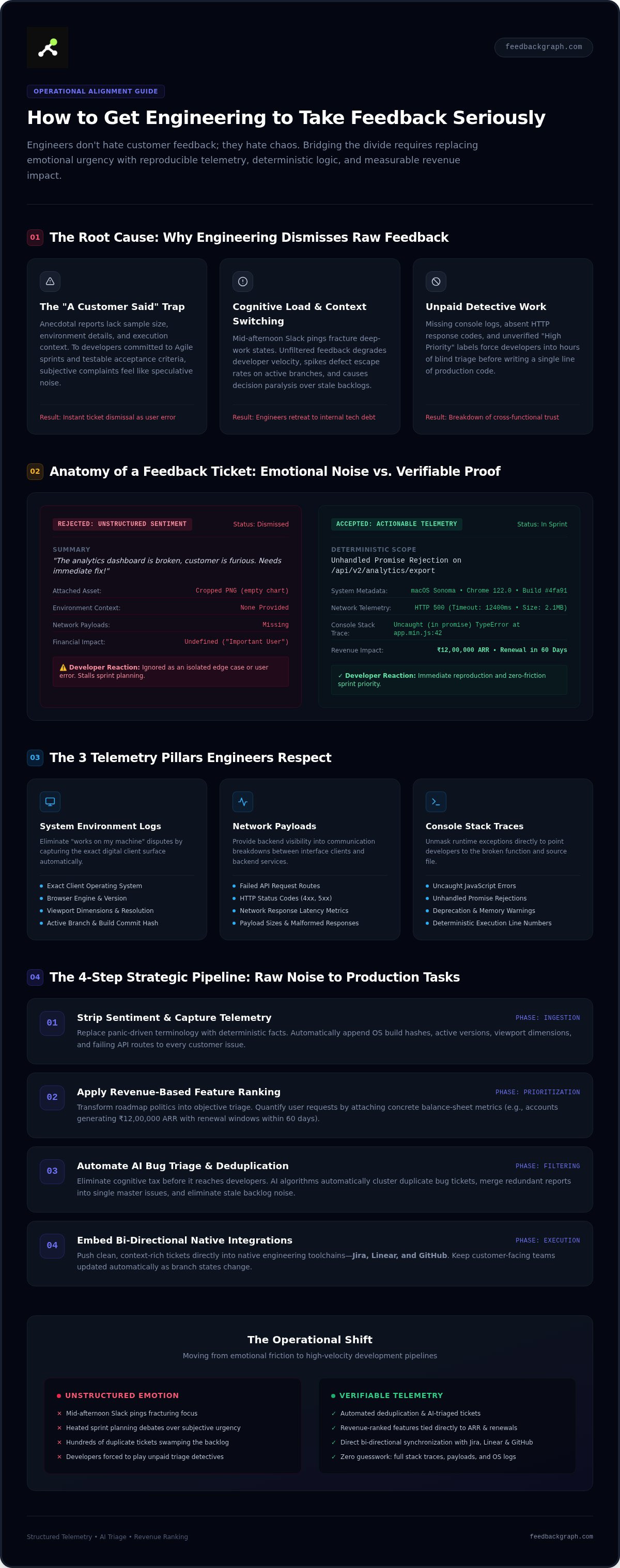
A support agent flags a ticket reading: "The analytics dashboard is broken, customer is furious." Attached is a cropped PNG showing an empty chart. To a developer, this ticket is worthless. It contains zero browser metadata, no network payload details, and no reproducible steps.
Every vague report forces an engineer into unpaid investigative work:
- Missing technical telemetry: Without console logs or API response codes, isolation requires blind guesswork.
- The "a customer said" anti-pattern: Anecdotal reports lack sample size, environment context, and version numbers.
- Emotional escalation: Slapping "high priority" on an unverified bug erodes credibility between product and engineering.
Developers simply push back because incomplete tickets demand hours of manual triage before writing a single line of code. They don't have time to play detective.
Cognitive Load and the Cost of Unfiltered Noise
Deep-work state is fragile. A single mid-afternoon Slack ping asking an engineer to investigate an ad-hoc customer complaint fractures focus immediately. Research shows that context switching degrades developer velocity and spikes defect escape rates across active branches.
When feedback channels lack automated filtering, backlogs swell with dozens of duplicate reports for identical root causes. Engineers face decision paralysis when staring at hundreds of stale, ambiguous requests. Rather than untangling that noise, technical teams naturally retreat into what they can actually verify: refactoring known technical debt, closing well-scoped internal bugs, or building infrastructure improvements. If you want to master how to get engineering to take feedback seriously, you must eliminate the cognitive tax of your bug pipeline, ensuring your developers evaluate structured data rather than deciphering raw user panic.
Translating Customer Sentiment into Hard Data Engineers Respect
Engineering teams reject emotional appeals because software systems run on deterministic logic. Telling a tech lead that a user is upset carries zero technical weight; proving that an unhandled promise rejection blocks checkout for accounts representing significant revenue commands immediate focus. The secret of how to get engineering to take feedback seriously lies in stripping sentiment out of the equation and replacing it with verifiable telemetry and fiscal impact.
Replacing Subjective Urgency with Revenue Impact
Subjective urgency creates friction. Sales teams mark every request critical, while developers view those flags as noise. You break this deadlock by tying bug tickets and feature requests directly to account metrics. When product leaders look at companies organized for innovation, they see functional teams making decisions around clear business constraints rather than internal politics.
Instead of reporting that five users requested an export enhancement, show that those accounts generate ₹12,00,000 in annual recurring revenue and carry renewal dates within sixty days. Implementing revenue-based feature ranking transforms an emotional roadmap debate into an objective prioritization exercise. Engineering leads don't fight fixes that protect measurable balance sheets.
Enriching Reports with Technical Telemetry
Technical teams demand hard proof. A reproducible bug ticket must describe the execution environment with total clarity before entering an active sprint:
- System environment logs: Automatically capture client OS, exact browser versions, viewport sizes, and active build commits.
- Network payloads: Record failed API requests, HTTP status codes, response latencies, and payload sizes.
- Console traces: Capture uncaught JavaScript errors, warnings, and localized stack traces at the exact second of failure.
Modern engineering organizations use AI bug reporting tools to automate this data capture directly from user sessions, eliminating manual interrogations between support agents and developers. When bug submissions arrive fully enriched with technical telemetry and financial weight, you answer the core question of how to get engineering to take feedback seriously without disrupting developer focus. If you want to see how clean data pipeline triage changes sprint execution, you can book a live walkthrough to see automated ticket enrichment in practice.
The 4-Step Framework to Make Every Feedback Submission Actionable
Negotiation tactics and empathy exercises fail when your ingestion pipeline is broken. If you want a lasting playbook for how to get engineering to take feedback seriously, you need an automated assembly line. That pipeline must convert raw user frustration into clean, formatted software requirements before an engineer ever opens the ticket.
Step 1 & 2: Frictionless Capture and Intelligent Deduplication
Friction kills feedback quality. If users face lengthy fifteen-field forms, they drop off or leave angry one-liners in support chats. Implementing an in-app, two-click capture widget lets users submit problems the instant an anomaly occurs. The front end collects the report; the processing layer handles the heavy lifting.
Once submitted, automated intelligence clusters incoming records. If fifty users encounter the same broken modal on a billing page, your developers should never see fifty disjointed Jira cards. An intelligent ingestion layer identifies semantic similarities, merges duplicate reports beneath a single master issue, and aggregates user count. Backlog clutter disappears before sprint planning begins.
Step 3 & 4: Context Enrichment and Native Workflow Routing
Raw text like "the button doesn't work" is an engineering dead end. The pipeline must translate human language into deterministic technical syntax before creating a backlog entry:
- Generate precise ticket titles: Convert vague user feedback into standardized summaries describing the exact failure mechanism.
- Formulate testable reproduction steps: Turn recorded click streams and session parameters into clear, step-by-step developer instructions.
- Calculate objective severity: Assign issue levels based on actual error impact and customer revenue exposure rather than arbitrary user feelings.
Learning how to streamline bug reporting workflows removes the manual burden of ticket writing. The final phase routes these structured payloads straight to where development actually happens: Jira, Linear, or GitHub.
Developers pull assigned tasks that already contain stack traces, user environment details, and clear acceptance criteria. No investigative calls. No cross-team Slack debates. When every ticket arriving on the board is pre-vetted, reproducible, and tied to business priorities, how to get engineering to take feedback seriously ceases to be an organizational friction point; it becomes standard operating procedure.
Embedding Feedback Loops Directly into Native Developer Workflows
Engineers protect their workflow environments fiercely. Forcing a developer to log into third-party survey dashboards, browse customer support ticketing portals, or review messy spreadsheets guarantees friction. If you want to know how to get engineering to take feedback seriously, meet developers where they live: terminal windows, pull requests, and native issue trackers like Jira, Linear, and GitHub.
Eliminating Tool Fatigue with Bi-directional Dev Sync
Context switching burns engineering hours. When feedback operates on an isolated island, product managers end up serving as manual copy-paste relays between support queues and sprint boards. This breaks communication flow on both ends.
Real adoption requires bi-directional synchronization. Discovering how to connect customer feedback to dev tools bridges this divide automatically:
- Native issue creation: Vetted bug reports populate directly as Linear issues or GitHub tickets with proper epics, labels, and acceptance criteria.
- Automated status propagation: As an engineer moves a card from "In Progress" to "Closed" in Jira, the originating customer ticket updates in real time.
- Zero check-in overhead: User-facing teams see deployment statuses instantly without sending status update pings on Slack.
Developers work strictly within their preferred tools. Customer success teams receive automated updates the instant code merges. Nobody conducts manual status chasing.
Leveraging Modern Infrastructure and MCP Integrations
Engineering workflows in 2026 rely heavily on agentic developer environments. Modern teams integrate feedback streams into Model Context Protocol (MCP) servers, turning raw customer pain points into machine-readable context. Instead of searching across fragmented backlogs, an engineer can query top user friction points directly inside their IDE while refactoring a codebase.
Connecting feedback repositories to MCP servers allows developer tools to pull related user bug traces during pull request reviews. The system can even generate automated, user-friendly release notes linked to specific closed tickets during deployment. When feedback infrastructure fits smoothly into local build pipelines, you solve the puzzle of how to get engineering to take feedback seriously permanently.
From Conflict to Collaboration: Scaling Your Product Feedback Engine
Sustainable product velocity depends on structural alignment, not interpersonal persuasion. Relying on personal favors or backchannel lobbying during sprint planning is brittle; building a permanent bridge between product and dev requires shared metrics and reliable software infrastructure. Mastering how to get engineering to take feedback seriously means replacing weekly priority debates with transparent, data-backed operational systems that align engineering outcomes directly with commercial growth.
Creating a Shared Definition of Product Value
Engineering teams frequently evaluate sprint success through internal metrics: story points completed, change fail rates, and PR review latency. Product teams track retention, churn risk, and user sentiment. Bridging this disconnect requires pairing delivery metrics with business impact during sprint retrospectives.
Presenting clear outcomes closes the loop effectively:
- Tie merged PRs to retention: Show developers how fixing a specific session caching failure preserved accounts generating ₹8,50,000 in ARR.
- Combine qualitative quotes with telemetry: Present raw user relief alongside error drop charts to build genuine developer connection to end users.
- Evaluate automated workflows: Inspect core pipeline integrations on the FeedbackGraph features page to see how unified tracking replaces administrative back-and-forth.
When developers see that fixing an issue directly protects company revenue and eliminates user friction, engineering ownership shifts from reactive resistance to proactive investment.
Automating the Feedback Pipeline with FeedbackGraph
Manual triage cannot scale with product growth. When feedback collection, deduplication, enrichment, and routing rely on manual effort, tickets inevitably fall through the cracks. FeedbackGraph automates this entire lifecycle, capturing user feedback in two clicks, deduplicating repetitive tickets automatically, and generating structured reproduction steps before creating tasks in Linear, Jira, or GitHub.
Instead of arguing over which feature requests warrant immediate attention, the platform applies objective revenue-based ranking to calculate the exact ARR behind every request. Backlogs stay lean. Developers receive pristine, reproducible issues with complete technical telemetry, and customer teams stay informed via automated bi-directional status sync. Knowing how to get engineering to take feedback seriously ultimately comes down to running an automated pipeline that respects developer attention while elevating customer value.
Turn Customer Feedback into Prioritized Engineering Velocity
Ending friction between product teams and developers requires clean systems, not louder complaints. When you strip out emotional urgency and enrich tickets with technical telemetry, developers stop treating user reports as distractions. Knowing how to get engineering to take feedback seriously comes down to running an automated pipeline that deduplicates incoming noise, calculates true revenue impact, and delivers reproducible requirements directly into native development environments.
Automated AI bug triage removes administrative chaos by generating structured titles and grouping identical defects. Bi-directional integrations ensure that progress in Jira, Linear, or GitHub automatically reflects back to customer-facing channels, while objective ranking ties engineering backlog prioritization directly to retained account ARR. Your product iterations move faster, developer focus remains protected, and critical user fixes ship without weekly roadmap battles.
Equip your team with the data infrastructure they need to build higher-impact software with total clarity.
Frequently Asked Questions
Why do software engineers frequently push back on customer bug reports?
Engineers push back because raw bug reports almost always lack reproducible technical steps and environment data. When a ticket contains vague complaints without console logs, network responses, or browser versions, developers must spend unallocated hours investigating rather than fixing code. To understand how to get engineering to take feedback seriously, teams must eliminate this manual investigative burden by delivering structured, reproducible telemetry upfront.
How can product managers prove the monetary value of fixing technical bugs?
Product managers prove value by tying individual bug tickets directly to account Annual Recurring Revenue (ARR) and renewal timing. Aggregating affected user accounts into cumulative revenue numbers changes the conversation. When engineering leads see that a specific caching failure threatens ₹15,00,000 in active accounts facing renewal within thirty days, prioritizing the fix becomes a clear commercial imperative rather than an emotional negotiation.
What is the best way to format a bug report so developers fix it immediately?
The best bug report follows a strict, deterministic schema. It must include an unambiguous summary title, exact numbered reproduction steps, expected versus actual system behavior, console error logs, network failure payloads, and complete environment metadata (OS, browser build, viewport). Formatting feedback into verifiable technical parameters answers the core challenge of how to get engineering to take feedback seriously by respecting developer deep work.
How does automated AI triage prevent duplicate issue submissions in developer backlogs?
Automated AI triage analyzes the semantic content and technical stack traces of incoming reports rather than relying solely on matching keyword strings. When multiple users submit tickets about the same underlying failure across channels, the triage system clusters them under a single master issue. It aggregates the affected account count and revenue impact while keeping developer backlogs completely free from duplicate ticket bloat.
Can customer feedback synchronize bi-directionally with Jira and Linear?
Yes. Modern feedback platforms connect bi-directionally with native trackers like Jira, Linear, and GitHub. When an issue is created from a user report, all metadata routes directly into the engineering backlog. As developers update issue statuses, link commits, or mark tickets resolved, those changes sync automatically back to customer success teams and reporters without manual coordination meetings.
What are Model Context Protocol (MCP) servers and how do they assist engineering feedback?
Model Context Protocol (MCP) servers create an open standard for AI agents to access external data sources securely. In product feedback pipelines, an MCP server exposes enriched customer bug reports and feature requests directly to developer IDEs and coding assistants. This lets software engineers query live customer pain points, failure trends, and user context straight from their development environment during feature implementation.
How does linking user feedback to recurring revenue prevent executive roadmap derailment?
Linking feedback to revenue creates an objective, data-backed prioritization filter that shields roadmaps from arbitrary executive whims. Instead of shifting sprint goals based on isolated sales conversations, teams evaluate feature requests against aggregate ARR and churn probability. Transparent financial ranking establishes a clear source of truth that executive leadership, product management, and engineering leads can mutually trust and respect.


