
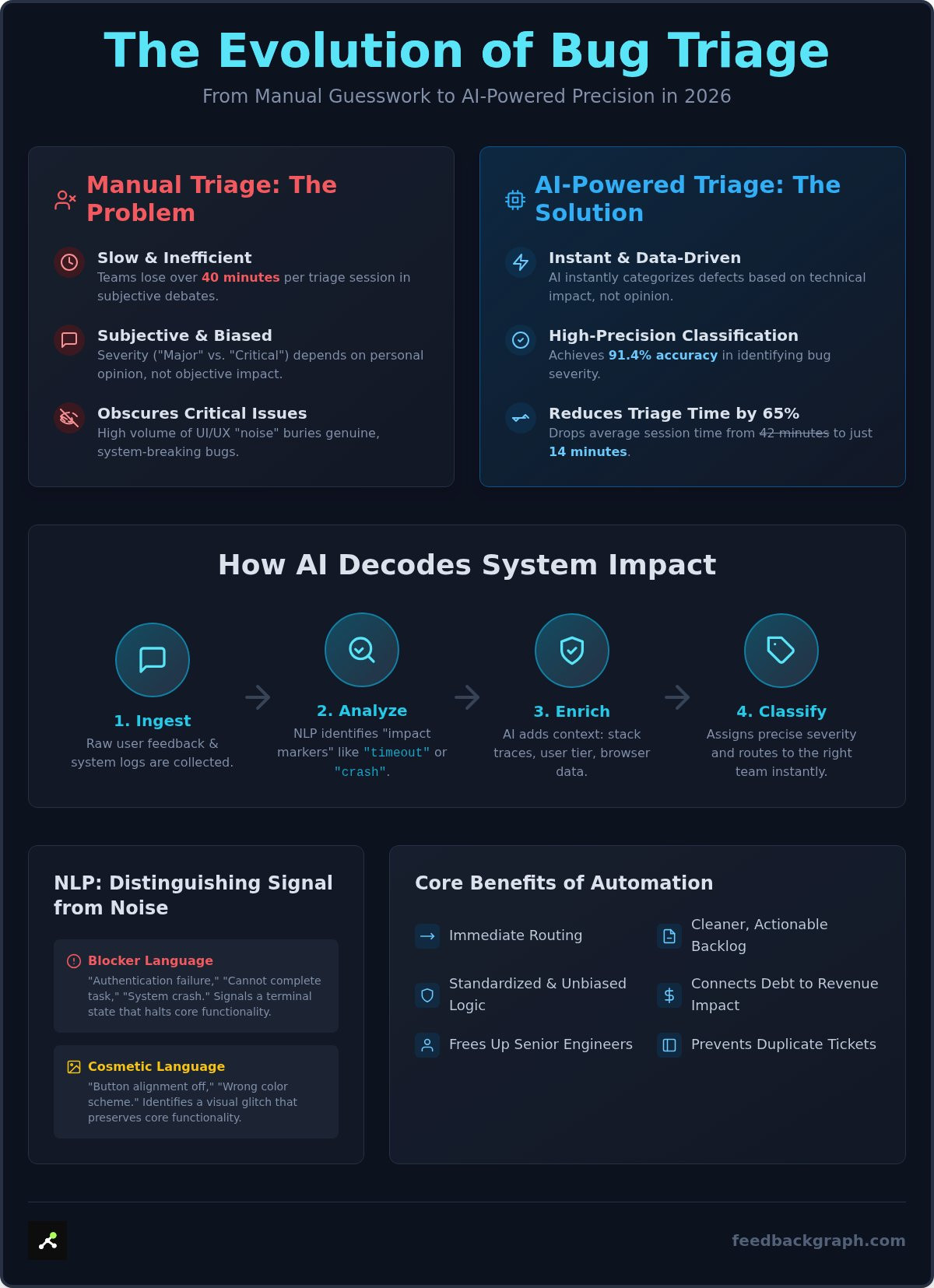
In 2026, engineering teams still lose over 40 minutes per triage session to subjective debates over whether a bug is "Major" or "Critical." It's a massive drain on velocity. Recent research shows that automated bug severity classification delivers a 91.4% accuracy rate while slashing triage time by 65%. Instead of wasting hours in meetings, high-performing teams use AI to instantly identify system impact and clear the UI/UX noise that often buries genuine technical debt.
You've felt the frustration of misprioritization. When subjective labels lead to the wrong fixes, your roadmap stalls and customer trust erodes. It's time to stop treating triage as a manual chore that relies on gut feeling. This guide outlines how to master the shift from manual QA guesswork to high-precision, AI-powered triage that scales alongside your engineering team. We'll break down the roadmap to zero-touch classification, seamless sync between customer feedback and dev tools, and objective ranking based on actual system impact.
Key Takeaways
- Replace slow, subjective triage meetings with an objective AI-driven process that categorizes defects instantly based on technical impact.
- Master automated bug severity classification by leveraging NLP to detect impact markers within user feedback and system metadata.
- Implement deep learning architectures to accurately identify rare, critical bugs that are often buried under minor UI noise.
- Deploy a strategic framework to capture friction-less data and use AI enrichment for a standardized, high-precision engineering backlog.
- Connect technical debt to financial value by using revenue-based ranking to prioritize the fixes that matter most to your bottom line.
The Evolution of Bug Triage: From Manual Guesswork to AI Precision
In 2026, the traditional Bug tracking system has evolved from a passive record-keeper into an active intelligence layer. Automated bug severity classification is the engine behind this shift. It uses machine learning to parse incoming reports and assign a technical impact level without human intervention. This replaces the slow, subjective nature of manual triage with an objective process that operates at the speed of your CI/CD pipeline. By removing the guesswork, engineering teams can focus on shipping code rather than debating labels.
Modern SaaS environments move too fast for manual gatekeeping. High-velocity teams now rely on "Enriched Data" where AI adds the context users typically omit. When a user submits a vague report about a failed login, the AI doesn't just pass it through. It enriches the ticket with stack traces, user tier data, and browser environment details. This immediate enrichment ensures that the severity level reflects the true threat to your system's uptime and revenue. It turns a one-sentence complaint into a high-fidelity, actionable engineering ticket.
Why Manual Triage Fails in 2026
The primary obstacle is volume. As your user base scales, you face a backlog of noise that obscures critical failures. Manual triage is inherently unscalable; it relies on the availability of senior staff to make gut-call decisions. This leads to the subjectivity trap. Without a standardized model, three different testers might assign three different severity levels to the same defect based on personal bias or incomplete information. A 2026 study showed that AI-assisted systems can reduce this triage time by 65%, dropping the average session from 42 minutes down to just 14. This efficiency is vital to stop the drain on engineering productivity during redundant weekly meetings.
The Core Benefits of Automation
Automation brings structural integrity to your development lifecycle. It enables immediate routing, where AI identifies a "Blocker" and instantly alerts the on-call engineer via Slack or PagerDuty. There is no lag time. Automation also ensures standardized logic across your entire organization. Every report is judged against the same structural rules, removing human bias from the equation. This leads to a cleaner backlog and significantly reduced technical debt. By integrating these processes into your bug tracking workflow, you ensure that every bug is categorized correctly the moment it appears, preventing minor issues from masking deeper systemic failures.
The Mechanics of Automated Severity Classification: How AI Understands Impact
AI doesn't just read text. It decodes structural failure. Effective automated bug severity classification relies on a multi-layered analysis of user input, system logs, and environmental metadata. Instead of waiting for a human to interpret a vague complaint, the AI engine immediately scans for "impact markers"—specific phrases or error codes that signal a break in core functionality. It looks for keywords like "timeout," "permission denied," or "authentication failure" to distinguish between a minor UI annoyance and a critical system blocker.
This automated approach leverages advanced models specifically designed for predicting bug severity levels by correlating user sentiment with technical reality. By the time a report reaches an engineer, the AI has already cross-referenced the issue against your existing backlog. It identifies near-duplicate submissions to prevent "noise" from cluttering your sprint, ensuring that ten reports of the same login failure appear as one high-severity event rather than ten isolated tickets. This deduplication is critical for maintaining a high-velocity roadmap.
NLP and Contextual Understanding
Natural Language Processing (NLP) allows the system to understand the gravity of a user's language. It separates "blocker" language—where a user cannot complete a task—from "cosmetic" complaints about button alignment or color schemes. The engine also parses attached stack traces and console logs to find the root cause. While a glitch is a visual anomaly that preserves core functionality, a crash is a terminal state that halts the execution flow entirely. AI identifies this distinction in milliseconds, ensuring that terminal errors bypass the standard queue for immediate attention.
The Role of Data Enrichment
Raw feedback is often messy. AI enrichment fixes this by automatically generating concise bug titles that improve searchability within your bug tracking tools. It summarizes long user rants into actionable engineering briefs, stripping away the emotion to leave only the technical facts. Furthermore, the system links reports to specific product modules or features. This allows for bi-directional sync between your feedback widgets and platforms like Jira or Linear, keeping every tool in your stack aligned with the same severity data. To see how this works in a live environment, you can book a technical walkthrough of our AI triage engine.
Metadata provides the final layer of refinement. By analyzing the browser, OS, and user tier, the AI can escalate issues that affect your highest-paying customers or specific critical environments. This ensures that a high-severity bug on an obsolete browser doesn't distract your team from a major failure on your primary platform. The result is a triage process that is not just automated, but fundamentally smarter.
Machine Learning vs. Deep Learning: The 2026 Triage Tech Stack
The shift in automated bug severity classification is driven by a transition from simple heuristics to deep neural architectures. Traditional machine learning models, such as Support Vector Machines (SVM) and Random Forest, provided the foundation for early automation. They remain useful for lightweight applications where computational resources are limited. However, 2026 engineering environments demand the contextual depth of Long Short-Term Memory (LSTM) networks and Transformers. While an ensemble machine learning scheme can provide high reliability, deep learning models now achieve an accuracy of 89.2% with an F1-score of 0.86, outperforming legacy systems in complex SaaS ecosystems.
A significant hurdle in training these models is the "Class Imbalance" problem. In any production environment, minor UI bugs far outnumber critical system blockers. If left unaddressed, the model becomes biased toward low-severity labels, potentially missing the defects that threaten uptime. We solve this by using SMOTE (Synthetic Minority Over-sampling Technique) to generate synthetic examples of rare, high-severity defects. This ensures the model recognizes a "Blocker" even when it hasn't seen one in weeks, maintaining the structural integrity of your triage process.
Model Performance Benchmarks
Success isn't just about raw accuracy. We measure performance using ROC-AUC and F1-scores to ensure the model handles edge cases effectively. In bug triage, recall is more important than precision for high-severity labels. It's better to flag a minor bug as a "Blocker" (a false positive) than to let a critical system failure slip through as "Minor" (a false negative). Stability and robustness are the benchmarks of a production-grade triage engine, ensuring that automated bug severity classification remains reliable as your codebase evolves.
The 2026 Shift to LLM-Based Triage
We're now moving beyond keyword matching into the era of intent-based classification. Modern tools utilize Large Language Models (LLMs) for zero-shot classification, meaning the AI can categorize a bug correctly even without specific prior training on that exact error. By using Retrieval-Augmented Generation (RAG), the system cross-references new reports against a library of historical bugs to find patterns and suggest fixes. You can learn how FeedbackGraph uses AI for triage to automate this entire workflow, ensuring your team only sees the issues that actually require human intervention. This intent-based approach represents the current gold standard for high-velocity software teams.
Implementing Automated Triage: A Strategic Framework for Engineering Teams
Transitioning to an AI-driven workflow requires more than just a new tool. It demands a structural shift in how your team handles incoming data. Static templates and manual forms are no longer sufficient for 2026 SaaS environments. Users often ignore required fields, leaving engineers to hunt for context. A strategic framework for automated bug severity classification solves this by filling the gaps automatically, ensuring every ticket is high-fidelity and correctly prioritized before it even hits your backlog.
Follow these five steps to deploy a robust triage engine:
- Step 1: Capture friction-less data. Deploy an in-app widget to capture session data, console logs, and environment metadata without forcing the user to fill out complex forms.
- Step 2: Apply AI enrichment. Let the AI standardize the report by generating concise titles and identifying the specific product module affected.
- Step 3: Auto-classify severity. The engine compares the report against historical data and your internal impact rules to assign an objective severity level instantly.
- Step 4: Route issues. Push enriched tickets directly into your dev stack via bi-directional sync, keeping Jira, Linear, or GitHub aligned with your feedback tools.
- Step 5: Monitor and refine. Use human-in-the-loop feedback to train the model. When an engineer manually adjusts a severity level, the AI learns from that correction to improve future precision.
Integrating with Modern Dev Tools
Modern engineering teams don't work in silos. Your triage system must exist within your current stack to be effective. Establishing a bi-directional Jira feedback sync ensures that when a developer closes a ticket, the status update flows back to the feedback widget automatically. You can also map AI-generated severity levels to your specific Linear or GitHub labels, maintaining consistent terminology across the organization. This level of integration is essential to reduce engineering backlog noise and keep your roadmap focused on high-impact fixes.
Setting Up Automation Rules
Precision relies on clear boundaries. Define "Blocker" thresholds that trigger immediate Slack or PagerDuty alerts for high-severity events. Since no AI is perfect, you should also create fallback mechanisms for low-confidence classifications. If the model's confidence score falls below a certain percentage, the system flags the report for a quick human review. This hybrid approach ensures automated bug severity classification remains reliable while providing a safety net for edge cases. Finally, ensure that status updates sync back to the customer automatically, closing the feedback loop without manual intervention.
FeedbackGraph: Revenue-Led Severity and Triage
FeedbackGraph redefines the triage process by moving beyond purely technical metrics. While automated bug severity classification identifies how a bug breaks your system, our platform identifies how that break impacts your bottom line. We turn raw feedback into high-fidelity data that directly informs your revenue strategy. By integrating your billing data with your engineering stack, you can finally stop guessing which fixes deserve priority. This structural approach ensures that your roadmap reflects both technical necessity and financial value.
Our AI triage dashboard serves as a single source of truth for product teams. It aggregates reports from our two-click in-app widget, providing a frictionless experience for users while capturing the session data engineers need. This setup eliminates the backlog noise by using AI to enrich tickets before they reach your developers. You get a streamlined workflow where every ticket is enriched, deduplicated, and ranked by its business value, allowing your team to ship high-impact code faster.
Quantifying the Revenue Impact
Traditional triage models treat all users equally, but in a high-stakes SaaS environment, that's a strategic error. A "Minor" UI glitch reported by a million-dollar enterprise account is often more critical than a "Major" crash on a free-tier user's obsolete device. FeedbackGraph uses Revenue-Based Feedback Ranking to calculate the actual financial cost of your bug backlog. This allows you to visualize the potential churn risk associated with every open ticket.
This approach ensures that your highest-paying customers receive the attention they require to remain loyal. You can explore bug tracking use cases to see how teams use these financial insights to justify engineering spend. By mapping automated bug severity classification to account value, you move from reactive patching to proactive revenue protection. It's a pragmatic shift that aligns engineering efforts with business growth.
The FeedbackGraph Advantage
The platform does more than just rank issues. It automates the tedious parts of the development lifecycle. Our AI-powered enrichment generates concise titles and deduplicates near-identical reports, keeping your Jira, Linear, or GitHub boards clean. For teams using modern AI workflows, our MCP server integration allows your existing agents to interact directly with triaged data. This ensures your entire tech stack remains in sync without manual data entry.
This level of automation prevents the misprioritization that stalls roadmaps. You get a system that thinks like a product manager and acts like a senior QA engineer. It's time to replace manual guesswork with a system built for speed and financial precision. Experience the difference by starting your journey toward zero-touch triage today.
Start your free trial of FeedbackGraph
Scaling Engineering Velocity with AI Triage
Manual triage is a relic that drains engineering resources and stalls innovation. By adopting automated bug severity classification, you replace subjective debates with objective, impact-based logic. This shift ensures your team focuses on the defects that actually threaten system integrity and business revenue. You now have the strategic framework to transform a noisy backlog into a high-fidelity roadmap using AI-powered enrichment and revenue-based prioritization that syncs directly with Jira and Linear.
It's time to stop letting critical bugs hide behind UI noise. Integrating these automated processes creates a seamless loop between customer feedback and technical execution. You can finally scale your triage operations without increasing your meeting load or sacrificing precision. The future of software development belongs to teams that prioritize structural integrity and rapid iteration through data-driven decision making.
Frequently Asked Questions
What is automated bug severity classification?
Automated bug severity classification is an AI-driven process that uses machine learning to label the technical impact of software defects. It analyzes user descriptions, console logs, and system metadata to assign labels like Blocker or Minor instantly. This replaces manual sorting with a scalable, objective system that ensures every report is categorized according to its actual threat to system stability and uptime.
How does AI determine if a bug is a blocker or minor?
AI identifies severity by parsing natural language for specific impact markers and technical signals. It looks for phrases indicating a total loss of function, such as "app won't open," and correlates them with stack traces or error codes. High-impact technical failures are labeled as blockers, while cosmetic issues that don't interrupt the core user journey are categorized as minor or trivial in the system.
Can AI severity classification replace manual QA teams?
AI doesn't replace QA teams; it eliminates their operational friction. By automating initial triage, AI reduces the time spent in meetings from an average of 42.3 minutes to just 14.8 minutes. This allows QA professionals to focus on high-level strategy and exploratory testing while the AI handles the repetitive task of labeling and deduplicating high volumes of incoming reports without human intervention.
How do you integrate automated bug triage with Jira or Linear?
Integration works through bi-directional sync between your feedback capture tool and your project management platform. When a user submits a report, the AI enriches the data and pushes it directly into Jira, Linear, or GitHub. Any updates made by developers in those tools sync back to the original report automatically, keeping the entire team and the customer aligned in real time without manual data entry.
What is the difference between bug severity and bug priority in an automated system?
Severity describes the technical depth of the failure, while priority determines the order of the fix. An automated system calculates severity based on system logs and impact rules. Priority is often a business logic layer that considers revenue impact. For instance, a low-severity typo on a checkout page for a high-value enterprise account might receive a high priority for an immediate fix to protect revenue.
How does AI handle duplicate bug reports from multiple customers?
AI uses semantic analysis to identify near-duplicate submissions across your entire user base. Research shows that AI-assisted tracking can reduce duplicate submissions by 23%. Instead of sifting through ten separate tickets for the same login error, the system groups them under a single parent issue. This provides engineers with a clear view of the bug's reach without cluttering the development backlog with redundant tickets.
What are the best ML models for bug severity prediction in 2026?
In 2026, LSTM (Long Short-Term Memory) models and Transformers are the leading architectures. Study data shows that LSTM models achieve an accuracy of 89.2% and an F1-score of 0.86 in classification tasks. Many teams also leverage Large Language Models (LLMs) for zero-shot classification, which allows the system to accurately categorize new, unseen bug types without requiring extensive historical training sets for every possible edge case.
How do I reduce noise in my engineering backlog using AI?
You can reduce backlog noise by deploying automated bug severity classification to filter out low-priority cosmetic issues. AI enrichment helps by generating concise titles and actionable summaries, making the backlog easier to navigate. By automatically deduplicating reports and ranking them based on system impact and revenue, you ensure your engineering team only spends time on the most critical, high-value tasks that drive product growth.


