

Your CEO doesn’t need another feature pitch. They need to understand how engineering time can support growth. That scrutiny is fair, but justifying product roadmap to leadership gets difficult when the loudest opinion wins, customer feedback is scattered across Slack and spreadsheets, and no one can connect a bug fix to business value.
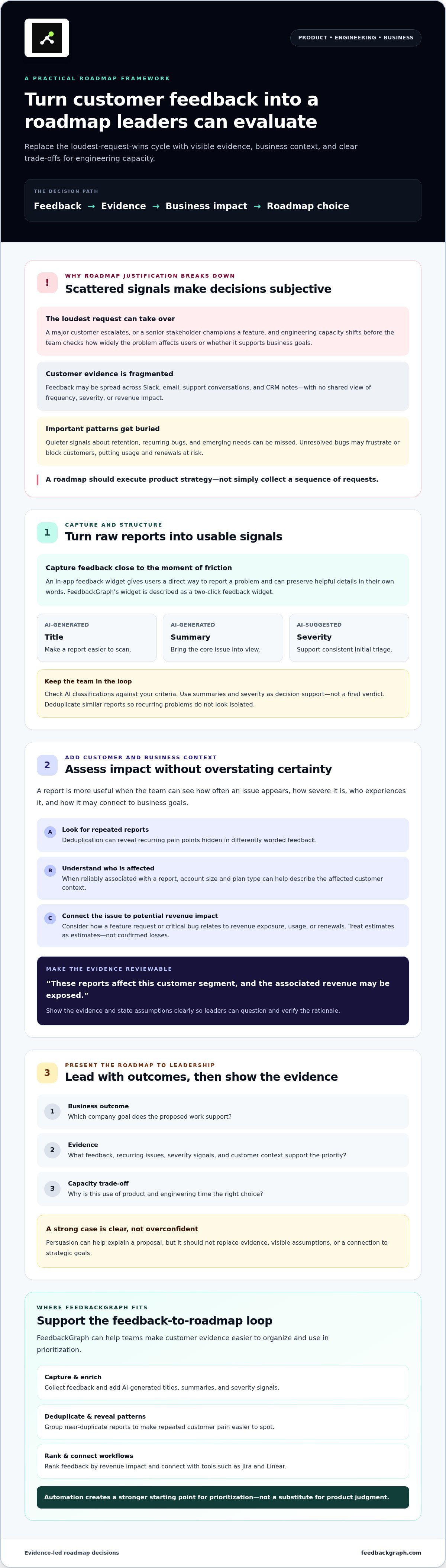
A stronger case starts with evidence, not persuasion. This article offers a practical framework to organize feedback, assess its business impact, and align engineering capacity with company goals. The aim is to make trade-offs clearer and roadmap decisions easier to evaluate.
We’ll cover how to capture and structure feedback, assess its potential revenue impact, and present a rationale leaders can question and verify. FeedbackGraph can support this process by using AI to enrich and deduplicate feedback, rank it by revenue impact, and connect it with tools such as Jira and Linear.
Key Takeaways
- Understand how loud requests and fragmented feedback can pull roadmap decisions away from strategic goals.
- Turn qualitative feedback into more usable signals with structured capture and AI-generated titles, severity, and summaries.
- Make prioritization more financially meaningful by connecting feature requests and critical bugs to revenue impact.
- When justifying a product roadmap to leadership, lead with business outcomes and support proposed work with evidence.
- See how FeedbackGraph can capture, enrich, deduplicate, and rank feedback by revenue impact to strengthen your roadmap rationale.
Why Roadmap Justification Fails in Modern SaaS
A roadmap can look strategic and still be shaped by whoever makes the most noise. A major customer escalates a request, a senior stakeholder champions a feature, and engineering shifts capacity before the team has checked how widely the problem affects users or whether solving it supports business goals. Meanwhile, quieter signals about retention, recurring bugs, and emerging needs can get buried.
Fragmented feedback makes this harder. Customer evidence may sit across Slack threads, email, support conversations, and CRM notes, with no shared view of frequency, severity, or revenue impact. Product managers then have to reconstruct the story manually, making important patterns easy to miss. A roadmap should execute a broader product strategy, not simply collect a sequence of requests.
Roadmap justification means showing why a proposed use of product and engineering capacity is expected to support business goals. For justifying product roadmap to leadership, connect each priority to evidence and a strategic outcome. A persuasive story can help explain the case, but it should not replace evidence or clear assumptions.
The Cost of Misaligned Roadmaps
Misalignment drains capacity in several ways. Teams may spend engineering time on features that attract attention but don’t address a meaningful customer problem. Maintenance debt can delay work needed to respond to market changes. And when recurring bugs frustrate or block customers, leaving them low on the backlog can put usage and renewals at risk. These outcomes aren’t inevitable, but they’re harder to prevent when teams can’t see which issues recur or whom they affect.
The Shift from Subjective to Objective Planning
For 2026 planning, “I think customers need this” is a weak basis for competing for budget and engineering time. AI can help teams process feedback at scale, but its output only supports a decision when the evidence is visible and reviewable. Aim for a case such as, “These reports affect this customer segment, and the associated revenue may be exposed.” Identify assumptions clearly instead of presenting estimates as confirmed losses.
Automated triage can make evidence easier to use. AI-generated summaries and severity signals can turn unstructured reports into clearer backlog items, while deduplication can reveal repeated issues that might otherwise look isolated. FeedbackGraph can enrich feedback, rank it by revenue impact, and connect it with Jira and Linear. This creates a stronger starting point for prioritization, not a substitute for product judgment. Next, we’ll look at how to turn those signals into a revenue-impact framework.
Step 1: Enriching Qualitative Feedback into Quantitative Signal
A roadmap case is only as strong as the evidence behind it. Start by making feedback easy to submit. An in-app widget, such as FeedbackGraph’s two-click feedback widget, gives users a direct way to report friction without asking them to find a separate form or explain the issue twice. Capturing feedback close to the moment a problem occurs can preserve useful details in the customer’s own words.
Raw reports still need structure before they can inform prioritization. AI enrichment is the process of adding metadata to raw text so teams can organize and analyze it more consistently. For example, AI can generate a concise title, summarize a report, and suggest a severity level. This can reduce repetitive manual triage, but teams should check classifications against their own criteria rather than treat an AI label as a final verdict. See how AI bug triage can support prioritization.
Automating the Triage Process
Manual triage can become a bottleneck when product teams have to read, categorize, and route every report by hand. It can also lead to inconsistent judgments: two similar issues may receive different labels depending on who reviews them. AI-assisted triage can standardize the initial summary and severity signal, leaving the team to validate details and investigate impact. FeedbackGraph’s AI-powered summary and severity generation helps structure reports before they enter the development workflow.
Deduplication adds another useful signal. When several customers describe the same failure in different words, separate tickets can hide the pattern. Grouping near-duplicate reports helps reveal recurring pain points and gives product and engineering teams a clearer basis for investigation. A coherent feedback workflow can make these reports easier to review together.
Connecting Feedback to the User Identity
The issue matters, but so does who experiences it. When account context is available and can be reliably associated with a report, include details such as account size and plan type. A request from a free-tier user may point to a broad usability concern; a similar request from an enterprise account might affect a contractual workflow or a strategically important customer. Don’t dismiss either request based on tier alone. Context helps teams compare reach, urgency, and business relevance.
Build a “customer voice” profile around each feature request: the distinct accounts reporting it, their use cases, and the evidence behind its priority. This makes justifying product roadmap to leadership more rigorous because leaders can inspect the signal rather than rely on an anecdote. Established roadmap prioritization methodologies can help teams evaluate evidence consistently. To see how FeedbackGraph could fit into your feedback workflow, explore a FeedbackGraph demo.
Step 2: The Revenue-Impact Framework for Prioritization
RICE can help compare reach, impact, confidence, and effort, but an impact score may still depend on opinion. Make the financial signal explicit by distinguishing revenue exposed to a problem from revenue a feature might help create. Use popular roadmap prioritization methods as a starting point, then adapt the criteria to the business outcomes leadership needs to assess.
For a critical bug, estimate at-risk revenue by identifying affected accounts, their associated revenue, and the evidence that the issue could contribute to churn or downgrade. Treat the result as exposure, not a guaranteed loss. Record assumptions, such as whether the bug blocks a core workflow or whether customers have raised renewal concerns. For a feature request, estimate expansion opportunity by considering which accounts could use it, how likely they are to adopt or pay for it, and the expected incremental revenue. Validate these assumptions with customer and commercial evidence.
Intuition vs. Revenue-Based Ranking
Gut-feel prioritization often favors the latest escalation or the most persuasive stakeholder. Data-backed prioritization makes the reasoning easier to inspect: what customer evidence supports the request, which accounts are affected, what revenue is exposed or possible, and how confident the team is in the estimate. Software for ranking feature requests by revenue can help organize these signals. FeedbackGraph’s revenue-based feedback ranking brings revenue impact into the prioritization picture, so leaders can compare requests using a more consistent evidence base.
Keep the score transparent. A practical model can weigh revenue exposure or expansion potential, the number of distinct affected accounts, confidence in the evidence, and engineering effort. Define each input, show its source, and document how the team handles missing data. The score supports judgment; it doesn’t replace it. This gives reviewers a way to understand why one initiative ranks above another.
Quantifying the Cost of Inaction
Technical debt can be difficult to defend when it’s described only as an engineering inconvenience. Map recurring failures to affected accounts, support patterns, usage friction, and available churn or downgrade evidence. Use observed customer behavior to assess whether a UX problem is associated with drop-off, and label estimates clearly when causation hasn’t been established. Revenue mapping makes the business implications of technical debt clearer by showing the customer revenue exposed while an underlying issue remains unresolved.
For justifying product roadmap to leadership, combine the cost of inaction with the opportunity cost of competing work. FeedbackGraph can provide a revenue-ranked evidence layer, while the team remains responsible for the assumptions, validation, and final investment decision.
Step 3: Presenting the Roadmap to Leadership
Executives need a clear decision, not a tour of the backlog. Start with the business outcome each roadmap theme supports, then show the evidence behind it. Keep the executive view focused on a few strategic themes, such as reducing revenue exposure from recurring bugs or enabling expansion into a customer segment. Make supporting customer reports, account context, and engineering details available for deeper review.
Lead with the “why” before the “what.” For each proposed initiative, explain the customer problem, its revenue relevance, and the outcome you expect. If you project revenue lift for the next quarter, label it as a forecast, state the assumptions, and distinguish potential upside from confirmed revenue. This gives leaders a useful basis for comparing investments without presenting uncertain estimates as guaranteed results.
The Revenue-Led Roadmap Template
Structure each initiative as Problem → Revenue Impact → Proposed Solution. Describe the customer workflow that repeatedly fails, identify the accounts or revenue exposure supported by your evidence, and explain the product change and how you’ll measure whether it worked. Close with engineering dependencies or capacity needs so the proposal connects business value to delivery.
Show execution readiness with traceable evidence. Linking customer feedback to GitHub issues can connect a customer problem to work engineering can assess. FeedbackGraph connects feedback with GitHub, Jira, and Linear. Present the expected outcome, such as fewer blocked workflows or stronger retention signals, rather than treating a shipped feature as the outcome itself.
Live Data vs. Static Slides
A slide deck captures one moment, but feedback and priorities can change. Treat the roadmap as a living decision tool. Bring current feedback trends and supporting reports into reviews, whether through connected work items or a maintained evidence view. Give leaders access to the underlying customer voice while keeping the executive summary concise.
When someone champions a pet project, acknowledge the idea and apply the same criteria used for every initiative: customer evidence, revenue impact, confidence, and effort. If the proposal lacks support, explain what evidence could change its ranking. If a new signal emerges, update the case. This keeps the conversation focused on trade-offs rather than title or volume. A clear, auditable rationale makes justifying product roadmap to leadership a resource-allocation discussion, not a contest of opinions.
Automating the Justification Loop with FeedbackGraph
A roadmap earns trust when its evidence stays connected to the work. FeedbackGraph brings customer feedback into a structured workflow: its two-click widget captures reports, AI enriches and deduplicates them, and revenue-based ranking helps teams compare customer issues by business impact. Product managers can revisit the evidence as new feedback arrives instead of rebuilding the rationale from scattered notes each planning cycle.
Structured reports can sync with development tools, including Jira and Linear. This helps teams trace a customer signal to the work item created to address it. FeedbackGraph also supports syncing feedback with GitHub. Its integrations can connect feedback and development workflows, with status updates synced back to the reporter. Check the supported behavior for your tools and workflow before relying on a particular update path.
Closing the Loop with Bi-directional Sync
Bi-directional Jira feedback sync can keep feedback and linked development work connected, giving product and engineering teams a clearer view of progress. When a developer closes a ticket, review the original revenue rationale: did the fix address the customer problem, and what evidence will show whether the risk has changed? Ticket completion is a delivery signal, not proof of revenue recovered. Stakeholder updates should reflect confirmed progress and any remaining uncertainty.
Use FeedbackGraph’s feedback management features to connect customer input with product workflows. Preserve the source reports alongside the summary, severity, account context, and ranking rationale. That audit trail helps leaders understand why an item was prioritized and gives product teams a basis for reassessing it as evidence changes.
From Triage to Roadmap in Minutes
Deduplication can prevent roadmap bloat by surfacing repeated reports as a shared pain point instead of treating each as a separate feature request. AI-generated summaries and severity signals can also reduce repetitive organization, while product managers retain responsibility for validating findings and setting priorities. This can help a team process growing feedback volumes without assuming that automation replaces product judgment or automatically increases team capacity.
For justifying product roadmap to leadership, the value is a traceable path from customer voice to ranked evidence to development work. Use the ranking to guide discussion, then revisit the underlying reports and assumptions before committing resources. That keeps the roadmap responsive without letting every new request displace strategic priorities.
Explore FeedbackGraph’s feedback and revenue-ranking features to see how they can support this workflow.
A Practical Framework for Justifying Product Roadmap to Leadership
A roadmap earns executive confidence when each priority has a clear customer signal, a transparent business rationale, and a measurable outcome. Start by organizing feedback into useful evidence, then compare initiatives by revenue exposure or potential rather than letting the loudest request set the agenda.
When justifying a product roadmap to leadership, make the reasoning visible: show what the evidence supports, state where estimates rely on assumptions, and connect planned work to the outcome you’ll measure. FeedbackGraph can support that process with AI-powered revenue ranking and integrations with Jira and Linear, keeping customer signals connected to the development work they inform.
Build your next roadmap case on evidence your team can inspect and leadership can question. Clear assumptions and traceable feedback make the conversation more productive and help teams focus engineering capacity on work with a strong rationale.
Frequently Asked Questions
What is the best way to justify a product roadmap to skeptical leadership?
Connect each proposed initiative to a business goal, customer evidence, and a measurable outcome. When justifying a product roadmap to leadership, show the problem, the accounts or workflows affected, the expected revenue impact, and the assumptions behind your estimate. Then explain the engineering effort and how you’ll measure results. Clear evidence invites scrutiny and discussion instead of asking leaders to approve a feature based on enthusiasm alone.
How do you calculate the revenue impact of a feature request?
Estimate the opportunity by identifying eligible accounts, the likelihood they’ll adopt or pay for the capability, and the expected incremental revenue per account. For a bug, assess the revenue associated with affected accounts and the evidence that the issue could contribute to churn or downgrade. State your data sources and assumptions. Treat these figures as estimates of potential or exposure, not guaranteed revenue or proven losses.
Why is data-driven prioritization better than the RICE framework?
Data-driven prioritization isn’t automatically better in every case; it can make the evidence behind a decision easier to inspect. RICE helps compare reach, impact, confidence, and effort, but its impact score may rely on subjective estimates. Add observed customer signals and revenue exposure or potential to make financial relevance clearer. Teams can retain RICE while defining how evidence informs its inputs and documenting uncertainty for leadership.
Can AI really help with product roadmap justification?
Yes. AI can help turn unstructured feedback into more consistent inputs by generating titles, summaries, and severity signals, and by identifying near-duplicate reports. That gives product teams a clearer view of recurring issues and customer needs. AI doesn’t prove revenue impact or decide roadmap priorities on its own. Review classifications, connect reports to reliable account context, and validate financial assumptions before presenting recommendations to leadership.
How do I handle an executive who wants to add a 'pet project' to the roadmap?
Evaluate the request using the same criteria as other initiatives, rather than dismissing it or granting priority by authority alone. Ask what customer problem it addresses, what evidence supports the need, how it aligns with business goals, and what work would move to make room. If evidence is limited, agree on what would validate the request. A transparent comparison keeps the conversation focused on trade-offs.
What tools help link customer feedback to product roadmaps?
Use a feedback system that captures customer reports, organizes and deduplicates them, and connects them to development workflows. FeedbackGraph uses AI to enrich feedback, rank it by revenue impact, and integrate with tools including Jira, Linear, and GitHub. Teams can use those links to trace a roadmap priority back to customer evidence. Check which sync behaviors each integration supports before relying on a particular workflow.
How often should I present roadmap justifications to leadership?
Set a regular review cadence that matches your planning cycle, then revisit priorities when material evidence changes. A quarterly discussion can work for reviewing planned outcomes, capacity, and assumptions, while a significant customer signal, new risk, or changed business goal may warrant an earlier update. Avoid presenting every backlog change as a leadership decision. Share the roadmap at the level needed for alignment and resource choices.
What metrics do executives care most about in a roadmap presentation?
Choose metrics that connect directly to the initiative’s goal. Revenue-focused proposals may show expansion opportunity or revenue associated with accounts affected by a problem. Retention work can include relevant churn, downgrade, or renewal signals; usability work can track task completion or adoption if those measures are available. Pair outcome metrics with customer evidence, delivery effort, and confidence. Label forecasts and assumptions clearly, and define how you’ll assess results.


